Trump recaps 1st year of 2nd term, lists accomplishments
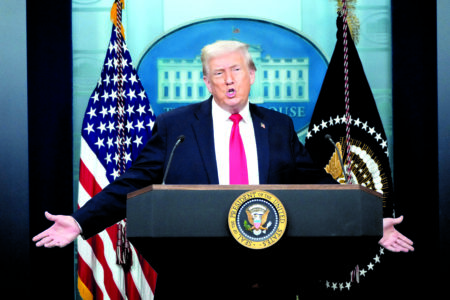
President Donald Trump speaks during a press briefing at the White House in Washington, Tuesday, Jan. 20, 2026. (AP Photo/Mark Schiefelbein)
WASHINGTON (AP) — President Donald Trump marked the first anniversary of his second inauguration on Tuesday with a rare appearance at a White House press briefing. There he spent roughly 1 hour and 45 minutes commenting on everything from his relationship with foreign leaders to God’s pride in him.
The president shared a laundry list of accomplishments, including executive orders he’s signed and his administration’s move to increase law enforcement in the nation’s capital and cities across the country.
Among others he highlighted were rebuilding the military, securing trade deals, lowering prescription drug costs, controlling the border through deportations and policies, designating cartels as terrorists, boosting energy exports and cutting diversity and inclusion programs
He said he has especially focused on immigration and deporting alleged criminals. Foreign policy talk has been scarce so far, even as tensions with Europe have escalated over his desire to control Greenland.
The president said the immigrants his administration has removed from the U.S. make the Hells Angels “look like the sweetest people on Earth,” only to then pause for an aside during Tuesday’s news briefing and compliment the infamous motorcycle gang.
“I like the Hells Angels,” Trump said. “They voted for me. They protected me, actually.”
A former leader of the Hells Angels, Chuck Zito, did join with Trump at a Manhattan courthouse last year. The president likes to discuss his general love of bikers. But it was unclear whether the outlaw motorcycle gang has ever been contracted to provide security for Trump.
The Hells Angels infamously provided security at a 1969 concert at the Altamont Speedway in California, an event that broke out in violence and led to multiple deaths.
Trump also highlighted his efforts to shrink the size of the federal government over the past year.
“We slashed tremendous numbers from federal payroll,” Trump said during the press briefing, adding that millions of federal workers were terminated by the Trump administration.
Scott Kupor, director of the U.S. Office of Personnel Management, said last September that there would be roughly 300,000 fewer federal workers on the payroll nationwide by the end of 2025. The government employs roughly 2.5 million workers, including military members.
Trump said the fired workers are “getting much better jobs and much higher pay.”
Trump’s briefing Tuesday also included a split second of religious reflection.
A reporter asked Trump if he believed God was proud of him, after the president had last year said he believed he got into office because God put him there to save the world.
“I think God is very proud of the job I’ve done, and that includes for religion,” Trump replied. “We’re protecting a lot of people that are being killed. Christians, Jewish people, lots of people are being protected by me that wouldn’t be protected by another type of president.”
“I think that we will work something out where NATO is going to be very happy and where we’re going to be very happy,” Trump responded, when asked near the end of his press conference about whether splintering was worth his pursuit of the Arctic territory that belongs to Denmark.
Trump repeated his position that the U.S. needs to take control of the territory for the sake of U.S. national security. During his second term, the Republican president has signed off of his social media post with the catchphrase “thank you for your attention to this matter” 242 times, according to data compiled by Roll Call .
Factba.se.
He has spent decades seeking attention, first in the New York tabloids and later as a reality television star. Attention, positive or negative, is its own reward. In the attention economy, Trump is what Wall Street might call a market maker.
The gambits often have a tenuous relationship with truth and sometimes involve misogyny or racism. They can step on the administration’s other priorities and don’t always bend political realities in Trump’s favor (see affordability concerns and the Epstein files ).
But they’re hard to ignore.
“He’s saying hello to you in the morning, and he says good night to you at the end of the day,” Republican strategist Ron Bonjean said. “You’re never not going to hear from him.”
In his second term, he observed even fewer constraints on where to assert his presence, with a fondness for sports. During September alone, Trump attended three major sporting events around New York City. His visit to the U.S. Open final forced long security lines and delayed the start of the match. The crowd — dominated by New York’s elite — booed him, but that didn’t matter. He was still on the stadium’s big screen and all over social media.
That’s where some of the biggest changes during Trump’s second term have unfolded.
During his first administration, many Silicon Valley leaders were cold — or outright hostile — to Trump. He was banned from platforms including Twitter and Facebook after the Jan. 6, 2021, attack on the U.S. Capitol.
The leaders of those companies are now openly allied with Trump or at least friendly with him. Twitter is now named X and owned by Elon Musk, who led the Department of Government Efficiency during the first months of the second term and has returned to the president’s orbit after a brief falling-out. Musk and Meta CEO Mark Zuckerberg were among the technology executives who attended Trump’s inauguration last year.
AI quickly produces memes and videos
Trump, who’s not known to use a computer, this time has his own social media platform, where his team relies on fresh artificial intelligence technology to quickly produce memes and videos that keep the president at the forefront of the online conversation. Those posts often veer into crude territory, such as one in October that showed him wearing a crown, flying a plane, dumping excrement on his opponents.
“The social media we’re talking about in Trump’s second term is not the social media of Trump’s first term,” said Nolan Higdon, a lecturer at the University of California, Santa Cruz, where he focuses on critical media literacy.
For now, there are few brakes on Trump’s impulses.
House Speaker Mike Johnson brushed off the excrement post as “satire.” Vice President JD Vance, a devout Catholic, has defended Trump’s posts, including one depicting him as the pope. In an interview with Vanity Fair, White House chief of staff Susie Wiles described Trump, who doesn’t drink, as possessing an “alcoholic’s personality,” meaning he “operates (with) a view that there’s nothing he can’t do.”
Indeed, his approach has been remarkably successful in achieving the disruption he seeks to impose in the U.S. and abroad. He uses social media as a weapon, warning of aid that will be cut off to states that resist him. His posts regarding Greenland and Denmark sparked a genuine diplomatic crisis and raised questions about the long-term sustainability of NATO.
The two nagging exceptions revolve around Epstein and affordability.
After telling his supporters to “not waste Time and Energy on Jeffrey Epstein,” he eventually gave in to congressional pressure and signed a bill that earned overwhelming support on Capitol Hill calling for the files to be made public. The Justice Department has already missed deadlines for the release, and Democrats including Rep. Alexandria Ocasio-Cortez of New York and Gov. JB Pritzker of Illinois have said the flurry of news this month has amounted to a distraction from the Epstein issue.
Trump has similarly struggled to convince the public that he understands and is responding to their concerns about high prices. After calling affordability challenges a “Democratic hoax,” he has tried to take action, including delivering a prime-time address last month. But that speech and more recent efforts, including the mortgage rate push, were quickly drowned by the deluge of more jarring news.
Indeed, a Michigan visit last week to talk about affordability may ultimately be best remembered for images of Trump delivering an obscene gesture at someone who was yelling at him from afar.
Trump’s central challenge
That underscores Trump’s central challenge heading into an election year that will test his grip on power. While his hard-line approach may delight supporters, it does less to convince a broader swath of Americans that he’s an effective president.
Approval of Trump’s handling of most issues is low, but health care stands out as a particular weakness for him. Only about 3 in 10 U.S. adults approved of the way he was handling health care, according to a December AP-NORC poll. That was slightly lower than his overall approval. He’s also slipped on immigration since the start of his second term, when this stood out as a relative strength. According to a January AP-NORC poll, about 4 in 10 U.S. adults approve of his performance on immigration, down from about half of Americans toward the beginning of his first term.
Meanwhile, Democrats are taking stronger steps toward winning American attention spans. California Gov. Gavin Newsom, a potential 2028 presidential candidate, hosts a podcast and taunts Trump by mocking him on social media.
New York City Mayor Zohran Mamdani is perhaps the most successful Democrat to translate a digital media machine into political success. Over the course of about a year, the 34-year-old went from a relatively unknown state lawmaker to the leader of the nation’s largest city by introducing himself to voters with videos that showed him in unscripted environments, like the course of the New York City marathon.
“They’re learning not to impose an old framework on a new paradigm,” said Basil Smikle, a former executive director of the New York State Democratic Party and a professor at Columbia University.
The long-term question is whether Trump has fundamentally changed the presidency. Ari Fleischer, the White House press secretary under then-President George W. Bush, said Trump “is the definition of unique” and predicted that the next president — regardless of party — will communicate differently.
“Whoever succeeds him,” Fleischer said, “the velocity of the presidency will slow down.”
Latest News
Suspect in vandalism case against Vance pleads not guilty
COLUMBUS (AP) — The individual charged in connection with the vandalism of Vice President JD Vance’s Ohio home ...
Delivery driver robbed, forced into basement
YOUNGSTOWN — A food delivery person was kidnapped at gunpoint and robbed of her car when she went to an ...

Immigration probe snares Minn. governor
Trump recaps 1st year of 2nd term, lists accomplishments
Youngstown council to fill 6th Ward seat
YOUNGSTOWN — With the Mahoning County Democratic Party unable to have a quorum of central committee members meet ...