
‘Old Pogy’ featured in Canfield history talk
Trending
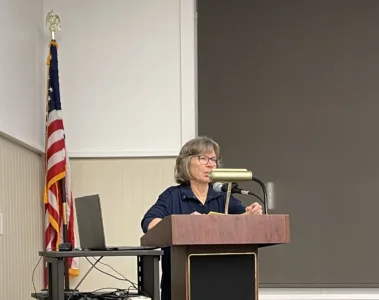
CANFIELD – The Canfield Historical Society hosted a recent lecture highlighting the history of the infirmary known as The Old Pogy.
The structure was centered on a 233-acre farm on Herbert Road and was the place Mahoning County townships sent those who could not fend for themselves.
"It could have been considered an early form of welfare," Canfield Historical Society President Suzie McCabe said. "The County Home was a place for the insane, the homeless, handicapped, elderly and poor to go."
She said townships could have a person committed to the County Home if it could be shown they couldn't support themselves. She said even a productive person could fall on hard times and find themselves committed to the County Home. Since Canfield was the center of Mahoning County, and originally the county seat, it was decided to locate it in Canfield Township.
McCabe said the property was purchased from John and George Harding in 1855. It began as a working farm and on Nov. 15, 1855, received its first inmates: David Pegg from Milton listed as no goods or poor; Daniel Duches from Canfield listed as a cripple; Harriet Chidester of Canfield listed as insane; Henry Everett of Canfield listed as a 12-year-old; Edward Hughes of Poland listed as insane; John Randolph of Austintown listed only as an 81-year-old shoemaker by trade; and John's wife, Mary Randolph of Austintown.
Each community had to pay a small fee to the County Home for the person's care, which is one reason communities attempted to run a person out of town if they were homeless or could not provide for themselves.
“It was a working farm that took care of 200 inmates,” McCabe said.
She said the inmates grew and butchered their own food, and took care of the property. Some inmates died there and were buried in a cemetery at the corner of Herbert Road and the former Niles and New Lisbon Railroad Line (known today as the bike trail). The cemetery was listed on an 1874 county map.
On Feb. 20, 1897, the County Home burned to the ground. The 235 inmates housed there all got out alive, as did all the employees.
"One man, Martin Hartzell, ran back into the building and died in the fire," McCabe said. "Hartzell was listed as insane, and no one knows why he felt the need to run back into the burning structure."
After the fire, the inmates were sent to various hotels and available buildings. Approximately 60 women were housed temporarily in Canfield Township Hall.
A new building was constructed after the plans were unveiled in May of 1897. The County Home was again in business.
McCabe noted the cemetery that was on the 1874 map and a prior map no longer appeared beginning with the 1899 county map.
The new building was large and had a few wings. McCabe said the "men's wing" caught fire on Jan. 21, 1909. It was believed to be caused by smoking.
Another building was constructed on the west side of the main building to serve as a TB (tuberculosis) hospital. It had its own nursing staff to work with TB patients.
In 1910, men from the County Home were used to pave Herbert Road, which was still a dirt road.
"The inmates of the time were free to come and go as they wished," McCabe said.
She mentioned two incidents where inmates may have been drinking alcohol and stumbling on the railroad tracks. Both were killed by trains.
The name Old Pogy came as a reference to the money paid out to keep an inmate. It stuck as a name for the County Home and as time went on, it became a common reference.
In 1962, the Old Pogy was closed as Mahoning County had a new county nursing home on Kirk Road. McCabe said in 1968, the buildings were torn down and the land was returned to agricultural use.
"During the years the Old Pogy operated, there were 438 burials listed between 1889 and 1935," she said. "Some of the markers have been found, but no bodies."
The markers were simple tubular stones with numbers inscribed on them that corresponded to an inmate.
Today, the Old Pogy property is a beautiful development and the railroad is a bike trail. The cemetery was never found, but McCabe said the developer was ready and willing to fence it in if it were located.
The lecture was well attended by hundreds of residents interested in learning about an important part of Canfield history.