
OEPA tries to cut through confusion of Canfield chemical spill
Trending
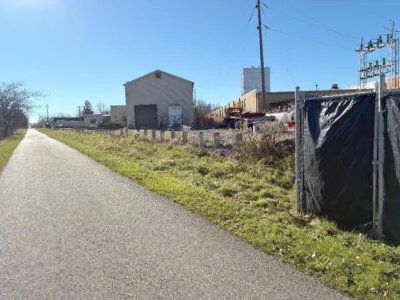
CANFIELD -- One of the hallmarks of the chemical spill discovered in a ditch next to the Mill Creek MetroParks Bikeway and Material Sciences Corp factory just south of U.S. Route 224 in July of 2024 has been confusion.
Canfield City Council expressed confusion when Canfield resident resident Brad Kinkade informed them at an Oct. 2, 2024, council meeting that he had learned from Ohio Environmental Protection Agency representatives at the site that the spill might turn out to be serious and that dangerous chemicals may have been leaking for a while.
Kinkade said in February of 2025 he wished he knew more about the science of analyzing and cleaning up industrial chemical releases, adding “Obviously it’s toxic, but how toxic? How dangerous is it? They don’t give any of that,” he said of the Ohio EPA.
August Mack, the consultant hired by MSC to handle the spill, has submitted many long and scientific documents since then, reporting on the chemicals found at various locations at the factory, ditch and elsewhere, leaving others to search for clarity on how dangerous the chemicals are.
But chemical spills are not only an environmental issue, but a political and legal one, so attempts at finding anyone in academia to assist The Vindicator in interpreting the results has been unsuccessful.
But a 613-page, Nov. 2 August Mack document that is posted on the OEPA eDocuments website provides perhaps the best chance so far to understand the nature and severity of the chemical spill. The OEPA required August Mack to produce the report.
It's called a Human Health Risk Assessment. OEPA spokesman Bryant Somerville tried in an email last week to sum up what a Human Health Risk Assessment is: "In simple terms, the HHRA is a key step in identifying risks and helping determine the final remedies that will be recommended" in the next step in the process of cleaning up the chemical spill. A key part of that is a Corrective Measures Study that will be submitted by August Mack in the coming months.
Somerville said the OEPA is "currently reviewing" the Human Health Risk Assessment "and will have comments on it." He said the HHRA looks at how people could potentially be exposed to contamination, such as through direct contact with soil, vapor intrusion into buildings or groundwater use."
He said the HHRA, "then evaluates whether those exposure pathways pose an unacceptable risk to people, such as workers or residents. If the risk exceeds acceptable levels, corrective action is needed. The HHRA helps identify where those risks exist so remedies can be developed."
Somerville said that when the HHRA is finalized, Material Sciences Corp. and August Mack will enter into the cleanup phase. The Corrective Measures Study, when approved, will guide that work, Somerville said. "MSC has until January 29, 2027, to submit a Corrective Measures Study work plan, "outlining any additional data needed to support remedy selection."
HUMAN HEALTH RISK ASSESSMENT
August Mack's Nov. 2 Human Health Risk Assessment describes the chemicals found in various locations at the factory and around the factory since testing began after the chemical was first spotted in July of 2024. The report describes them as Chemicals Of Potential Concern (COPC), naming them as hexavalent chromium, zinc, cadmium, cyanide and lead.
The report states that construction workers and commercial workers could potentially come in contact with hexavalent chromium, zinc and cyanide in the soil during future work on the factory site and in Sawmill Creek, which is not far away from the factory.
The creek flows west to east a short distance north of the plant. Also nearby is a wetland at the north end of the ditch. The creek flows along the northern edge of the Canfield High School property, just south of South Briarcliff Drive.
Testing of soil, water and air near the factory never identified any elevated levels of chemicals on the high school property, Canfield Superintendent Joe Knoll confirmed last week.
The report states it looked at the chemicals identified through testing of surface soil, surface sediment, subsurface soils, perched water, groundwater and surface water on the MSC property, neighboring adjacent properties, in the adjacent wetland and in (downstream) portions of Sawmill Creek."
The report noted that a "wetland is not a typical recreational destination, and the perimeter of the wetland is secured by fencing." It states that despite this, "as a conservative measure," the risk to people entering the wetland was evaluated as if a "recreator," meaning a person in that area for recreation, might access the area.
Residents living in the area of Sawmill Creek and the wetland have mentioned their concerns about children, such as baseball and soccer players on the school property, having played in the creek and adjacent areas over the years.
At least one sign on the edge of Sawmill Creek warns people that the creek contains “potentially polluted water.” The sign tells people to “avoid recreational use. Do not drink the creek water.” Plans to erect a fence to keep children on the school property out of the creek never came to fruition, apparently because of the wishes of South Briarcliff residents.
The report states that August Mack determined that a residential area just to the south and west of the factory is "outside of the estimated extent of groundwater contamination." It states that the neighborhood was therefore excluded from evaluation as a "pathway" of potential harm to people. The neighborhood in that area is called The Preserve.
POTENTIAL HAZARDS
The report states that construction workers working near the factory in the future could encounter hexavalent chromium, zinc, cadmium, lead and cyanide while working in the soil in the wetland at the north end of the adjacent ditch.
Construction workers also could encounter cadmium, zinc and cyanide in the soil during construction in the ditch adjacent to the factory. And they could encounter cyanide while working in the area of the Bikeway.
A great deal of earthmoving took place in the ditch starting in late 2024, and a liner was installed in the ditch in an effort to clean up contamination. Lots of soil and water were also removed and hauled away, according to MSC documents.
A person considered a "recreator/trespasser," could encounter cyanide in the soil if he or she was in the area of the adjacent ditch or on the Bikeway, the new report states.
A "recreator/trespasser" could encounter cadmium, hexavalent chromium, lead, zinc and cyanide in the soil of the wetland.
A fence is in place to keep the public out of the adjacent ditch, the MSC property and the wetland.
The report states that construction workers would be expected to encounter soils up to 10 feet below below the surface during construction work, calling that "comparable to the approximate depth of a storm sewer or other utility installation."
In the more than two years since the spill was discovered, several potentially contaminated areas have been mentioned many times -- the MSC factory site, the adjacent ditch, the wetland, the Bikeway and Sawmill Creek.
But the new report mentions three other properties -- three other businesses on either side of the MSC factory -- two on the east side of MSC and one on the west side of MSC. All three businesses front on West Main Street (U.S. Route 224).
The report says testing of the groundwater at two properties on the east side of the MSC factory showed the presence of dichloroethene and trichloroethylene on the property of one business and hexavalent chromium on the property of the other. The third business showed the presence of dichloroethene and trichloroethylene in groundwater on its property.
The report states that the "properties directly west and east of the (factory) are within the presumed groundwater plume." The report notes that all three properties are zoned industrial or commercial and have no existing water wells. The report states that the groundwater at the three businesses poses a potential danger to people through ingestion, contact with skin and inhalation.
But danger to construction-workers on the property of the three businesses is "not reasonably likely" because the groundwater is about 20 feet below the surface.
The Vindicator visited all three of the businesses Thursday. At one of the businesses east of the MSC factory, an industrial facility, a manager said he was aware of the results of the testing done on that company's property related to the the MSC spill, but said, "We don't have any concerns" about the results.
A chart August Mack prepared just for that property states that because the property is zoned for manufacturing, it is unlikely to receive recreators and because there were no “impacts” found near the surface of the ground that would warrant a risk evaluation for recreators.
It states that contaminated soils associated with the spill were not found on that property, and because of the average depth of groundwater there being 20 feet below the surface, “construction workers are unlikely to encounter groundwater.” It states that “impacted groundwater is potentially within the property boundary.”
At the two other businesses -- one industrial and one commercial -- The Vindicator left a business card for the appropriate manager to call but did not hear back.
There is also a risk to people of ingesting chemicals, having chemicals come in contact with their skin and chemicals being inhaled through groundwater on the MSC factory property, the report states.
BIKEWAY
The report also found a risk for people coming in contact with groundwater on the MetroParks Bikeway near the factory, but it is unlikely that people "recreators on the Bikeway would come in contact with surface water. The report notes that both the adjacent ditch and the wetland are on Mill Creek MetroPark property.
A chart addressing just the Bikeway states that “construction workers could come into contact with contaminated soils during utility installation that intersects the Bikeway,” so it was evaluated for trench groundwater and soil groundwater risks.
It states that a construction activity on the Bikeway could generate dust from contaminated soils. It states that a recreator on the Bikeway “will potentially come in contact with surface soils,” so recreators on the Bikeway were evaluated for recreator contact with soil or sediment.
The report states that it is unlikely that a recreator could ingest groundwater from the Bikeway property, but there is nothing in place currently to stop a water well from being drilled there and the water from it being used for consumption, the chart states.
When Mill Creek MetroParks Executive Director Aaron Young was asked about the findings of the report, he replied in an email: “We are confident n the oversight being provided by the OEPA of the ongoing monitoring and remediation efforts of August Mack to ensure that any and all environmental risks to persons and property are appropriately addressed on behalf of all affected property owners, including Mill Creek MetroParks.”
The report rated adults less at risk from ingestion, contact with skin and inhalation of chemicals in groundwater on the Bikeway than children.
That is based on the differences in behaviors of children and adults and differences in the biology of adults and children, according to the U.S. Environmental Protection Agency.
Children more often play close to the ground than adults, which is a behavioral difference. Biologically, children may be at greater risk because "their organs and systems - including the brain, lungs, liver, kidneys, nervous system, and immune system - are still developing," and "pollutants may be absorbed differently and cleared less effectively" by a child's body, the U.S. EPA web site states.
The report noted elevated risks for construction workers if they work in an area of the MSC factory property that contains what is called "perched water," which "exists above the main water table, often held in place by impermeable layers of soil or rock," according to the uslegalforms.com web site.
The report contains a "summary and conclusions" section stating that the risks of "soil/sediment exposures" for commercial workers and recreators in the adjacent ditch, Bikeway, wetland, or Sawmill Creek are "below Ohio EPA target thresholds" for cancer and non-cancer effects on such populations.
But the report adds that "Chronic exposure to impacted groundwater will result in unacceptable risks and/or hazards to affected (people)." It added that "there are currently no (water) wells within the contaminant footprint."
MSC STATEMENTS
The MSC Canfield Incident Response website run by MSC and its public-relations consultant states that on Sept. 17, the Ohio EPA issued conditional approval to the Resource Conservation and Recovery Act (RCRA) Investigation report submitted by Material Sciences Corporation last summer.
MSC has stated that the goal of the RCRA Investigation is to "determine the nature and extent of contamination and whether impacts may pose future risks." After the RCRA gets final approval, MSC and August Mack will complete a Corrective Measures Study.
The MSC website stated Sept. 17 that MSC began to work on the Corrective Measures Study in the fall. MSC estimated that study, "which will evaluate potential remedial options for the site, will be submitted to Ohio EPA in the spring of 2027."
To access news releases from MSC, visit the MSC Canfield Incident Response website. To view the documents associated with the spill filed with the OEPA, visit the Ohio EPA documents website, click on the eDocument Search Ohio Environmental Protection Agency, select "launch eDocument search, fill in the drop down menus for entity name (Material Sciences Corp) and County (MAHONING). The documents for MSC will appear and can be downloaded.