
McFarland Speaker Series kicks off with talk on Irish conflict
Trending
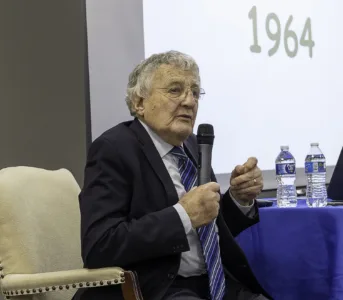
WARREN – Near the end of his presentation, Rev. Harold Good said, "I'm just a storyteller."
Much more than that, the retired Methodist minister spoke to a rapt audience on "From Conflict to Connection: Insights from the Lifetime of Advancing Peace and Reconciliation" Thursday evening at the Warren-Trumbull County Public Library's Harding Room.
His appearance became the debut event of the McFarland Speaker Series, which aims to foster community engagement and meaningful dialogue through guest speakers involved in art, music, literature, culture and current affairs.
Despite his attempt to be humble, Good made on impact locally as well as in his native Ireland, where he put himself in harm's way in order to help end the deadly Northern Irish Conflict.
Hood brought everyone through the history of the Northern Ireland Conflict - aka The Troubles - by explaining that the British Government partitioned Northern Ireland, which remained part of the United Kingdom, from the rest of Ireland, known as the Republic of Ireland. This led to years of conflict between the Protestants (UK loyalists) who controlled the government and police, and marginalized the Catholics in that area.
While there were violent episode for years, the major and bloodiest conflict lasted 30 years from 1968-1998, just when Good and his family arrived in Belfast. It finally ended with the Good Friday Agreement.
“After many years of violence and bloodshed, bombings and shootings, killings, and all the things that go with insurrection, there were two realities that dawned. It took a long time for the realities to dawn. One was for the Republicans to realize that an armed struggle would not deliver a united Ireland. It would only deliver a fragmented and divided Ireland, leaving a trail of misery and grief and sorrow in its wake.
"Secondly, part of the British establishment, they came to realize that with all the might of the British Army, and it was mighty, and there were many many casualties and losses of life from the part of the British Establishment. They realized that there could be no military solution to the problem of Ireland. There's a lesson for our world of today."
Good mentioned that he was told by Gerry Adams, the leader of Sinn Fein, the outlawed party, that the "breakthrough" came about when he was invited into the minister's home. He called that "the gospel of hospitality."
Nearly a decade after the Good Friday Agreement, Good, along with Catholic priest Father Alec Reid, acted as independent witnesses that the the Irish Republican Army's munitions were decommissioned and unusable.
Still, as he put it, the way to move forward deals with the "hurt of history." He highlighted the words Confession (as in an apology), Grace and Forgiveness.
Queen Elizabeth II of England did that with a statement, "With the benefit of hindsight we can all see thing we wish we had done differently or not at all." British Prime Minister David Cameron also apologized for his country's actions that led to Bloody Sunday wherein troops opened fire and killed 13 during a peaceful protest in Derry on Jan. 30, 1972.
He also highlighted how bitter enemies can now be compatriots by discussing the unlikely political partnership and personal rapport between Ian Paisley (Democratic Unionist Party and Protestant) and Martin McGuinness (Sinn Féin deputy first minister and onetime IRA commander). The two were nicknamed the Chuckle Brothers.
Following his speech, Don McFarland – brother of Jim McFarland, who funded the series with a partnership of the library and Trumbull County Historical Society – presented Good with a watch that was made locally at Thumm's Bicycle and Clock Shop in downtown Warren. He mentioned that Jim couldn't attend the event because he is battling cancer in Florida.
Good, along with his wife, Clodagh, and their two young children lived in Warren from 1964 to 1968. Fondly remembered in the area, a brick dedicated to Clodagh, who passed away last June, is placed at the Warren Women's Park.
Also present at the event were members of his youth group who joyfully reunited with Good and its members who attended. He served as a youth minister at the First Methodist Church in Warren from 1964 to 1966.
Earlier in the day, Good took part in a moderated talk during a special luncheon at West & Main at Courthouse Square.