
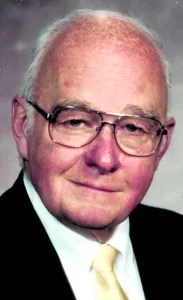
Wellington remembered for integrity, leadership
Commended for integrity as Youngstown police chief, Mahoning sheriff
Trending
YOUNGSTOWN -- Randall Wellington spent more than five decades in law enforcement, and those who worked alongside him remember a steady, honest leader who earned the respect of his colleagues and the community.
Wellington, who died Friday at age 93, served 14 years as Youngstown police chief before becoming Mahoning County sheriff in 1999. He retired in January 2013, ending a 55-year law enforcement career.
Colleagues recalled Wellington’s leadership during some of Youngstown’s most turbulent years and his efforts to restore confidence in a sheriff’s office shaken by corruption.
"The biggest thing I can say about his tenure is he brought honesty and integrity back to us at a very bad time, when the sheriff’s office was clouded with corruption," said Sheriff Jerry Greene.
Wellington took over the sheriff’s office following the federal racketeering conviction of former Sheriff Phil Chance, whose administration had been linked to organized crime.
Greene said Wellington’s example influenced his own approach to leading the department.
"I liked him a lot, and he mentored me in so many ways on how to run an agency properly," he said.
With his retirement pending, Wellington supported Greene’s campaign for sheriff in 2012.
Wellington began his law enforcement career with the Youngstown Police Department in 1957. He spent 41 years with the department, rising through its ranks before Mayor Patrick Ungaro appointed him chief in 1984.
Youngstown was struggling with violent crime, organized crime and corruption in those days. Wellington acknowledged the influence of the Mafia and illegal numbers operations in the city and made combating those activities a priority.
A graduate of the FBI National Academy, he strengthened cooperation with federal authorities in investigating organized crime and pursued allegations of public corruption, including an investigation involving a federal housing program.
Among his first actions as chief, Wellington transferred 24 officers from desk assignments to street patrols to increase police presence in the city’s neighborhoods.
Former Youngstown Police Chief Robin Lees worked under Wellington from his own years as a patrol officer through several promotions.
"To me he was kind of a long-term mentor, a very stable, solid kind of person in charge; he had a reputation for being honest and straightforward," Lees said. "As a police officer the man had no flaws. He was the kind of chief that you would expect from central casting."
Lees said Wellington’s calm approach to difficult decisions was among the lessons he carried into his own career.
"One in particular was a calm approach to situations that would arise, and he would weigh the issues and make a good decision in the end," he said. "His stability and demeanor through tough times, I feel, was something I tried to emulate in my own time."
Lees said Wellington left behind a well-functioning police department when Richard Lewis succeeded him as chief.
"When Lewis came in, he inherited a stable, functional police department, which is all you can hope for," Lees said.
James M. Lewandowski was appointed interim sheriff on July 14, 1998 to replace Chance. Wellington was appointed sheriff on Aug. 28, 1998, by Democratic precinct committee members to complete the remainder of the term.
At a community meeting shortly after taking office, Wellington received a standing ovation from members of ACTION after pledging to root out corruption within the department, The Vindicator reported in a 2011 editorial.
He won election to a full term in 2000 and was reelected in 2004 and 2008.
His years as sheriff included financial difficulties and litigation over conditions at the Mahoning County jail.
Mahoning County Commissioner Anthony Traficanti said he worked closely with Wellington to address those problems after taking office.
"When I became commissioner, our jail was in litigation and our office worked hand in hand daily with Sheriff Wellington to get the jail opened and get the sales tax passed to make our jail constitutional," Traficanti said.
He said the county had twice failed to secure voter approval for a sales tax needed to support jail operations, and financial problems were forcing the release of inmates.
"If it wasn’t for Sheriff Wellington, it would’ve been a higher hill to climb," Traficanti said.
He described Wellington as open about the department’s needs and willing to work with county officials.
"Working with a guy you knew was honest really helped things," he said. "He was an honest office holder, and I enjoyed working every second with him."
Wellington’s administration also established a senior-citizens unit, negotiated police services in Canfield Township and expanded partnerships with federal agencies, including the U.S. Marshals Service and Immigration and Customs Enforcement.
In 2006, he established a day-reporting program that allowed certain misdemeanor offenders to perform community service rather than serve time in the county jail. The program was intended to reduce incarceration expenses while holding offenders accountable. By 2011, it had saved the county an estimated $1 million, The Vindicator reported.
Wellington announced in October 2011 that he would not seek another term. He retired Jan. 5, 2013.
Traficanti said his relationship with Wellington extended well beyond county government.
He recalled the sheriff calling to invite him to lunch at Boomba’s on the city’s South Side, where Wellington liked to take members of his department for pierogi. They also met for spaghetti dinners at the Italian American War Veterans organization.
"He’d call me: 'Hey Tony, you got time today? Boomba’s at noon,'" Traficanti recalled.
He described Wellington as a devoted family man and a kind, decent person.
"I had the utmost respect for Randall Wellington," Traficanti said. "Whenever you heard the name, you always heard that name being synonymous with the highest integrity in law enforcement. That’s what I knew, and that’s what I experienced."
Lees said Wellington’s career was remarkable not only for its length but for the trust he earned from the public.
"I can’t think of any other law enforcement official that spent that long as a chief and went on to become an elected official as a sheriff, and that speaks to how the community embraced his leadership," Lees said.