
Struthers wards redefined
City council poised to approve first changes in boundaries since 1971
Trending
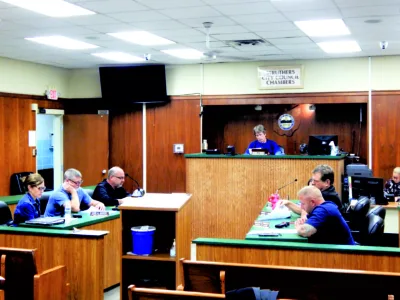
STRUTHERS -- City council at its meeting last week had the second reading of a proposed ordinance to redefine the boundaries of all four city wards after city leaders were informed by the League of Women Voters that the current ward boundaries violate the Ohio Revised Code.
The third and final reading of the ordinance will take place at the Oct. 14 council meeting to allow residents time to review the proposed ward map, ask questions and give input. If there are no objections, the ordinance will pass, and the ward maps will be redrawn as proposed.
"The League of Women Voters reached out to us a while ago and brought this to our attention that we were not compliant with ORC," Struthers Mayor Catherine Cercone Miller said. "Every 10 years, so the year following a census ... you're supposed to do a redistricting."
Under the ORC, cities need their ward populations to be within 10% of one another to maintain democratic fairness in city government.
LWV of Ohio representative Trevor Martin recently said after each U.S. Census, the Ohio secretary of state sends out notices to all 88 county boards of elections in the state telling them the new population numbers and advising them of what to do.
"One ward can't have too many more people than the other wards to keep it fair, and that way when they're voting they're not representing more people than the other wards," Miller said.
While state law requires city wards to be redefined on a regular basis, this law has not been strictly enforced in decades. Struthers has not updated the boundaries of its wards for more than 50 years. The last time was in 1971, before Miller said she was born.
Because of the lack of state enforcement, other cities in the Mahoning Valley such as Warren and Campbell have recently redrawn their wards as well. Warren passed its new map Sept. 9 after having town halls on the subject in every ward throughout the year.
Martin said he spoke with members of Hubbard City Council last week. Hubbard has not adjusted its ward boundaries since 1966, when it became a city.
"We're not the only community faced with this decision to redo the boundaries," council president Michael Patrick said.
Despite needing to redraw the wards, the city attempted to keep any changes to a minimum rather than any dramatic redistricting. They also saw it as an opportunity to make ward boundaries clearer for residents to understand.
"There's only a couple of streets that have changed wards," Miller said. "We fortunately didn't have to make big switches, so it wasn't like we had to cut out any wards or anything like that."
"The boundaries are cleaner. I think it'll be easier for people to understand which ward that they are in," Patrick said.
City council will maintain its seven members, with one member representing each of the four wards and three at-large, with Patrick emphasizing the importance of having an odd number of council members to avoid having a tie. The size of council is determined by population.
Miller defended the city's lack of awareness of the redistricting law, saying that the quick turnover in city government can lead to newly elected officials not always knowing all the rules.
"When we brought it to council, everyone did not know that this was a thing," Miller said. "I think sometimes you have so much turnover when it comes to city council administration, even with our municipal courts and elected officials, ours change every two years. So sometimes when new people get in, they're just not aware of it."