
WWII vet recalls a devastated Tokyo
Trending
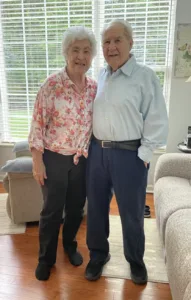
POLAND -- Alfred Russo has lived a full life of service both during wartime and in civilian life. As he nears turning 100 in November, he had a chance to look back over the past 99 years.
Russo grew up in Lowellville and graduated from Lowellville High School in 1944. He entered the military at age 17 and was sent to Fort Riley in Kansas for his basic training. He became a member of the U.S. Army's 1st Cavalry Division and even trained with military horses.
"The horses were all brown with a white streak on their forehead," Al said. "All the horses were the same color."
He said while his unit trained on horseback, they headed to Japan with a tank unit. They were among the first U.S. troops to enter a bombed out Tokyo following Japan's surrender in World War II.
"The Marines actually went in first and then we went in," Russo said. "We had to explode mines in Yokohama Bay as we made our way to shore. I lost hearing in one ear from exploding the mines."
His unit had to guard a flat area that included a section of land under 4 feet of water that contained gold bars. He said one could see the bars glistening under the water.
He said Tokyo was leveled from a barrage of incendiary bombs. The bombs were dropped by B-29 aircraft and it was the first time napalm was used. It devastated Tokyo and killed nearly 100,000 people.
"I remember seeing a man whose entire backside was burnt," Russo said. "He couldn't walk at all."
He said everywhere he looked was leveled, burned out land. The skeleton of a shot down bomber was like the skeleton of an airplane.
In Japan, Russo served as a supply sergeant -- a job he enjoyed doing.
"Captains and lieutenants had to come to me to get supplies, so they had to be nice," he said. "I was a sergeant that was in charge of supplies. It was the best job you could end up with in the service."
He said he landed the supply sergeant's job because he knew how to use a typewriter.
He said when the 1st Calvary landed, Japan had just surrendered. Occupying the town of Tokyo was odd as all the people had fled to the mountains. He said as they started coming back, it took a while to realize his unit was made up of "good people."
Russo was in Tokyo for 11 months and 20 days. During that time, he developed a friendship with a Japanese soldier named Halo Miyamoto. After the war, Halo would write to Russo and even send him Christmas cards.
In the spring of 1946, Russo returned to the states and was honorably discharged. He went to work at Sharon Steel until the mills went down. He then got a job with the Post Office in 1956 and continued working until 1976 when he retired.
In 1975, Russo was elected as mayor of Lowellville, where he served until 1991.
In 2003, a friend, Frank Sergo, was running for trustee in Coitsville. Through him, Russo met his wife, Michelle, and the two married that year. Michelle came to the United States from Italy in 1955 and ended up in Lowellville.
"I think God put us together," Russo said. "If I had it all to do over again, I wouldn't change a thing. I have been able to help a lot of people in my life and I have had a good life."
During his time as mayor, Russo was credited with the development of CASTLO, an industrial park that was a joint effort with leaders from Lowellville, Campbell and Struthers. It was located on the former Youngstown Sheet and Tube site.
Among other achievements during his career was the development of a senior citizen housing complex, the construction of a $4.5 million sewage plant along the river in Lowellville and the Stavich Bike Trail that runs from Struthers through Lowellville to New Castle, Pa.