
Valley police defend Flock cameras
Critics fear privacy abuses
Trending
Flock cameras have raised the ire of residents in the Mahoning Valley and across the country.
Public pressure has led some police departments to remove them and legislators to propose laws regulating their use and increasing penalties for abuse. Flock itself has responded to the outcry by increasing the guardrails on its system.
More than 100 Flock cameras operate across Mahoning County in Boardman, Canfield, Youngstown, Struthers and Poland Township, and the Mahoning County Sheriff's Office is pursuing a contract with the company.
Earlier this month, Austintown trustees drew criticism for the police department's new contract with Flock to install and operate six cameras. The three-year deal costs $54,000. Trustees have been under fire since the motion approving the cameras passed Aug. 3.
"If it doesn't prove its value, the board will consider eliminating it," said trustee Bruce Shepas. "However, if it saves one child under an Amber Alert, or stops a serious criminal who's injured or killed somebody, we're most likely going to keep them."
The Flock camera debate focuses on privacy concerns. Many worry that their every move is being monitored, that the cameras are following their whereabouts, storing that data, selling it to third parties, or that their activities can be observed by virtually anyone.
Critics contend the cameras constitute Fourth Amendment violations in the form of a warrantless search, and also point to abuses by law enforcement officers who have used the system for personal reasons such as monitoring or even stalking their significant others.
But law enforcement officials in the Valley say residents may be getting bad information from people who largely misunderstand or intentionally misrepresent what Flock cameras can actually do, and how they are used.
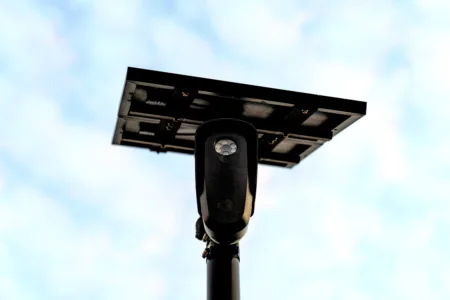
A standard Flock automated license plate reader, used by local law enforcement agencies, photographs passing vehicles, reads plates and logs those observations with a time and camera location. It also identifies certain vehicle characteristics. All of those observations are searchable in the Flock system for any department with a Flock account. Flock cameras are not facial recognition tools and do not regularly record continuous video of passing motorists.
Detective Ty Hyshaw of the Mahoning County Sheriff's Office and Mahoning Valley Drug Task Force said the hardware and system access are available to anyone.
"Flock started down South, in Georgia, in a gated community, as a mounted iPhone. As a civilian, you can purchase a Flock camera and put it on your property. You just don't get access to the NCIC stuff," Hyshaw said.
The National Crime Information Center system is linked with Flock so that it notifies police when a passing vehicle has a warrant attached to it, an active Amber Alert or is linked with terrorist or criminal gang organizations.
Boardman police Chief Todd Werth said his department's policy, which many other local departments have mirrored, is that if a Flock camera pings the system because a passing vehicle has a warrant attached to it, that warrant must be independently verified before any law enforcement action is taken.
Police and other advocates point out Flock cameras are hardly different from surveillance cameras at businesses, traffic cameras, ubiquitous mobile phone cameras, dash cams and even Ring doorbell cameras.
"The Ring camera -- why is it OK for my neighbor to have a camera pointing right at my house, that sees my children playing on the lawn, or watches my family having a birthday party or a cookout?" Shepas asked.
Police contend that detectives have always consulted video-monitoring systems for evidence during investigations for as long as video monitoring has been around.
Critics argue that it is not the existence of the independent video system or the single camera that poses a problem, but the Flock system's ability to capture the same vehicle's movements as it passes one camera after another and store that photo evidence in an easily searchable database -- the very same element that makes it a valuable tool for criminal investigations.
Werth said that concern is valid, and even one he shares. He said that is why Boardman's policies are so strict and why other departments' policies should be as well.
"I understand and completely respect the privacy concerns, and as we looked at purchasing these, those were a specific area we focused on," he said. "We spent a lot of time developing our policy, and we tweaked it to the point that we are very comfortable with the guardrails in place and the protection of the data."
Police across the county coordinate with one another and often obtain access to others' systems so they can follow a suspect vehicle across jurisdictions. This raises concerns for critics of the technology. Werth said his department keeps a close eye on who is using the system, how and for what purpose.
"Internally, as far as how we track, we do internal audits, we're already doing the things Flock is now mandating in their software as a response to the public concern," he said. "We've been able to share our policies with other agencies. In law enforcement, we're given a lot of authority to conduct our mission, and with that comes a lot of responsibility to ensure we have transparency to the public and we're adhering to the rule of law."
Werth maintains that law enforcement officers who abuse the system should be prosecuted and stripped of their badges. Hyshaw agrees and said the system is intended to minimize the potential for abuse.
"Nothing is abuse-proof, you can abuse anything. But they have audits in place as a safeguard, and the administrator can see what officers have run and who they've run," he said. "Abuse should be dealt with accordingly, but you can determine where the valid uses are and what abuses are. There's accountability."
Hyshaw said he would estimate that the degree of abuse of Flock cameras by individual officers is somewhere between 1% and 2% nationally.
The Institute for Justice has compiled more than 100 alleged incidents involving Flock or other ALPR systems. In Orange City, Florida, for example, Officer Jarmarus Brown allegedly searched his ex-girlfriend's plate at least 69 times, her mother's 24 times and her father's 15 times in 2024.
A Wisconsin woman seeking a domestic-abuse restraining order said her police-officer ex-boyfriend searched plates associated with her and her new partner 179 times. The list goes on.
Other opponents of the cameras might point to a May 2025 case, in which the Johnson County Sheriff's Department in Texas searched across more than 80,000 Flock cameras to track a woman wanted for seeking an abortion. Immigration-rights advocates also note that while Immigration and Customs Enforcement does not have an active Flock account, it has obtained license plate data on its targets through cooperation with other agencies that do.
The bipartisan legal and civil rights objections to abuse have led some agencies to pull the cameras. Legislators have drafted laws to curtail abuse or penalize it more severely.
State Sen. Al Cutrona, R-Canfield, just proposed a bill that would forbid government agencies in Ohio from sharing Flock camera data with an outside party or for any outside party to solicit the data. It also would limit the storage period for Flock camera data to 10 days before being automatically deleted. Violations would be a fourth-degree felony.
Detective Sgt. Rob Whited of Austintown Police and the Drug Task Force said that while strong regulation and heavy penalties for abuse should be embraced to ensure public safety, reactionary laws based on uninformed public pressure do much more harm than good.
"I've been working in law enforcement for a long time, and we constantly deal with complaints about not solving enough crimes or solving them fast enough," he said. "But any time we gain an advantage, some congressman or senator imposes a bill to limit that, hoping they get the votes for helping with privacy issues, when all they're doing is hindering us."
For all the negatives critics throw out, law enforcement officials in the Valley point to countless successes they say they would not have achieved without the cameras.
"If we're just taking a picture of a car, and that car has a warrant associated with it, I'd think that as a resident of this county, you'd want a person with a warrant picked up," Hyshaw said. "If there's a missing child and that car is associated with that Amber Alert, if it hits a Flock camera, the police would know that. If it's a sex offender, terrorist or gang affiliated person, if that information is attached to the plate, we can see that."
Hyshaw points to a recent case out of Lowellville, in which the suspect fled to Cleveland. Police were able to track him remotely through the Flock system and notify local police. The man ultimately barricaded himself in his vehicle and took his own life before he could be arrested.
Other stories have happier endings. Werth said his department has helped at least a few missing elderly residents get back home, thanks to Flock cameras.
"In one case, we looked at the plate, followed it to a camera inside Pennsylvania and we contacted that police department," Werth said. "They looked for her and found her in a parking lot in a strip mall. She was having medical issues and they were able to get her immediate attention and it saved her life."
In another case, Werth said, an expensive piece of stolen construction equipment was traced to Akron and recovered. Multiple high-value cars stolen from a local dealership were recovered in Cleveland.
Last year, he said, they solved a rape case in which the woman did not know her attacker.
"These cameras very quickly provide a lead and also disprove other avenues of investigation," he said. "We used to solve crimes without this, yes, but if you're able to solve it quickly, then you help that victim and you also eliminate the opportunity for that suspect to create more victims."
In other cases, still, police point out that Flock cameras have been used to exonerate suspects.
In San Diego, last year, Hugo Parra was arrested for an attempted carjacking of a red Alfa Romeo. They initially identified Parra's similar vehicle through Flock, but a timestamp placed Parra about five miles away from the crime scene at the time of the carjacking. That factor, along with additional Flock camera sightings along his route and cellphone-location evidence supported his alibi, even though he spent nearly a month in jail while police sorted through the evidence.
Werth, Hyshaw and Whited all maintain that Flock provides far more benefit than risk and insist the tool is worth its weight in gold.
"The people illegally using it will get caught. They'll just keep on doing that until they get caught. But we also can have someone who just committed a homicide arrested within 15 minutes. Same thing with an Amber Alert, and now law enforcement is rescuing a child. And the public wants to take that away? That's the most asinine thought process," Whited said. "Please, please, please do not take this away from us."