
Trending
YOUNGSTOWN -- The number of citations issued from Youngstown's unstaffed speed cameras in school zones significantly increased during the past school year, but the city is still struggling to find ways to spend the money it generates from collections.
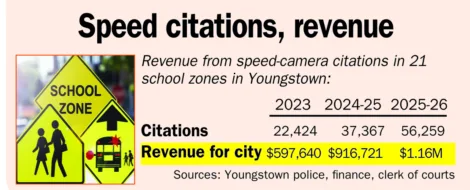
The speed cameras in 21 school zones in the city issued 56,259 citations between August 2025 and the end of July, according to the city clerk of court's office.
That's up more than 50% from the 37,367 citations issued during the previous school year: August 2024 to July 2025.
The city started using the unstaffed cameras in school zones in phases beginning Feb. 21, 2023, and were shut off when classes ended between May 18 and June 2, 2023, depending on when schools, which includes private and charter schools, closed that year. Because of a disagreement between the city administration and the city court over hearings on contested speed citations, the program stalled for a year and did not return until August 2024.
During that operating period in 2023, the cameras issued 22,424 citations for a total of 116,050 citations issued since the cameras were installed.
The city has a contract with Blue Line Solutions of Chattanooga, Tennessee, to run the camera program. Of the money collected, the city gets 65%, with Blue Line receiving the remaining 35%.
The city has collected $2,676,735 since the cameras were turned on, with Blue Line receiving $1,441,319.
The city received $597,640 in 2023, $916,721 for the 2024-25 school year and $1,162,374 for the 2025-26 school year, according to records provided by the city finance and police departments.
The city chose to forgive those who did not pay the fees in 2023 when it resumed the program in September 2024, having all of the citations canceled.
The collection rate has been low -- around 35% -- for those issued citations.
There is nothing the city can do to force people to pay the fees. Blue Line could turn over the unpaid citations to a collections agency, but that is highly unlikely.
Blue Line sold the program to the city, saying it would not only make school zones safer, but that people's driving habits would quickly change and the number of citations would decrease. That hasn't been the case, with a huge increase in citations issued in the last school year compared with the 2024-25 school year.
SPENDING ISSUES
The city has experienced difficulties in spending the money it collects from the citations because of state restrictions on those expenditures.
To date, the city spent $261,397 from the money collected from those who paid speed camera citation fees. That's less than 10% of the money it's received.
Most of the money, $184,384, paid for two annual maintenance agreements with ShotSpotter, a company whose technology is able to detect and locate gunfire in real time. The city's law department determined in December 2024 that it was a permissible use for the speed camera funds.
The city also paid $51,522 in December 2024 to Blue Line to purchase a surveillance trailer with two cameras with the rest of the money going toward improvements and maintenance to school zone flasher units and signage.
The law department in December 2024 stopped a planned $211,251 expenditure to buy three SUVs for the city school district, determining it wasn't permissible under state law.
Also in December 2024, city council voted to spend up to $56,000 of the speed camera money to buy three metal detectors the city would own and permit the school district to use when classes were in session. The purchase, which also raised questions, was never made.
The cameras will be turned on again Sept. 1 in school zones when students in kindergarten and grades 6 and 9 return to class. The rest of the city school district's students start Sept. 2.
Cameras are in use on school days from the time kids head to class until 6 p.m. They aren't used on weekends, during the summer and on days when class is not in session.
During the two hours in the morning that children go to school, and the two hours when they leave, the speed limit in those zones is 20 mph. In between and after school ends, the speed limit is 25 mph and 35 mph depending on the location.
Motorists caught going at least 11 mph over the speed limit and up to 14 mph over it face a civil penalty of $100. Those going 15 to 20 mph over the limit face a $125 penalty and those traveling faster than 20 mph over the limit face a $150 penalty. They do not get points on their driving record for the citations.