
REMEMBERING OUR VETS: Decorated WWII veteran recalls ‘terrible’ conditions in France fighting Nazis
Trending
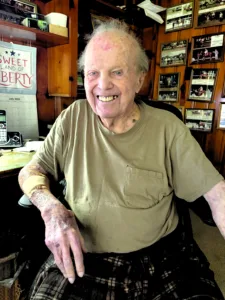
Earl Levine
AGE: 101
RESIDENCE: Youngstown
SERVICE BRANCH: Army
MILITARY HONORS: Purple Heart
OCCUPATION: Mechanical engineer
FAMILY: Wife, Bonnie (died in 1997); one son; and three daughters
YOUNGSTOWN -- Dwight D. Eisenhower, supreme commander of the Allied Expeditionary Force during World War II, once said, "I hate war as only a soldier who has lived it can, only as one who has seen its brutality, its futility, its stupidity."
This describes the personal experience of Earl Levine during his time in the infantry as a U.S. soldier fighting Nazi Germany during World War II.
Levine was born in Brooklyn, New York. When his father got a job in Cleveland, his family moved, and he was raised in Cleveland, where he graduated high school in 1943.
Drafted that same year at age 18, he went through basic training at Fort Bragg, North Carolina. He was then sent to the town of Bitche, in northeastern France, where he served in the infantry for one year fighting the German army.
Levine said his experience there was "absolutely terrible." During that year, he lived in a foxhole -- which they had to dig themselves -- with another soldier. He said they lived in the frozen ground where "the conditions were terrible, and many soldiers froze to death."
Levine said some American soldiers were in much more severe conditions than he was, and developed trench foot, which is caused by unsanitary, cold and wet conditions.
"It became so bad that some soldiers had to have their feet amputated," he said.
Levine was wounded when shrapnel from a mortar went through his left hand. He stayed in a U.S. Army hospital in Marseille, France, for six months because of an infection he developed.
"There was no penicillin. It hadn't been invented yet," Levine said. "You tried to stay alive in the hospital."
While hospitalized, he saw many wounded soldiers come and go, and during this time, Levine became friendly with other wounded soldiers.
Upon his arrival back in the U.S., he spent several months in a hospital for wounded American soldiers.
"There were hundreds of thousands of wounded soldiers that had to be taken care of," he said. "You don't just let them die. Many were more severely wounded than I was."
He earned a Purple Heart for his injury.
He and the soldier with whom he shared a foxhole operated a 30-caliber water-cooled machine gun that was set on a tripod. The gun weighed 60 pounds, and the tripod weighed 80 pounds. If they had to move to another location, one would carry the gun and the other the tripod. Several other soldiers carried the ammunition.
"The gun got its name because it fired so quickly that it became very hot, and that's why it was water-cooled," he said.
Levine described the combat as very severe. Artillery shells would explode around them, which is how he was wounded.
"I was very fortunate to be wounded, many in my situation in foxholes were killed," he said.
After his injury, he was honorably discharged from the Army and returned to life in Cleveland where he married and had a family. He graduated from the Case Institute of Technology (now Case Western Reserve University) and spent 20 years in Texas working as a mechanical engineer at his own manufacturing company.
He then spent 15 years in Kentucky in the horse business. His final move was in retirement to Youngstown because his wife wanted to be closer to her sister.
Looking back on his time-of-service, Levine said, "people today have no idea, no conception of how terrible it was. I had to learn how to shoot a weapon at 18 and how to take care of myself. It's not like today; everyone was scared to death."
Levine's military experience resonates with the words of former President Herbert Hoover who said, "older men declare war. But it is youth that must fight and die."
Levine also saw from first-hand experience what Union Gen. William Tecumseh Sherman discovered during the Civil War -- that "war is hell."