
Lecture celebrates Jewish melodies
Trending
YOUNGSTOWN -- The sounds of clarinets, violins, lively dance rhythms and traditional Jewish melodies filled the Jewish Community Center on Monday evening as guests gathered for the final presentation of the J. Newman Levy Speaker Series, featuring The Klezmer Orchestra's program, "Klezmer's Greatest Hits."
The evening began with dinner before audience members were treated to a performance celebrating the rich history and enduring appeal of klezmer music, a centuries-old Jewish musical tradition that originated in Eastern Europe.
Presented annually by the JCC and sponsored by Marcia Levy in memory of her husband, the J. Newman Levy Speaker Series highlights inspirational members of the Jewish community, including historians, professors, entertainers and cultural leaders. The programs are open to the community and combine education, fellowship and a shared meal.
Leading the evening's performance was bandleader Moss Stanley, who continues the work of preserving and sharing klezmer music through live performances and cultural outreach.
"Klezmer is Jewish music which has been around since the 15th century with influences from around the world," Stanley said. "It was played at celebrations such as weddings."
The Klezmer Orchestra traces its roots to 1995 when musicians Norman Tischler and Mark Hoffman formed what was then known as the Workmen's Circle Klezmer Orchestra. Tischler, a saxophonist, clarinetist and flutist who performed with numerous Cleveland-area groups, was deeply passionate about klezmer music.
After Tischler's death in 2019, the ensemble was renamed the Tischler Klezmer Orchestra in his honor.
"Norman loved klezmer music," Stanley said.
Over the past three decades, the orchestra has evolved while remaining faithful to its mission.
"Many musicians have come and gone," Stanley said. "They all left their mark on the orchestra."
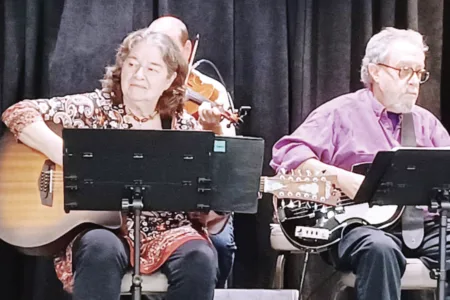
Today, the Cleveland-based ensemble typically performs with about a dozen musicians, although the group that appeared at the JCC featured a smaller lineup that included Stanley on piano, Mark Hoffman on trumpet, vocalists Beth Lieblich and Aaron Perles, Robert Booker on drums, David Budin on bass, Celia Lewis on guitar, Greg Henderson on violin and mandolin, and Richard Kiosk on clarinet.
The orchestra's mission centers on three primary goals: preserving klezmer music through heritage performances, introducing new audiences to the tradition through cultural outreach and teaching the genre to interested musicians. Over the years, dozens of performers have learned the music by playing with the group.
"Klezmer is a gift that needs to be shared," Stanley said.
For many audience members, the music evoked memories of family celebrations and cultural traditions. Stanley believes that connection is one reason the genre continues to resonate with listeners.
"It's music from their homeland," he said.
Klezmer music is known for its expressive melodies that often imitate the human voice. Instruments such as the clarinet, violin and accordion create the characteristic "crying" sound through bent notes and sliding pitches. Like jazz, improvisation is an important element, allowing musicians to create spontaneous variations during performances.
"A lot of the pieces speed up so the dancing follows suit," Stanley explained.
Historically, klezmer musicians performed primarily at weddings and other important life celebrations throughout Eastern Europe. As Jewish immigrants arrived in America during the late 19th and early 20th centuries, the music evolved by incorporating influences from jazz and big-band traditions while retaining its distinctive character.
Throughout the evening, audience members were introduced to several well-known pieces from the klezmer repertoire and Jewish musical tradition.
Among them was "Misirlou," a folk melody that traveled across the Mediterranean and has appeared in Greek, Turkish, Arabic, Persian, Armenian, Yiddish and Hebrew traditions. The tune later gained widespread popularity in the United States through Dick Dale's surf-rock adaptation and its inclusion in the 1994 film "Pulp Fiction."
The orchestra also performed "Bei Mir Bist du Schoen," originally written by composer Sholom Secunda for a 1932 Yiddish musical. The song later became an international hit through the Andrews Sisters and has since been recorded by numerous artists, including Benny Goodman and Ella Fitzgerald.
Another audience favorite was "Tum Balalaika," a traditional Jewish folk song that tells the story of a young man posing riddles about love to his sweetheart.
The group also played "Freylech Fun Der Huppe," a lively wedding dance standard associated with celebrations under the traditional Jewish wedding canopy.
No klezmer program would be complete without "Hava Nagila," one of the most recognizable Jewish songs in the world. Meaning "Let Us Rejoice," the song is based on a Hasidic melody and has become a staple at weddings and joyous celebrations.
Stanley noted that during traditional Jewish wedding celebrations, "Hava Nagila" often accompanies the custom of lifting the bride and groom on chairs while family and friends dance around them in celebration.
For anyone hearing klezmer music for the first time, Stanley offered simple advice.
"Listen with an open mind," he said.
Judging by the smiles and tapping feet, many attendees did just that.
"What I enjoy most is the smiling faces and tapping feet and the dancing," Stanley said.
As the final notes of the evening faded, the performance demonstrated why klezmer music has endured for generations. Rooted in centuries of Jewish tradition yet continually evolving through new performers and audiences, the music remains a vibrant expression of culture, celebration and community.
"It's played at all the Jewish holidays and celebrations," Stanley said. "It follows the Jewish traditions for centuries."