
Cemetery tour honors the past
Trending
YOUNGSTOWN -- When Oak Hill Cemetery is mentioned, it's easy to reflexively and initially think of the Wick, Tod, Pollack, Stambaugh and other influential families who shaped much of the city's early history.
Nevertheless, mixed among the movers and shakers buried in the historic South Side cemetery are lesser-known people who dedicated their lives to keeping the growing industrial city safe.
"He had an eighth-grade education, but he was able to read and write," former Youngstown City Schools Superintendent Benjamin McGee said.
McGee was referring to Guy Jacobs, who, despite a shortened education, became the Youngstown Police Department's first clerk before moving up the ranks from police officer to detective, then starting his own detective agency with a coworker.
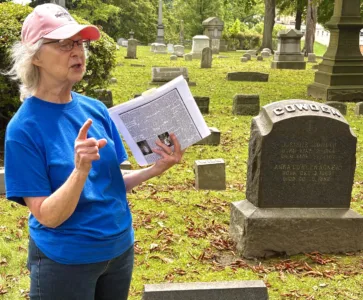
Jacobs was among the city's police officers and firefighters whose stories were told and who were honored during a walking tour Saturday afternoon through the cemetery.
Conducting the 90-minute tour to many of the men's resting places was the Oak Hill Volunteer Research Team, in conjunction with the Public Library of Youngstown and Mahoning County, where team members conduct their research.
Jacobs, who was born in 1876, moved several times throughout the city, having lived on Chalmers, Princeton and Judson avenues. In 1943, Jacobs answered a call at the Tod Hotel in downtown Youngstown to investigate a disturbance regarding a man who had booked a room with a married woman, something that was frowned upon at that time. After becoming suspicious of the man's account of having served in the military, Jacobs called the military police to verify the man's story, at which time he shot Jacobs in the groin area. The officer died 17 days later from an infection, McGee explained.
"He was a credit to the community and he was a credit to the police department," McGee said, adding that Jacobs performed his duties and lived honorably.
Longtime area historian and reenactor Steffon W. Jones provided a narration of patrolman William R. Freed, who was the first Youngstown police officer to be killed in the line of duty.
While on foot patrol with his partner in May 1891 in downtown Youngstown, Freed responded to the sound of a nearby gunshot, then saw a man fleeing the scene. A third officer had just arrested William E. Fitzgerald on a burglary charge when he pulled out a revolver and shot the arresting officer in the shoulder.
The suspect then shot at Freed during a chase, striking him in the chest. Freed died May 18, 1891.
Fitzgerald was convicted of murder and executed Dec. 18, 1891.
"This is the first line-of-duty death in Youngstown, Ohio," Jones said, adding, "You've got to figure, the jury didn't play around with this guy."
Jones also honored officer Frederick "Ted" O'Connor, who served in the U.S. Navy before joining the police department, where he specialized in working with troubled juveniles as well as helping others avoid getting into trouble. O'Connor established himself as someone who loved children and sought to protect them while providing activities for the young people to keep them off the streets, Jones noted.
"I think he was before his time," the historian said, adding that O'Connor became a detective in 1941 before dying of a heart attack in 1955.
Marianne Donley, a research team member and teacher in the Newton Falls Exempted Village School District, discussed officers George "Doc" Moyer and George Wallace, the latter of whom has his badge number etched on his gravestone.
Moyer, who was born in Pennsylvania, served about 30 years with the Youngstown Police Department and became a well-known and respected detective. Moyer retired and moved to San Diego to live with his sister but returned to the area before he died Oct. 16, 1925.
Little is known about Wallace's early life and career, Donley said, adding that portions of his obituary indicating he died July 3, 1929, at age 59 remain missing. In addition to serving with the department, Wallace was the second of eight siblings, she continued.
Phil Ciccone, a new research team member, gave a narration about officer John H. Gleckler, who came to Youngstown at age 6 with his family from Columbiana County. Gleckler joined the department in the early 1900s, though it's unknown how long he served, Ciccone said.
In addition, Gleckler was a bricklayer who worked for various contractors before retiring in 1930, he added.
Also remembered was officer Thomas H. Lonesome, who served 47 years with the department. Much of his beat was in the city's "Monkey Nest" section, a rough area of the South Side, though he was known to be tough but fair when dealing with offenders, the dozen attendees were told.
FIREFIGHTERS HONORED
Susan Wojtowicz of the research team offered information about Youngstown firefighters William H. Moore, Capt. Albert M. Probst and J. Smith Cowden.
Beforehand, she provided a brief history of the Youngstown Fire Department's origins, saying that it started as a volunteer entity. Nevertheless, a fire in early 1868 destroyed most of Gov. David Tod's partially finished mansion, prompting the one-term governor to approach Youngstown Village Council about establishing an official department, Wojtowicz noted.
On March 2, 1868, officials authorized $10,000 to organize the department and buy a new steamer, though it was not purchased, she said, adding that on April 6, 1868, Youngstown became a city.
Since more capital was to be generated as a result, Tod approached council again, then they authorized $20,000 for the same purpose as the first authorization.Six days later, the Youngstown Volunteer Fire Department was organized.
Cowden joined the fire department in July 1901 as a hoseman, and he was the first hourly paid member to die in the line of duty after a fire had broken out in late 1901 at horse stables on Belmont Avenue, Wojtowicz said.
"The water pressure from their hoses could not reach the second floor, so they were compelled to climb a ladder with their hose. It was while these fearless firemen were playing the stream of water on the flames that the wall fell in and they went down with it," according to a Nov. 1, 1901, Vindicator article.
Despite his injuries, Cowden showed signs of improvement in the ensuing months before he took a turn for the worse and died March 22, 1902. Cowden was 36.
"In 1903, his salary as fire marshal was $1,080 a year, which in today's money equals about $39,000," Wojtowicz said about Probst.
On June 23, 1904, Probst and others at the Central Station responded to a report of smoke at the Youngstown Consolidated Gas and Electric Cos. at Boardman and Champion streets, downtown. After bringing the fire under control several hours later, Probst decided to recheck the building for flames, but in the darkness, he fell through the floor and was found dead in the basement, Wojtowicz said. He was 54.
From 1862 to 1864, Moore served in the Civil War with Company G, 29th Ohio Volunteer Infantry. Soon after being discharged from the U.S. Army, he bought a business in Youngstown with a partner, according to Moore's obituary.
On May 7, 1883, Moore was elected as fire chief and served four years in that capacity while earning $500 per year (about $16,000 in 2026 dollars), Wojtowicz noted.
On May 16, 1891, the volunteer fire department was disbanded and the new paid professional department was established, with him elected as its chief, she said, adding that Moore served in the position until he retired in 1900.
During his tenure, Moore was committed to ensuring a law pertaining to fire escapes for buildings more than two stories was enforced after it had apparently been violated regularly.
"Chief Moore was determined that Youngstown should never suffer a disastrous loss of life in a fire due to building owners' noncompliance with fire safety laws," Wojtowicz said, adding, "Under his direction, some of the most stubborn fires in the history of Youngstown were checked with a great saving of lives and property."
Moore died April 21, 1909.
The Oak Hill Volunteer Research Team is seeking additional members. Those interested are asked to call Jones at 330-301-7365.