
Businessman attempts to bring affordable housing
Trending
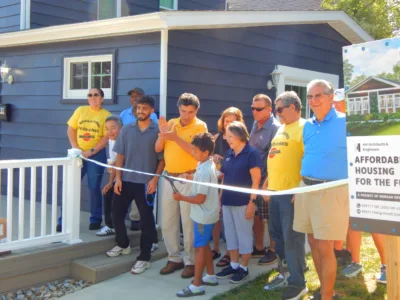
STRUTHERS -- Local businessman and owner of Morgan Oil Mike Kassem hosted a grand opening and ribbon-cutting event at a house he renovated at 98 Park Way St. on Friday.
It is one of 32 houses that have been renovated by Kassem. Citing his own experience growing up in poverty, Kassem said he wants to help provide affordable housing to people in Struthers during a time when affordability is an issue for many.
"When you're poor, you have no chance to live in a nice home. That's me doing that, giving people a chance, and to keep rent affordable," Kassem said. "Nothing is affordable in this country. Healthcare is not affordable, daycare is not affordable, education is not affordable and housing is not affordable. We are going to do something to make things affordable."
Kassem also said he wants to focus on modular housing, where prefabricated homes are built in sections and then transported to a building site. He said that helps make housing more affordable.
"Modular homes are a new technology, a very advanced technology, and they have good housing," Kassem said. "To keep things affordable, we have to move into the modular homes because the cost is like 60%, 60 cents on the dollar (of a regular home)."
This argument was echoed by engineer Ron Eiselstein, who believes that modular housing can help with affordability both in the U.S. and abroad.
"The evolution of housing is upon us," Eiselstein said. "It's the solution to our housing needs not only in the U.S., but worldwide, where houses will be manufactured in factories by robots to beat the labor shortage, so we can compete internationally for houses for the future generations."
Eiselstein compared this mass production of housing to when cars were first mass-produced for public use.
"You're gonna see modular homes being pumped out like automobiles. So, everybody could afford a car, everyone's going to be able to afford a modular house," Eiselstein said. "If we robotically manufacture these modular homes, they'll be pumping out like cars, and people can afford it."
Kassem's first modular home already has been placed at a site along Center Street.