
More to a neighborhood than its name
History lecture focuses on ‘Monkey’s Nest’ community
Trending
LIBERTY -- More than 50 people packed the Denny's meeting room on Belmont Avenue on Saturday morning for the William Holmes McGuffey Historical Society's Memories of a Lifetime program.
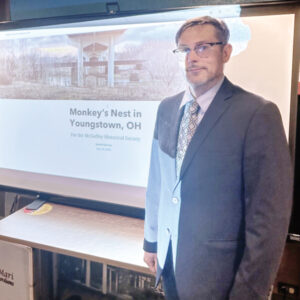
Jacob Harver, Ph.D. candidate at Kent State University, shared his research on the historic Monkey's Nest neighborhood, located on West Federal Street near the bend in the Mahoning River.
Society chairman Richard Scarsella said he remembers the variety of businesses and street names his family would pass through in the 1950s and '60's.
Harver grew up on the West Side of Youngstown and graduated from Ursuline.
"That's when I fell in love with downtown," he said.
He attended Youngstown State University and credits its history department for inspiring him to become a historian.
Although some people believe "Monkey's Nest" is a racist term, it predates African Americans living in the area. The earliest reference Harver could find was from The Vindicator in 1896, concerning the untimely death of John Gilully, owner of the Monkey's Nest Saloon.
Harver highlighted the history of the area, from the Lenape and other tribes affected by the French and Indian War and American Revolution, to the short-lived canals and the advent of the railroad in the 1860s. Harver said railroads were sometimes considered the cause of "the new civil war between labor and capital."
In 1874, the first streetcar line started.
"This is what created the neighborhood," he said.
The line ran from the corner of Jefferson and Federal streets to East Federal Street downtown.
It also became a hotbed of industrialization, from David Tod's coal-fired furnace to the Wick family consolidating what eventually became U.S. Steel. Harver noted the source of electricity for streetcars and houses is still running under the name SOBE, the focus of many recent news stories.
The neighborhood witnessed demographic changes. In the 19th century, tradesmen such as "Puddler Poet" Michael McGovern tended to be Irish. The Bessemer Process allowed mass production of steel and caused an influx of workers from southern and eastern Europe. Blacks came a few decades later as part of the Northern Migration.
Harver said they were "often brought up as strike breakers and often without their knowledge."
In 1938, houses were demolished to create Westlake Terrace, and in 1958 the new freeway changed the landscape.
This coincided with "redlining," where blacks were denied loans because the federal government designated high-minority sections to be "hazardous," as well as "white flight" to the suburbs.
Harver said although the name Monkey's Nest was often used by outsiders as an insult, the residents owned it with pride. Harver quoted a Vindicator story from 1996 that included a rhyme from Johnie Williams:
"I'm from the Monkey's Nest. Don't take no mess. You grab my chest, you get the rest."
Several attendees said they loved Harver's presentation, and it brought back a flood of memories.
Youngstown resident Jerry Serbel, 86, lived there until he was 9.
"There were nine of us living in a five-room house," Serbel said, but they somehow made it work and loved being part of the neighborhood.
George Kiraly, 91, grew up on Crescent Street. He remembered the stores, the pool hall and St. Ann's Church, adding, "You didn't have to lock your doors. Blacks and whites played together."
Ethel Brown, 95, lived on Manning Avenue until her graduation in 1949.
"We would gather our pennies and buy a loaf of bread at Balkan Bakery. There were Mexicans, blacks and Jews on each corner. I was never afraid to walk down the street. It was a wonderful neighborhood to grow up in," Brown said.
Next month's presenter will be Janet Weir Creighton, director of intergovernmental affairs under President George W. Bush. She will talk about formal state dinners and display examples of fine china used by the first family.