
Youngstown Freedom School kicks off at Tyler museum
Trending
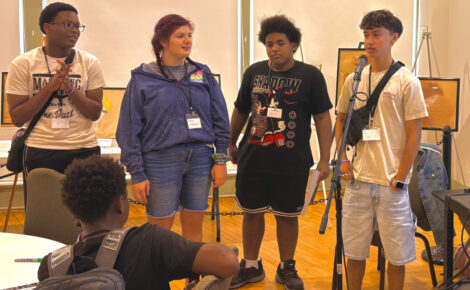
YOUNGSTOWN -- Sophia Krannich has never met James Meredith, but that didn't diminish her gratitude for the groundwork she feels he helped lay for her.
"He was a very brave person," Sophia, a Salem Middle School student, said Monday. "I think he was a good person for society, and it's important to honor people who helped us have what we have now."
Sophia also is among the students in grades four to eight who are participating in a one-week Youngstown Freedom School project that is patterned largely after the 1964 Freedom Summer movement throughout Mississippi that centered primarily on registering blacks to vote in a state many historians and others contend was the most violent, repressed and segregated.
Sponsoring the workshops are Mahoning Valley Sojourn to the Past and the Zinn Education Project.
Sophia added that she supports the philosophy of nonviolence, the six principles of which were discussed during Monday's opening workshop. On a basic but important level, nonviolence also entails being "kind and calm," she said.
The program's overarching goals are to allow the young participants to develop greater critical-thinking, research and writing skills, learn about the importance of voting and shared history, use poetry and art as nonviolent means toward achieving social justice, gain knowledge of key events that occurred 60 years ago, and find their voices and inner power.
The two key figures the students studied were Vernon F. Dahmer, a civil rights icon who lived with his family about five miles north of Hattiesburg, Mississippi, and Meredith, 92, a civil rights activist, political adviser, a veteran who served nine years in the U.S. Air Force, and writer who's famous for being the first black, in 1962, to integrate the University of Mississippi, also known as "Ole Miss."
VERNON DAHMER
Penny Wells, Mahoning Valley Sojourn to the Past's executive director, gave the students an overview of each man, saying that Dahmer "felt that everybody should vote," and that he had a small grocery store on his property where especially blacks could pay their $2 poll taxes to vote (even though the Voting Rights Act of 1965 banned such taxes, literacy tests and other obstacles, Mississippi still used them to disenfranchise mainly blacks).
In addition to being a prominent and well-respected civil rights figure, Dahmer was a farmer and known by many as a generous businessman who helped black and white people.
Dahmer's efforts, however, angered the White Knights of the Ku Klux Klan, the headquarters of which was in Laurel, Mississippi, about 30 miles from the Kelly Settlement on which the Dahmer property and home sat. Early on Jan. 10, 1966, two carloads of klansmen, under orders from Imperial Wizard Samuel H. Bowers, firebombed the home, and Dahmer shot back at the marauders, allowing several family members to escape through the rear of the home, Wells told the students. Nevertheless, Dahmer died later that day from smoke inhalation at age 58.
"His dying words were, 'If you don't vote, you don't count,'" Wells said, adding that Dahmer and his wife, Ellie Dahmer, acted as sentries to protect their home via sleeping in shifts.
A few years ago, a statue of Dahmer was erected at the Forrest County Courthouse in downtown Hattiesburg.
JAMES MEREDITH
Wells noted that even though Meredith is perhaps best known for his actions at Ole Miss, he also spearheaded a one-man, 220-mile March Against Fear from Memphis, Tennessee, to Jackson, Mississippi – more than four times longer than the 1965 Selma-to-Montgomery march for voting rights.
Nevertheless, on June 6, 1966, the second day of the effort, a white salesman named Aubrey Norvelle ambushed, then shot Meredith several times near Hernando, Mississippi, rendering him unable to continue. Local law enforcement officials did nothing to protect Meredith.
"He had a few dollars in his pocket and no weapons," Wells said, adding that Meredith also carried a staff he received, perhaps from Senegal in Africa.
While Meredith recovered in the hospital, leaders representing five major civil rights organizations -- the Southern Christian Leadership Conference, the Student Nonviolent Coordinating Committee, the Congress of Racial Equality, the NAACP and the National Urban League -- met to continue the march, Wells noted. As a result, Dr. Martin Luther King Jr., of the SCLC, Stokely Carmichael of SNCC and Floyd McKissick of CORE joined thousands of others for the march.
In addition, McKissick, who also was a lawyer, became the first black student at the North Carolina School of Law.
In November 1966, Norvelle received a two-year prison sentence after pleading guilty to assault and battery.
In his autobiography, "A Mission from God: A Memoir and Challenge for America," Meredith describes how what was supposed to be a one-man peaceful protest to encourage blacks to alleviate fear and to push for voting rights morphed into a massive undertaking, later known as the "Meredith March."
Nevertheless, it faced a series of logistical challenges, uncertainties and differing – and sometimes conflicting – philosophies and approaches ranging from militant black power to complete nonviolence espoused by King.
"The new march was launched with deep problems. The leaders drove back to Memphis for the night deeply divided," he wrote.
Meredith also described how he told King and McKissick they had carte blanche to handle the march as they saw fit, but cautioned that such an undertaking was vastly different from past protests such as the Aug. 28, 1963, March on Washington for Jobs and Freedom, as well as the Selma-to-Montgomery campaign.
"I told King, 'I'm not going to try to tell you what to do, but I am concerned that in the heat of emotion, you'll attempt something logistically that you can't do…. I don't want any innocent people getting hurt," Meredith wrote, adding that he scoffed at some leaders' insistence on having women and children in the march because he feared they could be used as human shields or, worse, be injured or killed.
For his part, Meredith recovered from his wounds and was able to join the march just north of Jackson.
Some historians contend that more than 3,000 black Mississippians were registered to vote during the march, according to the Zinn Education Project.
LOCAL HISTORY
Also at Monday's workshop, area historian Vincent Shivers told the students that even though many associate the civil rights movement with the 1950s and 1960s, it actually had been launched in the early days of the republic. He cited the example of private Peter Salem, a black soldier who fought in the Revolutionary War in Gen. George Washington's Continental Army, as well as in the Battle of Bunker Hill.
"Many black soldiers came home and wanted their civil rights, but slavery prevented that," Shivers said.
He also outlined the achievements of several local black movers and shakers, such as P. Ross Berry, who built many of Youngstown's well-known structures and was an abolitionist who worked on the Underground Railroad in Pennsylvania. Others he cited included Thomas D. Johnson, a Civil War veteran and stone mason; William R. Stewart, a prominent attorney in Youngstown's early days; James T. Chaney, a Civil War veteran also known as "Senator," Charles L. Berry, who also was a builder; and Samuel T. Stewart, a well-known barber and actor.
He also told the students that, contrary to many people's false perceptions about blacks who were brought to the U.S. from Africa during the slave trade as being unintelligent, many of them were educated and had valuable skill sets.
The Youngstown Freedom Summer project also will include a picnic Friday in Wick Park, along with a Teach Truth walk Saturday in Salem.