

Speaker profiles pioneering broadcaster
Dorothy Fuldheim interviewed Hitler, anchored a TV news broadcast and hosted her own show
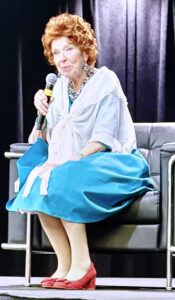
Correspondent photo / Sean Barron Anne McEvoy of Cleveland, who’s with Women in History Ohio, portrays iconic Cleveland broadcaster and journalist Dorothy Fuldheim during a program Wednesday at the Jewish Community Center of Youngstown. May is Jewish American History Month.
YOUNGSTOWN — Before she became a legendary Cleveland radio and TV personality, Dorothy Fuldheim was in Germany in the early 1930s, where she listened to a speech in an arena that Adolph Hitler gave.
“I knew how dangerous this man was,” Anne McEvoy, who is with Women in History Ohio, said.
McEvoy was portraying Fuldheim during a one-hour program Wednesday evening at the Jewish Community Center of Youngstown, 505 Gypsy Lane. The packed gathering kicked off the center’s summer J. Newman Levy Speaker series.
Fuldheim spoke with Hitler in 1932, several years before his ascent to power. By then, she was already fluent in German, and Hitler was unaware she was Jewish, McEvoy said. Such interviews during her travels to Europe also provided Fuldheim with source materials for lectures she later gave and used as a prolific public speaker.
Donning a red, curly wig, light blue dress, white sweater and bright-red shoes, McEvoy took her audience of more than 100 people through Fuldheim’s early life that began with her childhood in a neighborhood of immigrants in Passaic, New Jersey, years before she became a popular Cleveland radio and TV personality on WJW-AM, then on WEWS Channel 5. Fuldheim, who was Jewish-American, has been credited with being the nation’s first woman to anchor a TV news broadcast and host her own show.
During her career, Fuldheim interviewed many of the 20th century’s most influential movers and shakers, such as President Franklin D. Roosevelt, Dr. Martin Luther King Jr. and the Prince of Wales. One of Fuldheim’s most memorable interviews was with Helen Keller, McEvoy said.
“She was an incredibly inspiring, humbling woman to sit down and talk to,” McEvoy said about Fuldheim.
Despite having lost her hearing and sight when she was 19 months old, Keller later became adept at everything from playing chess to writing books to learning several languages, McEvoy said.
One of Fuldheim’s last interviews was via satellite in 1984 — when she was 91 — with President Ronald Reagan as he won a second term, McEvoy said.
During her childhood, Fuldheim moved to Milwaukee and, unbeknownst to her at the time, she lived near Golda Meir, who later served as Israel’s prime minister from 1969 to 1974, McEvoy said. Also by this time, the young Fuldheim already was becoming a voracious reader who performed favors for a neighbor and was paid not with money but with books — “dime novels,” as they were referred to then, McEvoy said, adding that the authors included Pearl S. Buck, who won a Pulitzer Prize in 1932 for her famous best-selling novel “The Good Earth.”
Before entering the broadcasting arena, Fuldheim earned a teaching degree, then taught elementary aged students in a rural school. In 1918, social activist Jane Addams recruited her to speak about social causes, a move that helped launch her career as a public speaker.
On Dec. 12, 1929, Fuldheim debuted with a weekly program on Cleveland radio station WTAM-AM, and she did not shy away from hot-button topics that included birth control.
In June 1944, WJW radio started airing her daily commentaries as part of its “Newspaper of the Air” program, then the station hired Fuldheim based largely on her reputation as a public speaker. During her three years with the station, Fuldheim spoke about rising tensions between the U.S. and Russia, advocated for peacekeeping and maintaining social welfare programs. In addition, she engaged in literary criticisms and book reviews, McEvoy said.
In December 1947, when she was 54, Fuldheim was given a small contract to join WEWS-TV, which had just signed on the air. That morphed into a 35-year career — with her as the first woman news reporter for what were then 15-minute segments, McEvoy said.
From the 1950s to the 1980s, Fuldheim operated against a backdrop of the Cold War, organized crime and the Joseph McCarthy era, but a defining moment came when Fuldheim had to tell her viewers about President John F. Kennedy’s assassination on Nov. 22, 1963, in Dallas.
“I did it with as much composure as I could,” McEvoy quoted Fuldheim as saying.
Another emotional pinnacle for the seasoned journalist came May 4, 1970, the day National Guardsmen shot to death four students at Kent State University, three of whom were protesting the Vietnam War. Fuldheim cried about the tragedy, and later, several KSU students thanked Fuldheim for her care and concern, McEvoy added.
“What is wrong with our country? We’re killing our own children,” Fuldheim said at the time.
In addition, Fuldheim dealt with her own tragedies after having lost her first husband, Milton Fuldheim, along with her sister, who was 14 months old, and her only child, Dorothy Fuldheim-Urman, on Nov. 26, 1980, at age 60.Fuldheim-Urman had taught Russian literature at Case Western Reserve University.
Also that year, the elder Fuldheim was inducted into the Ohio Women’s Hall of Fame before traveling to London for the 1981 royal wedding of Prince Charles and Lady Diana Spencer. Also in the 1980s, Fuldheim interviewed the family of Irish Republican Army hunger striker Bobby Sands, and she covered Egyptian President Anwar Sadat’s funeral after he was assassinated Oct. 6, 1981.
Fuldheim died Nov. 3, 1989, in Cleveland. She was 96.
“I’ve done her a lot over the last couple of years,” McEvoy said about playing Fuldheim, adding that she also performs about 22 other characters.
McEvoy, who has a background in theater, encouraged her audience members to share their stories with others, because by doing so, “we will find we have more in common than not,” she added.
Local News
On the record: Trumbull County
Trumbull County WHAT: Trumbull County Educational Service Center governing board meeting Friday PRESENT: Laura ...

Boardman native co-wrote country chart topper
Mock blazes keep local firefighters prepared
Commissioners to consider tax credit increase
YOUNGSTOWN — Mahoning County officials appear poised to provide some tax relief for homeowners, but it would come ...

Food, music and dance featured at JCC’s Lunch for Unity on Monday
Police blotter: Canfield
Police activity reported June 14-21: June 21 — Michelle Tanner, 39, 207 La Grande Drive, Cranberry, Pa., ...