
Creative expression, technical acumen unite at YSU showcase
Trending
YOUNGSTOWN -- Initially, it may appear that Gunnar Reed was insulting a family member with a statement he made -- until you coat it in a thin layer of context.
"The monster is my mom," said Gunnar, a Potential Development school sixth grade student who is on the autism spectrum.
Gunnar was referring to a character that was a central feature in a computer-style coding project he named "Chore Monster Escape."
His creation has two chapters, the first of which leads the viewer with a coordinated system of arrows and loops. The second one challenges the observer to find certain mistakes he intentionally designed, Gunnar explained.
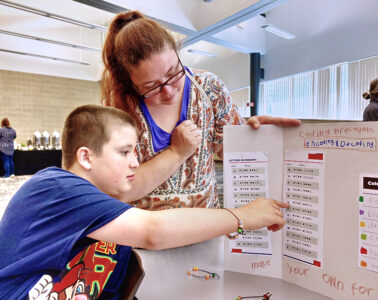
Make no mistake, however, in realizing that his project also was among those that were highlighted during a two-hour Showcase Day event Thursday morning in Youngstown State University's Beeghly Hall.
The gathering was the culmination of efforts about 15 sixth grade students on the autism spectrum from Potential Development and the Rich Center for Autism made throughout this school year to design projects that featured basic computer coding skills. A pivotal part of the computer program gave the students a monthslong opportunity to develop such refined skills via hands-on activities driven by creative expression and technical acumen, but without the use of a computer, Abdu Arslanyilmaz, YSU's director of the School of Computer Science and Information Technology, noted.
In addition, the program, which also was intended to celebrate the students' work, innovation and creativity, was a partnership between the university and the National Science Foundation, he said.
"I came up with this myself," Gunnar said, adding that he would like to see his project on Nintendo, Xbox or Sony PlayStation systems.
"This could be a sneak peak to Chapter 3," he continued.
"He was very anti-social, but Potential has a lot of projects and outings," William Schwentker of Warren said about his sixth grade son, Jaxson, and the help he feels the school has provided Jaxson.
For his part, Jaxson, who was diagnosed with autism at 3 or 4 and is learning to use words, had six colored bracelets with zeros and ones for his project. Each number represented an on or off pattern, and the specific codes to each of the six bracelets spelled one letter of Jaxson's name, given the outlay he devised, his mother, Valerie Schwentker, said.
No deciphering was necessary, though, to understand some things that give their son a great deal of pleasure.
"He comes home all the time and tells us how he likes coding and bowling," William Schwentker said, adding that Jaxson also is part of his school's special bowling team.
Playing soccer may be the next item on Jaxson's interest list, his father continued.
Mollie Grobosky, Potential Development's education assistant, said the students have worked diligently for nearly the entire school year learning then applying the concepts of computer coding while using hands-on concepts that included building structures to see how much weight they can hold, for example, she noted.
"It was a slow process, but it could potentially open up doors for them to learn different things," Grobosky said.
In addition, some of the students collaborated in small groups to share ideas with one another while others worked independently. A long-term benefit likely will be allowing the sixth graders to further develop social skills, she added.
In the bigger picture, Thursday's Showcase Day represented basic concepts such as learning a variety of computer patterns and algorithms, and is part of a two-year process that will become more challenging and complex for the students who opt to stay, Arslanyilmaz said.
The second year will revolve around teaching the students actual coding skills for them to assemble a program with more complicated variables and concepts. The final year will entail integrating coding into creating a robot, he added.