Yost highlights Fife killing in report
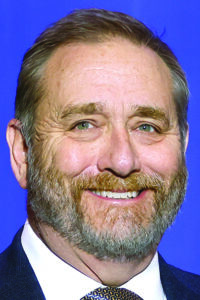
Republican Ohio Attorney General Dave Yost speaks during an election night watch party Tuesday, Nov. 8, 2022, in Columbus, Ohio. (AP Photo/Jay LaPrete)
WARREN — “This book (annual report) exists because monsters exist. Unfortunately, Ohio is protecting them.”
These jarring words were penned by Ohio Attorney General Dave Yost as he began his Capital Crimes Executive Summary that was released Wednesday. Yost, who for a brief while in 2025 ran as a Republican “tough on crime” candidate for governor, has long advocated for an effective death penalty in Ohio.
Yost campaigned that an effective enforcement of Ohio’s death penalty is needed, including the resuming of executions in the state.
Trumbull County Prosecutor Dennis Watkins talked to Miriam Fife on Thursday — the day after Yost released his report — and they both thanked Yost for his efforts to uphold death penalty convictions and sentences in Ohio, including the Danny Lee Hill case, during his nearly eight years in office.
Both Watkins and Fife agree that Ohio’s legal system is as good as other states that are carrying out executions at record levels in this country. They agree with Yost that none of Ohio’s 56 executions, including three men from Trumbull County — carried out in the state since 1999 and approved by governors of both political parties — involved innocent people.
Watkins and Fife said these bogus claims must stop. Ohio needs to enforce the death penalty statutes, just like neighboring Indiana, which resumed executions after a 15-year pause, and nearly a dozen other states. They believe that a cadre of dedicated politicians and antideath penalty groups from both political parties in Ohio are obstructing enforcement of the death penalty with meritless litigation and new laws to wear down victims and the public.
Watkins and Fife both strongly believe that Ohio’s death penalty opponents have a “Rope-a-dope” legal strategy to exhaust and wear down victims, police agencies, prosecutors, courts and citizens in order to tire them out and quit.
“We will never stop fighting for justice for Raymond Fife. Our journey doesn’t end until justice is done,” Watkins said.
The lead story in Yost’s executive summary began on a Tuesday afternoon in September 1985 in Warren and featured a 12-year-old boy riding his maroon bike on his way to a Boy Scout meeting.
“This boy had a life that was, by all accounts, typical. He was the youngest in a loving family… he enjoyed playing baseball and attending camps during summer break. He had just started junior high…” Yost wrote.
That boy, Raymond Fife, never made it to his Boy Scot troop meeting. To quote Yost: “His two killers beat, raped, stripped and strangled him with his own clothing. He was sodomized repeatedly with a piece of wood and with such force that it ruptured his bladder. Bite marks covered his body, one of which was so severe that it helped identify one of the killers.”
The bite marks belonged to Danny Lee Hill, who was sentenced to death in 1986. The other killer, Timothy Anthony Combs, in Yost’s words “was able to evade the death penalty because he was a few months shy of his 18th birthday at the time of Raymond’s murder.” Combs died in prison in 2018, while Hill is continuing his legal battles to stay out of Ohio’s death chamber.
“Our system is so broken that the man not sentenced to death died in prison before the one who was sentenced to be executed,” Yost stated. “This March marked 40 years since Mr. Hill was sentenced to be executed for his brutal attack on an innocent, defenseless boy.”
For the worst-of-the-worst killers, Yost stated “Ohio is wandering in a wilderness of lawlessness and desert of justice.”
At this point, Yost wrote, “We as a state bear responsibility for the horrors these families endured.”
Raymond’s mother, Miriam Fife, is still alive at age 85 and is almost blind. His father died in 2006. Raymond’s siblings are grown; they have adult children of their own and now grandchildren.
“They want to see justice for Raymond,” Yost wrote. “It took 36 years for the state to set Mr. Hill’s execution date, and even that long-awaited justice was denied.”
In 2025, Gov. Mike DeWine pushed back Hill’s execution date from July 2026 to sometime in 2029.
“Tragically, the never-ending delay of punishment in Mr. Hill’s case is not uncommon,” Yost stated. “That is the one, essential truth of this annual Capital Crimes report.”
Yost was sad to state that in the eight years he has issued these reports “not a single death sentence has been carried out — a mockery of the justice system and of the dead and their families.”
Ohio has 113 people with active death sentences. The average wait time on Death Row in Ohio exceeds 22 years and “that time gap continues to grow every year,” Yost wrote.
Of the 337 individuals to receive a death sentence since the passage of Ohio’s present death-penalty law in 1981, only 56 have been executed. During this same time period, 41 have died either of natural causes or suicide while waiting on death row. No additional people were added to death row in 2025.
Nine death row inmates have no further appeal, yet they do not have execution dates. Stanley Adams of Trumbull County, who was convicted of killing three people, also has exhausted all appeals and his death sentence is scheduled to be carried out on Feb. 16, 2028, after it was previously set for Feb. 19, 2025. This delay was because of the state’s ongoing issues with sourcing lethal injection drugs.
Yost also wrote in his report that Ohio has the fifth-largest death row population of all states that have the death penalty and each capital case costs between $116 million to $348 million.
Hill, meanwhile, has filed more than 30 appeals in his four decades on death row. His latest is hung up in the court system, bouncing back and forth between federal and state justices.
“There is no question of his guilt; only whether he should face the punishment handed down to him,” Yost states. “Instead of the conclusion promised, our capital punishment system forces communities to endure endless litigation. These decades of delays and uncertainties mean loved ones and juries never receive closure.”
Yost concludes his report by stating pathways do exist for Ohio to fulfill the justice it promised. In January 2025, President Donald Trump issued an executive order to restore the federal death penalty and secure states’ access to lethal-injection drugs. Also, Yost adds that alternatives to lethal injections do exist and are worth pursuing. Ohio lawmakers are considering nitrogen hypoxia as an alternative method of execution, which Yost fully supports. Alabama, for one example, has already used this nitrogen hypoxia method in some of its executions.
“Those on death row (like Danny Lee Hill) have had more than their fair share of due process — and second and third helpings of overdue process. It is past time that we do right by the victims and punish the monsters who killed them.”
Local News

Cockeye Creamery picks Gateways for new flavor

Strategizing continues in case of man who refused to testify at murder trial
Crash data reveal work-zone dangers
More than $137 million in construction work is about to get underway in Trumbull and Mahoning counties. Along with ...
Yost highlights Fife killing in report
Property transfers for April 4
Property transfers recorded March 23 to 27 in Mahoning County and portions of Trumbull County: Austintown ...