Students end emotional Sojourn
Final stops at Little Rock high, MLK Jr. assassination site
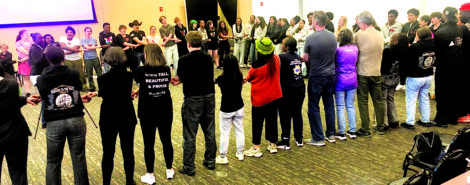
Sojourn to the Past participants gather for a closing activity, in which they sing “We Shall Overcome,” on Wednesday at the Lorraine Motel and civil rights museum in Memphis, Tennessee. Fifteen Youngstown area students and adults returned home Thursday morning from the eight-day journey to civil rights sites in the South.
LITTLE ROCK, Ark. — A civil rights icon has provided a seed for Akilah Heflin’s desire to create a safe space for fellow students — a seed that shows all signs of healthful growth and sustainability.
“Even though she was scared, she persevered and pushed through to the end,” Heflin, a Chaney High School sophomore, said.
The “she” to whom Heflin was referring was Elizabeth Eckford, 84, one of nine black students who, in September 1957, integrated the all-white, 4-square-block Central High School and paid a heavy price for wanting to receive a better education to prepare for college.
An iconic black-and-white image by Will Counts shows an angry mob behind the 15-year-old Eckford in a white dress and sunglasses holding textbooks. The photograph also captured Hazel Bryan with her mouth open widely and screaming at Eckford. Years later, Bryan apologized to Eckford, and, for a time, the two were friends.
Thanks largely to Eckford, who spoke Wednesday in the school library to her and others on an eight-day Sojourn to the Past journey to key civil rights sites in four Southern states, Heflin was inspired to create in her school a safe zone where other students would be able to freely express their feelings anonymously if they wished without being ridiculed or judged. In addition, Heflin researched studies showing that when students have opportunities to process their emotions, they tend to improve their grades, she noted.
On Sept. 4, 1957, Eckford arrived at the huge school and was met by guardsmen armed with bayonets who prevented her from passing through several entrances. After that, many in a vicious white mob spit on her new dress — which she never wore again — called her racial epithets and threatened to drag her to a nearby tree to hang her.
At one point, Eckford sought refuge in a drugstore across the street from Central High, only to have the owner lock her out before she sat at a bus stop, where three reporters formed a human shield to protect her.
Nearly 70 years later, Eckford, who still lives in Little Rock, has post-traumatic stress disorder in which she is prone to flashbacks from loud, sudden noises. Consequently, the Sojourn to the Past participants were asked to refrain from applauding her.
During her presentation to the 15 Youngstown area students and adults, as well as others from California and Oregon, Eckford recalled that during the traumatic experience, she noticed a white woman “with a kind face,” who, instead of helping the teen, spit on her.
Eckford, for whom it took more than 40 years to share her trauma, spent much of her talk focused on the violent nature of racist, derogatory language, especially as it applies to black people using it against other blacks.
“What you are showing if you’re African American, you’re showing other people you have racist self-hatred,” she said. “Stop hating yourselves.”
Eckford also alluded to the story of Horatio Alger Jr., a highly influential 19th century writer who was best known for his young adult novels and poetry that focused on impoverished boys who rose from difficult backgrounds to middle-class comfort, prominence and security through their good works, strong work ethics and honesty. Perhaps his most famous works were “Ragged Dick,” “Luck and Pluck” and the “Tattered Tom” series.
A portion of her presentation also looked at the corrosive and long-term damaging effects of bullying – which sometimes results in suicide — she and the other eight black students experienced soon after they were admitted to the school. Further contributing to the nine students’ trauma was that school officials, including Principal Jess Mathews, refused to take action unless a teacher bore witness to such an incident.
It’s essential to reach out with a kind word or other signs of support to someone being bullied without directly confronting the bully, Eckford told the group.
“You can help them live another day,” she said.
The Sojourn to the Past participants also spent time at a memorial that contains statues of the Little Rock Nine that are in the shadow of the state capitol building, near each of which is a quote from the nine students. Eckford’s reads, “If we have honestly acknowledged our painful but shared past, then we can have reconciliation.”
The nine bronze sculptures face different directions to symbolize that while in the school, the nine black students often had to be extra vigilant and continually look out for themselves, Eckford explained.
ON TO MEMPHIS
Heflin’s and the other Sojourn to the Past participants’ final stop before the local students and adults returned home Thursday morning was the Lorraine Motel, which is a civil rights museum that features a number of exhibits, including a re-creation of Room 306, where Dr. Martin Luther King Jr. stayed the night before his assassination April 4, 1968. The room was redesigned to look as it had when he was there.
Visitors can look out a window in a quiet space next to the closed-off room to see the spot on the balcony where he was felled by a single 30-6 bullet fired from a rooming house on nearby Mulberry Street across from a courtyard and gathering space. They also hear the song “Precious Lord, Take My Hand,” by gospel singer Mahalia Jackson, which was King’s favorite spiritual.
In addition, their time at the site included a lesson about the two-month sanitation workers strike in which an estimated 1,300 men walked off the job in early February 1968 largely because the newly-elected Mayor Henry Loeb refused to recognize and negotiate with their union, the American Federal, State, County and Municipal Employees Local 1733, for better working conditions.
The men, most of whom had been farmhands, made about $1.60 per hour, had no sick days, safety provisions or pensions and were not paid for overtime. Despite working full time, many of them still qualified for government assistance.
On Feb. 1, 1968, two garbage workers, Echol Cole and Robert Walker, were crushed to death when their truck malfunctioned.
Many of the men who peacefully marched along Beale Street carried signs that read “I Am a Man,” symbolizing their desire to be treated with dignity and respect.
At the same time, King was organizing the Poor People’s Campaign that was to begin in Marks, Mississippi, and have participants march about 900 miles to the National Mall in Washington, D.C., to set up encampments, known as Resurrection City, to confront the government about the plight of the country’s poor blacks, Appalachian and other whites, Native Americans, Asians and Latinos. Despite having been advised not to travel to Memphis because of death threats against him, King felt he had to advocate for the striking sanitation workers because they epitomized those whom he was trying to help in the campaign.
King came to the city March 28, 1968, to lead a peaceful demonstration on behalf of the workers, but violence marred the action when some blacks began breaking storefront windows and looting, and a 16-year-old teen named Larry Payne was killed. It was revealed later that FBI director J. Edgar Hoover, whose animus toward King was well documented, worked diligently to discredit him. In this case, the blacks who committed the violence were on the FBI payroll to disrupt the march and try to demonstrate that King had lost the ability to lead a nonviolent demonstration.
Proving that he had to lead a nonviolent protest, King returned to the city April 3, 1968, the evening on which he gave his “I’ve Been to the Mountaintop” speech, the last one of his life. The following day, he was assassinated.
On April 16, 1968, the strike was settled when city officials agreed to give the workers raises of at least 10 cents per hour, promotions for good work, a set of grievance procedures, city-issued uniforms, union recognition and a promise to end job discrimination. Nevertheless, the workers were denied pensions, something that was not resolved until at least 40 years later, according to the museum.
“If you stand up straight, people can’t ride your back, and that’s what we did – we stood up straight,” Taylor Rogers, a former sanitation worker who was Local 1733’s president from 1972 to 1992, said.
Additional exhibits Heflin and the others viewed included the famous Feb. 1, 1960, lunch counter sit-in at an F.W. Woolworth Co. lunch counter in Greensboro, North Carolina, along with one of the Rock Hill Nine, also known as the Friendship Nine, in which nine black students from Friendship Junior College in Rock Hill, South Carolina, sat peacefully at a McCrory’s Five-and-Dime lunch counter for a second time on Jan. 31, 1961, but were again denied service. The students became the first civil rights protesters to serve jail time after having been arrested for refusing to leave a lunch counter.
They adopted a new “jail, no bail” strategy, choosing to be incarcerated instead of paying money to what they saw as an unfair legal system. The students’ action also was a template that the May 1961 Freedom Riders adopted.
The Sojourn to the Past journey ended Wednesday afternoon with the local students and adults, as well as the rest of the group, assembled in a conference room at the museum, where they joined hands to sing “We Shall Overcome,” the mantra of the civil rights movement. Afterward, each of them was given a small rock on which was inscribed the Mahatma Gandhi quote, “Be the change you wish to see in the world.”
Local News

Cockeye Creamery picks Gateways for new flavor

Strategizing continues in case of man who refused to testify at murder trial
Crash data reveal work-zone dangers
More than $137 million in construction work is about to get underway in Trumbull and Mahoning counties. Along with ...
Yost highlights Fife killing in report
Property transfers for April 4
Property transfers recorded March 23 to 27 in Mahoning County and portions of Trumbull County: Austintown ...