

Sojourn students mourn lives lost too soon
Trip visits location of 1963 church bombing
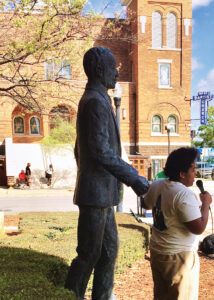
Correspondent photo / Sean Barron Marcus Bailey, a Chaney High School student, touches the hand of the statue of the Rev. Fred L. Shuttlesworth in Birmingham, Alabama, during a civil rights lesson Friday. Marcus and 14 other Youngstown students and adults joined others on an eight-day Sojourn to the Past journey to civil rights sites in the South.
BIRMINGHAM, Ala. — For Marcus Bailey, the similarities between the untimely death of a relative and the killing of four civil rights martyrs were uncanny.
“I thought of him and how much he did when he was alive. He will be remembered for the good he did,” Bailey, a Chaney High School sophomore, said.
The teenager was referring to his late uncle, Xavier Weaver of Youngstown, who died last year. He was 17.
His uncle’s early death — but, more importantly, the good he did for his school and community — parallels the plight of Addie Mae Collins, Denise McNair, Carole Robertson and Cynthia Wesley, the four girls who were killed in the Sept. 15, 1963, terrorist bombing of the 16th Street Baptist Church. The girls were ages 11 and 14.
Perhaps eliciting the parallel for Bailey was having been in the church Saturday as part of an eight-day Sojourn to the Past journey he and 14 other Youngstown students and adults have embarked, from which they will return Thursday.
Also part of the immersive traveling American history bus tour to key civil rights sites in four Southern states are groups from the San Francisco Bay Area and Portland, Oregon.
The program and educational opportunity seeks to fight racism, sexism, bigotry, hatred and intolerance while promoting critical-thinking skills, greater tolerance and acceptance of others, using the lessons from the civil rights era in the 1950s and 1960s as a guiding force. Participants are then challenged to incorporate those lessons into their lives and do their parts to work for greater fairness, equity and social justice.
While in the iconic church, the groups heard presentations from Lisa McNair and Kim McNair Brock, sisters of Denise McNair, and Sarah Collins Rudolph, one of Addie Mae Collins’ sisters, who was blinded in the bombing.
Creating a heavy pall of sadness for Bailey was thinking of his uncle, as well as the fact that the four girls’ bodies were found in a basement restroom stacked on top of one another. A piece of concrete was embedded in Denise McNair’s skull.
“He will be remembered for the good he did,” Bailey said about his uncle.
In her presentation, Lisa McNair, author of “Dear Denise: The Sister I Never Knew,” showed snapshots of her lost sister and painted her as someone who loved to help others. One day, Denise McNair had a fundraiser in her yard to raise money to fight muscular dystrophy. Another time, members of a small friends club rejected a girl from joining, and Denise encouraged them to let her in, Lisa McNair said.
Denise McNair was killed about a year before her sister was born.
McNair, who described her sister as “a leader and champion of the underdog,” also discussed her late parents, Christopher and Maxine McNair, both of whom were prominently featured in the 1997 Spike Lee film “4 Little Girls.”
McNair began his political career in 1973 as one of first black members of the Alabama House of Representatives since Reconstruction, where he served two terms, including one as chairman of the Jefferson County delegation. Beginning in 1986, he served 15 years on the Jefferson County Commission.
Despite their tragic loss, the McNairs were determined not to allow hatred and bitterness to consume them.
“Hatred only hurts the hater,” Christopher McNair was fond of telling many Sojourn to the Past groups he and his wife met over the years.
“This happened long ago, but given the political climate today, this could easily happen again. We have to know our past,” McNair Brock, a professional chef who opened a business called Bitty’s Little Kitchen, said.
In her presentation, she took more of a clinical approach toward dealing with trauma, telling the adults and students in the church that it’s vital people share their grief and difficulties with trusted others.
Shortly after the bombing, no one received counseling, and most children were back in school the following day, McNair Brock added.
Collins Rudolph remembered, at age 12, going to the church basement to freshen up for the choir and the day’s sermon, “The Love that Forgives,” just before the explosion at 10:22 that morning.
“All I could do was yell, ‘Jesus! Addie, Addie, Addie,’ but she did not answer,” Collins Rudolph said, adding that she was told at the hospital that Addie Mae Collins had merely injured her back before their mother told her the tragic truth.
For years, she dealt with a chronic nervous condition before turning to religion and beginning the healing process in 1984, said Collins Rudolph, who penned the book, “The Fifth Little Girl.”
She described Addie Mae Collins as a kind and talented girl, saying that had she lived, she might have become an artist.
Also during her talk, Collins Rudolph lamented that all of these years later, a few things are still missing.
“We didn’t get any counseling, any help or any restitution for what happened,” she said, adding that it’s imperative the students exercise their right to vote.
Also during their Birmingham visit, the group heard a presentation from the Rev. Gwendolyn Webb, who was among the more than 4,000 young people who were arrested during the May 1963 Children’s Crusade to desegregate the city.
Ironically, in 1975, Webb joined the Birmingham Police Department, becoming the second black woman hired in the department. During her career, Webb handled fraudulent financial activities and, in 1979, was assigned to the jail before serving as a team investigator for James K. Baker, the city attorney.
Starting in the early 1980s, Webb served as a security staff member for then-Mayor Richard Arrington.
Also, Webb married the late Lt. William Webb, a white officer with the police department.
Later, the longtime civil rights activist worked as a code enforcement officer for the Birmingham Public Works Department, helped establish the Birmingham Civil Rights Museum and the city’s Black Radio Museum.
In addition, she was shown in the 2004 documentary “Mighty Times: The Children’s March,” which won an Academy Award for Best Documentary.
During her presentation to the Sojourn to the Past students and adults, she encouraged them to recognize their potential to be change agents for social justice.
In another activity, Bailey and the others gathered around an outdoor statue of the Rev. Fred L. Shuttlesworth, a firebrand Baptist minister who was a key player in the city’s integration efforts, and who battled frequently with Eugene “Bull” Connor, the city’s racist public safety director who ordered the attack in nearby Kelly Ingram Park of marchers with fire hoses and German shepherds.
Shuttlesworth, who began in 1953 as pastor of Bethel Baptist Church in nearby Collegeville, was a staunch believer in the philosophy of nonviolence, despite 10 documented attempts on his life, including one in which 16 sticks of dynamite exploded in a narrow space between his home and church, yet left him with no injuries.
In 1957, Shuttlesworth co-founded the Southern Christian Leadership Conference, and founded the Alabama Christian Movement for Human Rights after Alabama officials outlawed the NAACP from operating in the state.
He met many Sojourn to the Past groups before his death in October 2011 at age 89.
While assembled around the statue, the adults and students were asked what they intend to do in their lives and communities to continue Shuttlesworth’s legacy of nonviolence and social activism.
Local News
County leaders tell election board: Find your own home
YOUNGSTOWN — In the ongoing saga over a new home for the Mahoning County Board of Elections, county commissioners ...
Cousins of state Dem leader quit committee races
YOUNGSTOWN — Two cousins of Ohio Democratic Chairwoman Kathleen Clyde withdrew as candidates for the party’s ...

CityScape celebrates community
Man wanted in ’24 murder arrested in Columbus
YOUNGSTOWN —The U.S. Marshals Service arrested Eddie L. Winphrie, 42, late Monday in Columbus on aggravated ...
3 girls arrested on felonies amid fights at WRTA station
ter YOUNGSTOWN — Youngstown police arrested three girls Monday afternoon following an altercation at the ...
Fired officer’s attorney defends ruling
YOUNGSTOWN — The attorney for Brian Flynn, fired as a Youngstown police lieutenant in December 2022, argued to ...