Sojourn students study horrors of slavery, Jim Crow
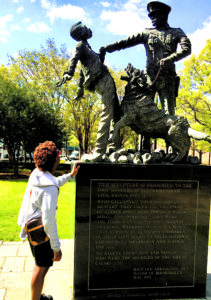
Correspondent photo / Sean Barron C.J. Hall, a sophomore who is home-schooled, looks at a statue Friday of a dog attacking a black child in Birmingham, Alabama, site of the May 1963 Children’s Crusade. He is among those on the Sojourn to the Past journey to major civil rights sites in four southern states.
MONTGOMERY, Ala. — It stabs at La’Rayah Hodges’ heart to think that a significant period of American history sanctioned stripping millions of black people of their humanity and dignity.
“I was thinking about how cruel it was selling these people like they were objects,” Hodges, an East High School sophomore, said. “It’s very hurtful to think about.”
Those she referred to were the millions of enslaved people who she learned about after having visited the Legacy Museum: From Enslavement to Mass Incarceration on Thursday, which was one of the stops on an eight-day Sojourn to the Past journey she and 14 other Youngstown high school students and adults embarked on last week.
She also was taken aback by the number of documented lynchings that have occurred in the U.S. dating to the late1800s.
Specifically, an estimated 4,400 such crimes occurred between 1877 and 1950. Of those, about 641 took place in Mississippi alone, Hodges observed.
“It was just cruel that a lot of people were killed, probably for the littlest reasons ever, like for talking back or speaking up.”
The 47,000-square-foot museum, which opened April 26, 2018, was built on the site of a former cotton warehouse where forced enslaved black labor there was among the backbreaking work that contributed to much of the nation’s wealth.
The space, which the Equal Justice Initiative founded, operates on a premise that racial healing and reconciliation can begin and continue when the nation’s painful past is acknowledged and the truth about it is told.
Confronting visitors is a haunting, low-pitch moaning sound as they see a three-dimensional moving image of choppy water, symbolic of the Atlantic Ocean where an estimated 2 million of the 12 million slaves who were brought from Africa to primarily American East Coast ports perished. Many of the enslaved men, women and children came from west African countries such as Borneo, Sierra Leone, Senegal and the Ivory Coast, and faced barbaric torture and, in many cases, were separated forever from their families.
Also displayed early on the tour are concrete molds of black children and adults’ heads on which are faces bearing great pain and agony.
Many burgeoning East Coast urban areas such as New York City, Baltimore and Boston benefited from slave labor. In Manhattan, for example, enslaved workers cleared and cut the road that became Broadway, and built the wall for which Wall Street was named.
In 1808, Congress outlawed the Transatlantic Slave Trade, but for about 50 years afterward, the Domestic Slave Trade flourished as about 1 million blacks were forced to move to the South, which transformed that part of the country from 1810 to 1860.
The prevailing justification and anchor for about two centuries of slavery was the narrative of establishing a racial hierarchy predicated on the false notion of black inferiority — something that endures into the 21st century — many historians have said.
The museum also has numerous black-and-white photographs of lynchings, along with tragic narrations of victims.
One of them was Thomas Moss’ last words before he was lynched in 1892 in Memphis, Tennessee: “Tell my people to go west. There is no justice for them here.”
Hodges and other students spent time reading ads describing the merits of slaves to be bought or sold that were posted in 1854 in the Montgomery Gazette. One of them read, “Ben – a strong and hearty man, about 30 years old, an excellent field hand and a remarkably handy boy in any use, being unusually quick and intelligent; a No. 1 Negro.”
“I never knew about these auctions until I saw the signs and posters,” she said.
In addition, the museum is home to about 800 jars of dirt, each of which marked the location of a lynching. In November 2019, Mahoning Valley Sojourn to the Past members collected one of them from where William Taylor had been murdered in 1878 near Sandusky.
According to the museum, many lynchings and other acts of racial violence against blacks became public spectacles that took on a carnival-like atmosphere. At some of them, politicians made speeches beforehand, food was served to spectators and in some cases, the crimes were captured on postcards that were sold for 25 cents apiece.
Even newspapers’ lead stories included headlines such as “Lynched because he didn’t say, ‘Mr.'” and “Mob howls in delight as he dies.”
In roughly 99% of the known lynchings, no one was held accountable, according to the museum.
Another exhibit examines the 12-year period of Reconstruction between 1865 and 1877 in which many newly emancipated blacks were absorbed into the fabric of American labor, political and social life, and they had greater rights. According to the exhibit, an estimated 2,000 blacks served in elected office, 16 of them held seats in Congress and more than 600 were elected to state legislatures.
In addition, hundreds more held offices across the South.
Nevertheless, the late 1800s marked the start of the Jim Crow era in which racist laws and customs that codified white supremacy circumvented the 14th and 15th Amendments by making it difficult for many blacks to register to vote. Enforcing the laws was the ubiquitous white power structure that included everyone from local police departments to governors to state Supreme Court members.
Thomas B. Perry, who served as a Mississippi Supreme Court justice, said, “You can dress a chimpanzee, housebreak him and teach him to use a knife and fork, but it will take countless generations of evolution development, if ever, before you can convince him that a caterpillar or a cockroach is not a delicacy.
“Likewise, the social, political, economic and religious preferences of the Negro remain close to the caterpillar and the cockroach.”
During their time in the Legacy Museum, Hodges and others also bore witness to examples of a powerful instrument used to prevent many blacks from registering to vote: the literacy test. One question that appeared on many of them asked blacks who visited the registrar’s office how many jelly beans were in a jar in front of them. Incorrect answers meant they were turned away.
The mass incarceration exhibits looked at the so-called “super predator” myth that permeated much political and sociological discourse in the 1990s. Many criminologists expounded on the argument — discredited about 20 years later — that some black children and juveniles are naturally and inherently violent and remorseless, and need to be treated more harshly.
The narrative resulted in inordinately long sentences for many black offenders and draconian “tough on crime” and “three strikes” policies.
For her part, Hodges said the Sojourn to the Past experience is helping to change her in how she views herself. Soon after arriving home Thursday, she hopes to educate her peers about the knowledge she gleaned on the immersive traveling shared American history experience through the South, as well as embracing what she has learned — much of which is scantily taught in many curriculums, if at all.
Local News
Large crowds join No Kings rallies in Youngstown, Warren
Sojourn students study horrors of slavery, Jim Crow
Pinwheel event plants awareness for child abuse
CANFIELD — The 21st annual Pinwheels for Prevention will take place 9 a.m. Thursday at Avion on the Water Banquet ...
Traffic signal projects coming to Trumbull in 2027
WARREN — The Trumbull County Engineer’s Office, in cooperation with the Ohio Department of Transportation, ...
Library program travels back to the Great Railroad Strike of 1877