

Sojourn students head south
8-day trip provides immersive experience at civil rights sites
MONTGOMERY, Ala. — From a historical perspective, Jon Luke Robles finds it rather challenging to compare the appearance of a history-rich southern city today with how it looked six decades ago.
“It’s just the sheer concept of where we are and the historical events that happened here,” Robles, a Cardinal Mooney freshman, said.
Specifically, it was tough for him to imagine a peaceful and serene Dexter Avenue near the state capital against a historic backdrop it provided of 50,000 peaceful marchers advancing toward the capital, which marked the end of the five-day, 54-mile Selma-to-Montgomery march for voting rights March 21 to 25, 1965.
Robles and 10 Youngstown City School students, along with several adults, left Tuesday for an eight-day Sojourn to the Past immersive traveling history experience and journey by bus to key civil rights sites in four states. They also will meet several activists who nonviolently fought during that time for social justice, voting rights and equality.
The mental juxtaposition also elicited additional feelings in him.
“It felt fulfilling and important in continuing what was started” in the efforts to secure social justice, said Robles, who also began playing the upright bass at age 11. “I hope to take away the values and objectives at the state of the civil rights movement in the 1960s and learn their goals and continue them.”
The group began their journey at the Freedom Riders Museum in downtown Montgomery, which is in the city’s former Greyhound bus station where, in May 1961, groups of peaceful, integrated volunteers challenged segregation on interstate transit. It also is one location where angry white mobs attacked many of the Freedom Riders.
The museum opened May 20, 2011, 50 years to the day after the riders arrived in the city., Also in 2011, the Greyhound station was added to the National Register of Historic Places.
From early May to December 1961, more than 400 Freedom Riders representing 34 states and four countries attempted to travel through the South in interracial groups to test the veracity of the 1960 Boynton v. Virginia U.S. Supreme Court ruling that outlawed segregation in bus terminals’ waiting areas and restrooms, and supported riders’ rights to disregard local segregation ordinances. The Congress of Racial Equality, a major civil rights organization, sponsored the rides that began in Washington, D.C., and were to continue to New Orleans. Nevertheless, hundreds of the nonviolent activists were arrested in Jackson, Mississippi, as per Gov. Ross Barnett’s orders, and sent to Parchman Penitentiary, where some of them were housed on the infamous prison’s Death Row as an intimidation tactic.
The farther south they traveled, the greater the danger they faced. Along the way, they were beaten or arrested in Rock Hill and Winnsboro, South Carolina, as well as in Birmingham, Montgomery and Anniston, Alabama.
On Sept. 22, 1961, the Interstate Commerce Commission issued a ruling requiring interstate bus lines to remove signage that enforced segregation, and it went into effect Nov. 1, 1961.
To test the ruling, activists engaged in further rides, including one CORE sponsored July 13 to 24, 1961, through parts of the mid-South, from Newark, New Jersey, to Little Rock, Arkansas.
The Sojourn to the Past group’s next stop was Troy University’s Rosa L. Parks Museum, which serves as a memorial to Parks’ life and legacy, along with the lessons gleaned from the 13-month Montgomery Bus Boycott.
Among the museum’s features are the original fingerprint record of when Parks was arrested for refusing to relinquish her seat to a white man, a replica of a 1955-era city bus and a makeshift 1956 station wagon, the likes of which were often used as part of an extensive carpooling system for those who refused to ride the buses to work and elsewhere.
The main attraction in the museum’s children’s wing is the Cleveland Avenue Time Machine, named after the bus Parks rode during her arrest Dec. 1, 1955. The vehicle is a showcase for interactive teaching exhibits that allow visitors to go back in time to learn about Homer Plessy, Dred Scott and Harriet Tubman and their fights against the Jim Crow system before the bus boycott.
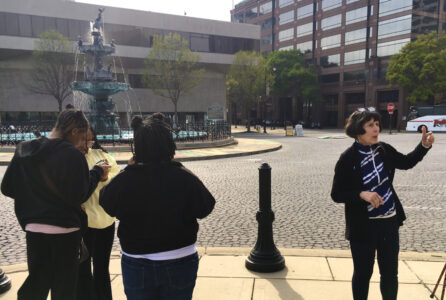
After visiting the two museums, Penny Wells, Mahoning Valley Sojourn to the Past’s executive director, took the students and adults on a walking tour along Dexter Avenue that began with where Parks boarded the bus, as well as the Court Square Fountain, a hub where slaves were routinely bought and sold. By 1860, the city had grown into one of the state’s most prominent slave-trading communities.
They also viewed the outside of Dexter Avenue King Memorial Baptist Church where Dr. Martin Luther King Jr. served as pastor from 1954 to 1960. During the bus boycott, he was selected to head the Montgomery Improvement Association, which guided the bus riding stoppage.
Their walk ended on the capitol steps, where Wells provided a lesson from “Walking with the Wind,” the 1999 best-selling memoir of the movement by civil rights icon and Georgia congressman John Lewis.
Also on the steps is a gold star that marks the spot where Jefferson Davis was sworn in as president of the Confederate States of America on Feb. 18, 1861.
Local News
U.S. House passes water package with two Joyce-sponsored bills
The U.S. House passed a major water quality legislative package that includes two bills sponsored by Congressman ...
Girard speed camera revenue down due to staffing shortage
GIRARD — The city’s revenue from its speed camera program is down $85,000 this year compared to this time in ...
Canfield trustees OK tractor purchase, get update from NOPEC
City board eyes changes to housing programs
YOUNGSTOWN — The city’s board of control will vote today on changes to three housing programs, funded through ...
Liberty man set for trial on two felonious assault charges
WARREN — A trial date of April 9 is set for Michael R. Derr, 33, of Mansell Drive in Liberty, on two counts of ...
Canfield trustees wrap up agreement with ABC Water District
CANFIELD TOWNSHIP — Trustees on Tuesday discussed the agreement with the ABC Water and Stormwater District ...