

Lynching victims memorialized
Area students visit civil rights sites
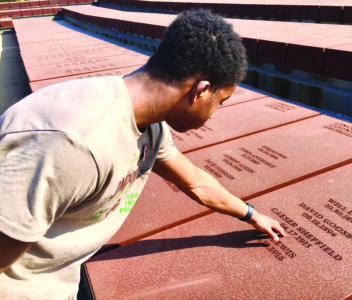
Josiah Moss, 15, of Sharon, Pa., honors his great-great grandfather, Caeser Sheffield, who was lynched April 17, 1915, in Lowndes County, Georgia. Josiah and other Youngstown-area high school students and adults visited the National Memorial for Peace and Justice on Wednesday in Montgomery, Alabama, as part of the Sojourn to the Past tour.
MONTGOMERY, Ala. — Josiah Moss stood still with a long look of contemplation on his face as he silently connected with a descendent he knew only from tragic stories about him.
“It just feels different having a relative per se being a part of this,” Josiah, 15, of Sharon, Pa., said.
Josiah, a Sharon High School sophomore, was referring to his paternal great-great grandfather, Caeser Sheffield, who was lynched April 17, 1915, in Lowndes County, Georgia.
Sheffield’s is among the names of more than 4,400 black people who were lynched between 1877 and 1950 in the U.S. and whose names are engraved on hundreds of corten steel monuments at the National Memorial for Peace and Justice, which is part of the Equal Justice Initiative. Each copper monument represents the name of a county and state where a racial terror lynching occurred and, in most cases, when.
The 6-acre site, on an incline that overlooks the state’s capital city, pays homage to those killed by racial violence, enslaved and humiliated by racial segregation.
The memorial also was among the stops Josiah, 15 Mahoning Valley students and adults, as well as additional participants from the San Francisco Bay Area and Portland, Oregon, made Wednesday on the second day of their Sojourn to the Past journey to major civil rights sites in four Southern states. The local students will return Thursday.
Josiah said his great-great grandfather was an architect by trade, and that he had been accused of stealing meat. In reality, though, Sheffield was murdered by someone who apparently wanted his house, Josiah theorized.
According to an April 17, 1915, article in the Atlanta Constitution, Sheffield was taken from his cell in the Lake Park jail at night, then fatally shot “by unknown parties.”
“Sheffield was arrested yesterday, charged with stealing meat from the smokehouse of Elder B. Herring and put in jail to await trial. The prison was forced open by unknown parties, and cries were heard from the Negro about 9 o’clock last night. … Sheffield’s body was found this morning in a field near the railroad station at Lake Park,” the article reads in part.
Fifteen blacks remembered at the memorial were known to have been lynched in Ohio, including William Taylor in 1878 near Sandusky. On Nov. 19, 2019, in an effort to honor him, members of Mahoning Valley Sojourn to the Past drove two hours to the site of where his body was found, then placed dirt from the location into a jar, which is now in the Legacy Museum across the street from the memorial. Afterward, the group hosted a celebration of Taylor’s life in a nearby park.
Also part of the Sojourn to the Past journey Wednesday was a visit to the civil rights memorial, a circular granite water table that architect Maya Lin designed and on which is inscribed the names of 41 civil rights martyrs whose lives were taken in the 1950s and 1960s. Among the more famous ones are Dr. Martin Luther King Jr., Emmett Till and Medgar Evers, who was the NAACP’s field secretary in Mississippi.
Nevertheless, Kaleb McQueen, 14, a Cardinal Mooney High School sophomore, connected with a lesser-known teenager only a few years older than him.
“It made me feel really sad, but happy for the memorial to commemorate their lives,” Kaleb said about the 41 men and women, adding that he found a connection with John Earl Reese, who was killed Oct. 23, 1955, in Longview, Texas. He was 16.
The day before his killing, Reese had been dancing with two cousins at a cafe in nearby Mayflower when two white men, Perry Dean Ross and Joe Simpson, fired nine shots from a passing vehicle, killing Reese and injuring the cousins.The killing was part of an effort to terrorize black residents into relinquishing plans to build a new school soon after the famous 1954 Brown v. Board of Education U.S. Supreme Court decision, according to the Zinn Education Project.
Ross was convicted of murder, but given only a five-year suspended sentence. Simpson was indicted, though the charge was dismissed.
Later, the Civil Rights and Restorative Justice Project renamed a street in Longview John Earl Reese Road.
Jeff Steinberg, Sojourn to the Past’s founder, creator and educator, asked the students and adults to quietly and slowly rotate around the memorial to not only connect with the names inscribed on it, but to make a commitment to do their part to nonviolently fight against racism and for equality.
Even though Reese’s is not a household name, Kaleb expressed happiness that he didn’t die in vain.
“At the memorial, I’m glad he was recognized and didn’t die to be forgotten,” Kaleb said.
The day for the group concluded with all of the participants holding hands to sing for the second time “We Shall Overcome,” often considered the song of the civil rights movement.
The names of the 40 martyrs and stories behind them also are in the nonprofit Southern Poverty Law Center Memorial Center, adjacent to the granite memorial.
The center states as its mission to honor the legacies of people who sacrificed their lives during the movement, as well as to appreciate the progress the nation has made since then regarding the quest for equity, and to consider the work that remains. It also envisions a world in which equality and justice are a reality for all.
On the walls of the space also are the names and narratives of people who were killed more recently than those in the civil rights struggles.Many of them have been considered hate crimes.
They include Khalid Jabara, 37, whom a neighbor shot to death Aug. 12, 2016, in an act of Islamophobic hate; Islan Nettles, a 21-year-old black transgender woman who died Aug. 22, 2013, five days after a man who had flirted with Nettles repeatedly punched her and left her brain dead in New York City after learning of Nettles’ sexual orientation; and U.S. Army 2nd Lt. Richard W. Collins III, who was stabbed to death May 20, 2017, as he and friends awaited an Uber around 3 a.m. on the University of Maryland College Park campus.
In 2021, Sean Urbanski, a University of Maryland senior, was convicted of murder and sentenced to life in prison.
Local News
Police blotters for Austintown, Boardman and Canfield for March 28
Austintown Police activity reported March 19-25: March 25, 10:30 a.m. — Buffalo Cartridge Company BRG-9 ...
Ohio court suspends law license of Poland attorney
The Ohio Supreme Court suspended the law license of Nick Graham of Poland, a former Warren city assistant ...
Judge awards $35K to ex-SOBE receiver
Regionalization talks continue
CHAMPION — Water representatives across the Mahoning Valley warned that regionalizing water would come at an ...
Ohio EPA awards $2.8M for water projects
Staff report The Ohio EPA is awarding more than $2.8 million to 122 public water systems in 58 counties to ...