Local prosecutors prevail when defense receives evidence late
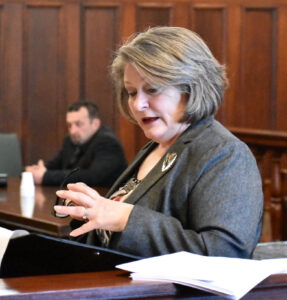
Staff file photo Mahoning County Prosecutor Lynn Maro cites reasons why evidence in the criminal case of Matthew Nicholson, 47, was turned over to the defense late.
YOUNGSTOWN — On Feb. 23, Mahoning County Common Pleas Court Judge Maureen Sweeney postponed the rape trial of Matthew Nicholson, 47, after his attorney, John Shultz, filed a motion asking for sanctions against the Mahoning County Prosecutor’s Office.
The request came after Schultz learned three days before Nicholson was about to go to trial that certain evidence had not been turned over to him.
Shultz argued in the motion that the failure to turn over large amounts of evidence despite repeated blanket requests was “so egregious” that dismissal of charges against Nicholson “would be warranted.” He also asked that “at the very least,” the trial be postponed to give him time to evaluate the new evidence.
Sweeney did postpone the trial. No new trial date is listed in court records. But a March 27 motions hearing is set, apparently to address the request for sanctions.
Prosecutors acknowledged in a March 2 response to Shultz’s motion that prosecutors were still providing a large video file to Shultz as late as the morning of Feb. 23.
Mahoning County Prosecutor Lynn Maro attended an unscheduled hearing before Sweeney on Feb. 23 to speak on the record about the issues that led to the postponement.
She said Assistant Mahoning County Prosecutor Melissa Dinsio had been preparing for Nicholson’s trial the previous week and contacted the Mahoning County Sheriff’s Office that Friday about something found on Nicholson’s property.
“At that time, Dinsio was told there were photographs that would provide assistance,” Maro said. “We did not have copies of photographs. We advised the sheriff’s office we did not.”
Maro said Dinsio immediately notified Shultz of the photos. When Dinsio got the photos, Dinsio “then said to the Sheriff’s Office ‘I want to see your entire file.'”
Maro said the prosecutor’s office had repeatedly asked the sheriff’s office for “everything the sheriff’s office had on this. And we believed we had everything. We then discovered three additional police reports” and then learned of text messages. Another large digital file was also provided by the sheriff’s office and in turn was provided to Shultz, Maro said.
Maro noted that since she took over as county prosecutor in January 2025, her office “implemented procedures to try to minimize this happening with untimely disclosures.” She said one step was not presenting cases to the county grand jury “until we have everything from the police. There is a checklist (law enforcement personnel) have to sign certifying they have given us everything.”
Maro said, “The Sheriff’s Office turned over everything they thought was relevant to this investigation. Items that were just disclosed on Friday and the (digital evidence) we just disclosed this morning, they did not believe was relevant to this investigation and these charges,” Maro said.
She called evidence “tangential issues,” such as “a dispute with a neighbor, ” Maro said. “(But) we have explained to them, ‘Everything means everything.'”
The prosecution response, authored by Dinsio and Maro, states that on Feb. 24, the day after the trial was postponed, Maro and Dinsio met with Maj. Jeff Allen of the sheriff’s office “and reviewed every page of his file.”
At that time, they found additional documents, “including another report and audio statements, had not been provided to the Prosecutor’s Office. Those items were copied and given to defense counsel that day,” the filing states.
On Feb. 23, Sweeney urged the prosecutor’s office to talk not only to the sheriff’s office but also all law enforcement agencies in the county to remind them that they should provide all of the evidence they have gathered in criminal cases to the prosecutor’s office without having to be asked for it.
The new filing states after the meeting with Allen, Maro had meetings with “various law enforcement departments in an attempt to ensure that there is not a similar situation in the future. She explained that ‘everything means everything,’ and that the Prosecutor’s Office needs everything in their files, regardless of whether they find something irrelevant.”
Law enforcement agencies must sign a checklist regarding all types of evidence that need to be provided before the prosecutor’s office will accept the materials, the filing adds.
As to Shultz’s suggestion that charges should be dismissed against Nicholson because of the late evidence in his case, Maro and Dinsio cited case law regarding turning over evidence late to the defense.
The filing cited a 2013 Ohio Supreme Court ruling that found a judge abused her discretion by dismissing charges against a defendant after the judge found that prosecutors unintentionally failed to turn over pertinent evidence.
The Supreme Court noted that the defendant in the 2013 case was free on bond and referenced a 1987 Supreme Court ruling stating that a judge should “inquire into the circumstances surrounding the violation, and it must impose the least severe sanction that is consistent with the purpose of the rules” surrounding evidence.
The Maro-Dinsio response stated that “Accordingly, a continuance of the trial in (the Nicholson) matter, rather than a more severe sanction, is appropriate.” It added that the failure to turn over all the evidence was “certainly not willful,” adding that prosecutors “supplemented” the evidence it turned over to Shultz “at least twice prior to the discovery” of the additional evidence.
It states that Maro has “taken affirmative measures to prevent a recurrence of (evidentiary) violations of this nature” and noted that Nicholson is free on bond rather than locked up while waiting for his trial.
PREVIOUS EVIDENTIARY DISPUTE
Issues related to late evidence erupted in Mahoning County in 2021 in the aggravated murder cases involving defendant Lavontae Knight after attorney Dave Betras complained about late evidence being turned over, prompting Mahoning County Common Pleas Court Judge John Durkin to postpone Knight’s trial and dismiss then-Assistant Mahoning County Prosecutor Dawn Cantalamessa from the case.
The Mahoning County prosecutor at that time was Paul Gains.
“To leave this conduct unchecked would undermine the integrity of our system of justice,” the judge said of Cantalamessa’s actions. “Achieving fair outcomes is perhaps the single most important function of criminal proceedings.”
Knight was later convicted in both murder cases involving 2018 homicides. He was sentenced to 58 years to life in one of the cases.
But the appeal in the case is currently before the Ohio Supreme Court for it to decide whether Durkin made the right decision in postponing the trial and removing Cantalamessa from the case or whether he should have done more to sanction the Mahoning County Prosecutor’s Office.
Oral arguments in the matter were heard in December with defense attorney Rhys Cartwright-Jones suggesting to the state’s top court that a better sanction might have been dismissal of the charges against Knight or the jury in the case being told that “DNA evidence had been withheld by the State and hidden for three years.”
STATEHOUSE NEWS INVESTIGATION
An organization called the Statehouse News Bureau, which is funded through the Broadcast Educational Media Commission and managed by Ideastream Public Media, published an investigative story in December 2023 focused on evidentiary issues in the criminal justice system in Ohio, especially Cuyahoga County.
It detailed the appeals of four people that resulted in reversals of the outcome of their trials on allegations that prosecutors withheld police reports, witness statements and other evidence that could have favored their defense.
In all four cases, the defendant was granted a new trial. Three of the four were in Cuyahoga County.
A Cuyahoga County Prosecutor’s Office spokeswoman said in no case did a prosecutor intentionally conceal evidence. She instead blamed high caseloads and a “staggering” volume of information for prosecutors’ failure to turn over evidence.
The report indicates that in 24 states, prosecutors must automatically turn over certain evidence to the defense. In 10 other states, including Ohio, prosecutors are required to divulge evidence “upon request.” Some counties do more than the law requires, the report states. Montgomery County (including Dayton) produces certain evidence without a defense request.
Local News
Man indicted on kidnapping, rape and repeat offender specifications
YOUNGSTOWN — Sanjuan V. Smith, 57, was indicted Thursday on kidnapping with a repeat violent offender ...
Youngstown detective fired over unbecoming conduct
120 Years Ago, 1906 transcribed as originally published in the Youngstown Vindicator: “Moyer adjudged guilty; ...
YPD SWEARS IN 11 OFFICERS
Youngstown to shovel out $272,000 for clearing snow
YOUNGSTOWN — City Council will consider Wednesday permitting the board of control to pay $272,000 to contractors ...
On the record for March 14: Trumbull Career Center, Weathersfield Township trustees
Trumbull County WHAT: Trumbull Career & Technical Center board of education meeting Thursday The ...