

Killing suspect in Youngstown found not guilty
City man acquitted of murder charge in 15-year-old's death
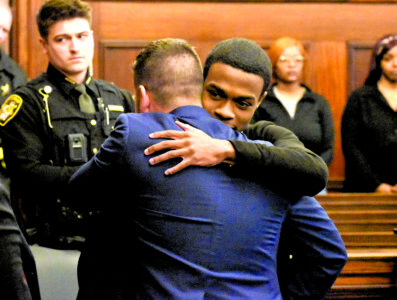
Staff photo / Ed Runyan Danyo Sellers, 19, hugs defense attorney Nick Cerni after a jury found Sellers not guilty Thursday of murder and the three other charges he faced in Mahoning County Common Pleas Court. Sellers was expected to be released from the Mahoning County jail as soon as Thursday. He was 16 when he was charged in the case.
YOUNGSTOWN — A jury found Danyo Sellers, 19, not guilty of murder and all three other charges Thursday at the end of a four-day trial in Mahoning County Common Pleas Court.
After almost three years locked up, Sellers was expected to be released from the Mahoning County jail as soon as Thursday. He was 16 when he was charged in the case.
Assistant Mahoning County Prosecutor John Juhasz said after the verdict he felt that the evidence was sufficient for a jury to convict Sellers of the April 15, 2023, murder of 15-year-old Amiya Monserrat outside of Martha’s Boulevard Tavern. Monserrat was with dozens of others at a birthday party for a 16-year-old girl at the time of the gunfire.
But jurors said they were not convinced Sellers was the person who fired a gun over the roof of a car and into the tavern parking lot, Juhasz said. The refusal of co-defendant Saun Peterson to testify, as he had earlier indicated he would, hampered the prosecution. Also hampering the prosecution was the refusal of witnesses at the tavern to provide testimony about the shooting and the tavern not having a working surveillance system.
Juhasz said Peterson, 23, had given a sworn statement as part of a plea agreement that Sellers “was the guy who shot” and that Peterson would testify against Sellers. But last week when the case went to trial the first time, Peterson refused to testify, and a mistrial was declared, causing the trial to be rescheduled for this week.
Two other people in the car did testify. They said Sellers was in the front passenger seat of Peterson’s Mercedes Benz, but they did not indicate that they saw Sellers with a gun or see him shooting it.
Juhasz said it’s too soon to know what effect Peterson’s refusal to testify will have on the prosecution’s recommendation for his sentence.
“He clearly breached his plea agreement,” Juhasz said.
During jury selection, opening statements and closing arguments, Juhasz made it a priority to tell jurors about the type of murder charge Sellers faced, called “felony murder.”
Juhasz told prospective jurors during jury selection Monday that felony murder is an offense in which a person might shoot a gun at someone, for instance, and someone is hit by a bullet. But the bullet may not have been the bullet the defendant fired.
“It may not have been the person you meant to hit. But as a result of what you did, things happen and … someone ends up dead,” Juhasz said.
Juhasz repeated that line of discussion during closing arguments Thursday. During his first closing argument he said, “This isn’t a murder case. It’s a felony murder case. It’s somebody who died as a result of (Sellers) committing another act,” which was a felonious assault for firing a gun toward a group of people.
Juhasz also brought it up the second time he spoke in closing arguments. But that time, he said it a little differently after defense attorney Aaron Meikle challenged the idea that the bullet that killed Amiya came from the Mercedes Benz.
Juhasz said Meikle’s comments were irrelevant. “It’s a felony murder case. Nobody is saying that a bullet from that car (that Sellers was allegedly in) caused her death because nobody can.”
Meikle said during his closing argument that there was no corroborating evidence for the theory that Sellers was hanging out of the car shooting into the parking lot, as Juhasz alleged.
“The detective spoke to numerous people at the party. Did you hear any corroborating evidence that someone was hanging out of a car shooting a firearm?” Meikle asked. “I’m pretty sure you would hear some corroborating evidence. Nothing corroborates the shooting the way (a brother and sister who testified) are describing it, the way the state has relied on (it) in bringing this case.”
Meikle said the evidence showed that the bullet that killed Amiya “went through” her mother’s car, passed through Amiya and exited the car through the front windshield. Meikle added that there were “no other bullet holes in that car.”
Meikle said, “The state wants you to believe that Danyo shot her from the street, over top of a car,” adding, “It hit her in the mid-back.”
Meikle said too many questions about what happened are not answered, such as who fired the shots, where the shots were fired from, when were they fired, “Did the shots cause Amiya’s death? Not the ones fired from that car.”
Meikle said another “interesting” thing about the state’s case was that “Every piece of evidence had a different time stamp, and not once did we hear any testimony about how any of those times were related. We got some generalizations.”
He mentioned time stamps on surveillance videos from St. Dominic’s Church a short distance away from the tavern, a school next door to the tavern, the times from the city’s ShotSpotter system, the times on police body cameras and times on the data from the city’s 911 center.
Youngstown Detective Michael Cox was the last witness for the state on Thursday morning. The defense did not present any witnesses. The jury deliberated about three hours before reaching its not-guilty verdicts on all counts.
After the verdict, Meikle said he feels terrible for Amiya’s family, and “This had to be very difficult going through the last two weeks of trials. But we are confident that the jury came to the right decision.”
His co-counsel, Nick Cerni, said he and Meikle are “not surprised” by the verdict because “We felt strongly about the evidence we reviewed.”
Local News
Canfield teen immerses his interest in World War II
Resident continues mission to beautify village of Poland
POLAND — Village resident Hugh Braham addressed village council at its meeting Tuesday with the final two trees ...
Campbell awarded pair of state grants worth nearly $110K
CAMPBELL — The city has been awarded a pair of grants that will be used to buy a new senior van as well as ...
McDonald explores safety service lev
MCDONALD — Wanting to provide enough funds for the fire and police departments for operations, village council on ...

Equity Day brings awareness to wage-gap issues
Poland superintendent search narrowed to 3
Staff report POLAND — The Poland Board of Education has narrowed its search for a new superintendent to three ...