Historians detail life of Youngstown museum’s founder
Butler Institute was first art museum in US to focus on American art
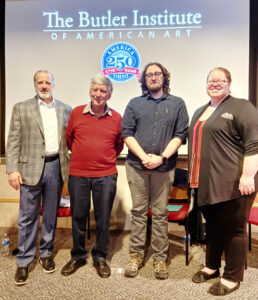
Correspondent photo / Kathryn Adams A panel of four local historians spoke Thursday about the life of Joseph G. Butler Jr., founder of the Butler Institute of American Art, as part of an America-250 program. They are, from left, Joe Lambert, co-author of the book “First Citizen: The Industrious Life of Joseph G. Butler Jr.”; author Paul Rohrbaugh, retired Youngstown State University history professor; Dante Bernard, museum educator at the Mahoning Valley Historical Society; and Traci Manning, curator of education at the MVHS.
YOUNGSTOWN — The Lou Zona auditorium at the Butler Institute of American Art was filled Thursday evening with those who came to celebrate “America250: The art, culture and history of Joseph G. Butler Jr.”
Butler was the founder and namesake of the museum on Wick Avenue which, when it opened in 1919, was the only art museum in the United States at the time to collect and display works strictly by American artists.
A panel of four local historians spoke about Butler’s life and legacy: Traci Manning, curator of education at the Mahoning Valley Historical Society; Joe Lambert, co-author of the book “First Citizen: The Industrious Life of Joseph G. Butler Jr.”; Paul Rohrbaugh, retired Youngstown State University history professor; and Dante Bernard, museum educator at the MVHS. The panel was moderated by Larry Jones, interim curator at the Butler.
Manning said it was in 1917 that Butler started to think about creating a museum of fine art, and at that time Youngstown was a “happening place.” Immigrants, drawn by employment opportunities in the steel mills, moved into the city. Youngstown was experiencing rapid growth, which included 49 public schools. The 1920 census recorded 132,358 residents.
Lambert pointed out that the purpose of the art museum was not only to exhibit works of art, “it was also to teach the American way of life to immigrants; to ‘Americanize’ these workers who spoke a variety of different languages. American art was one way to teach American values to immigrants.”
Rohrbaugh spoke about the fact that Butler enjoyed a tremendous amount of goodwill in the Youngstown community. Many people referred to him as “Uncle Joe.” Butler spearheaded campaigns to build libraries, memorials, hospitals and a host of civic causes in Youngstown.
Butler felt strongly that the steel mills were vital to the Youngstown economy, but art was an important, necessary element in the community. Aside from the iron and steel industry, art was Butler’s true passion. He built up a private personal collection and wanted to share it with others to enjoy.
After a fire destroyed the art collection in his home, Butler knew that a permanent structure needed to be built to keep the art safe. Prior to building the museum, Butler had raised the funds to create a memorial in Niles to his friend, President William McKinley, who had been assassinated. He followed that up with raising funds for his art museum. Rohrbaugh reminded everyone that all of this took place during World War I, and Butler was able to pull it off.
In “First Citizen,” Lambert writes, “It was Butler’s greatest visual offering to his beloved community and the culmination of an industrious life devoted to the advancement of the iron and steel industry, American art, and other philanthropic causes in which he was lifelong engaged.”
The most famous and valuable painting at the Butler Institute of American Art is Snap the Whip by Winslow Homer. Lambert said Butler fell in love with it because it reminded him of his childhood and school days shared with McKinley. Rohrbaugh said that Butler “saw the painting at an exhibition during the 1876 centennial in Philadelphia, acquired it, and it has become an icon for our community.”
Among those attending the event was Sheila Cuellar-Shaffer from Greensburg, Pennsylvania, which is a 90-minute drive. Sheila is an artist whose husband Adam supports her career and said, “We enjoy art, it’s a family interest.” They were joined by their 15-year-old son, Max, who is a budding artist. Sheila said, “I’m happy to be here and learn more about the history of this museum. This is a very special occasion.”
Fritz Coombs, of Liberty, was in attendance with his wife Janice who volunteers as a docent at the Butler museum. “I grew up five blocks up the street. The Butler is a bedrock institution, its art – it’s a part of history.”
Sandra Guarnieri of Warren said, “we are so blessed that this man had the vision to build the Butler, that it’s free, and features all American art.”
Joseph Butler was a man of what has been famously called the Gilded Age. Lambert writes, “Butler’s impact on the iron and steel industry, his contributions to the art world, his philanthropic endeavors and his accomplishments as an author and historian were uncommon for his era. Many of his larger-than-life contemporaries surrounded themselves with art and beauty and lived lavishly. Butler lived well, to be sure, but he, more than any other, lent his personal efforts to bring about positive change in his community.”
Joseph Butler is buried in Belmont Avenue Cemetery, where two angels stand watch on each side of his tombstone. One represents art and the second represents industry. His funeral was the largest funeral that ever took place in Youngstown at the time.
Local News
Police blotters for Austintown, Boardman and Canfield for March 28
Austintown Police activity reported March 19-25: March 25, 10:30 a.m. — Buffalo Cartridge Company BRG-9 ...
Ohio court suspends law license of Poland attorney
The Ohio Supreme Court suspended the law license of Nick Graham of Poland, a former Warren city assistant ...
Judge awards $35K to ex-SOBE receiver
Regionalization talks continue
CHAMPION — Water representatives across the Mahoning Valley warned that regionalizing water would come at an ...
Ohio EPA awards $2.8M for water projects
Staff report The Ohio EPA is awarding more than $2.8 million to 122 public water systems in 58 counties to ...