

Equity Day brings awareness to wage-gap issues
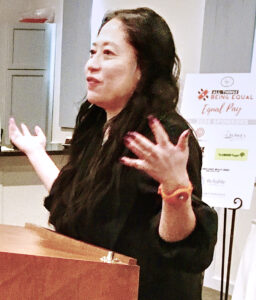
Correspondent photo / Sean Barron Joyce J. Chen, a professor of economics in the Women’s Gender and Sexuality Studies department at The Ohio State University, speaks at the annual Youngstown Business Professional Women organization’s gathering Wednesday.
BOARDMAN — Joyce J. Chen recalled being happy about a promotion, but that joy was greatly offset by the realization that her salary was still lower than her colleagues with far less tenure, but happened to be male.
“I filed a pay equity appeal in 2017. I saw that I was being paid less than people with less experience,” said Chen, a professor of economics in The Ohio State University’s department of Women’s Gender and Sexuality Studies.
The longtime professor shared her story during the Youngstown Business Professional Women’s organization’s Equal Pay event and dinner Wednesday evening in the La Casa Mexicana restaurant’s banquet hall, 7334 Market St.
Chen, who earned a doctorate degree in economics from Harvard University, was approved for tenure in June 2017, then promoted a few months later. Even after accounting for an 8% mandatory pay increase, she was still earning less than male untenured personnel in her department, she remembered.
Chen’s next move was to seek a resolution with her department chairperson, who recommended she accept a 4% adjustment, which she felt was insufficient and grounds to file the appeal. In the end, Chen received a 20% raise, but moved to a different department largely because of resentment and soured relations between her and some colleagues in that department, she told an audience of several dozen women and men Wednesday.
According to the American Association of University Women organization, many women lose income over their lifetimes for two reasons: the gender pay gap lowers their wages at work, and the American economy still fails to value or account for caregiving responsibilities, which women are more likely to shoulder.
In 2024, women working full time and year-round earned on average 81 cents for every dollar men made for the same work. The figure drops to 76 cents per $1 earned by men when factoring in all women, including part-time and seasonal workers, the AAUW’s website states.
Such salary disparities add up to about $542,800 in lost wages over an average woman’s 40-year career, the website shows.
Initially, Chen was afraid — perhaps as most women are in such situations — to address the problem and was told in effect to not make waves, and that the situation would eventually be fixed. Nevertheless, she internalized shame and embarrassment about being quiet, Chen said.
“It was very demoralizing as well,” she added.
In time, Chen realized that such a gender pay gap also reflected and spoke of a gap in many women’s value in the workplace, saying that the evaluation process for judging and critiquing their achievements often is broken and skewed. The problem also shined a spotlight on the fact that many women’s contributions are not judged or assessed equivalently to men’s, she explained.
“I always encourage women to negotiate,” Chen said, adding, “It’s a real fundamental values question we have to address as a society.”
The gap extends beyond individual professors, however. Across the disciplines at OSU, personnel in male-oriented departments such as engineering are generally paid more than those in female-oriented ones that include social work, she noted. That inequity is partly because the university doesn’t want those in the engineering department, for example, to go elsewhere, Chen added.
The longtime economics professor suggested using a proactive pay process based on what other employees are earning as a baseline, having men share their salaries with their female counterparts and ensuring women refrain from handling extra work and related projects without prior discussions pertaining to their scope and pay increases.
In addition, the COVID-19 pandemic worsened the gender pay gap because many women left the workforce, she noted.
According to the AAUW, the global pandemic widened the income gap between 2022 and 2024, when the economy was in recovery mode, and women-oriented employment took a stronger hit than men’s. Many women cut their hours or left the workforce when schools and day care centers closed, for example, making the gap appear smaller in the pandemic’s early days in 2021 and 2022, though that reflected the fact many women were temporarily out of the workforce and excluded in earnings calculations, the AAUW’s website shows.
Factoring in race also affects the gap because women of color are more likely to work in the caregiving, service, agriculture and domestic sectors — all of which have traditionally been undervalued and underpaid, according to the AAUW.
Gina DeGenova, the Youngstown Business Professional Women organization’s president, said her group also allows opportunities for women from all backgrounds and sectors to network with one another as a means to further feel empowered. It’s also vital to continue to spread the word about the income gap problem, she added.
“Pay inequalities exist in any age group,” DeGenova continued, adding that the YBPW offered a pair of scholarships last year.
Equal Pay Day is in March (specifically, March 26 this year) because that day represents how far into the new year the average woman has to work to earn what the average man made the previous year, DeGenova said.
Local News

Canfield teen immerses his interest in World War II
Resident continues mission to beautify village of Poland
POLAND — Village resident Hugh Braham addressed village council at its meeting Tuesday with the final two trees ...
Campbell awarded pair of state grants worth nearly $110K
CAMPBELL — The city has been awarded a pair of grants that will be used to buy a new senior van as well as ...
McDonald explores safety service lev
MCDONALD — Wanting to provide enough funds for the fire and police departments for operations, village council on ...
Equity Day brings awareness to wage-gap issues
Poland superintendent search narrowed to 3
Staff report POLAND — The Poland Board of Education has narrowed its search for a new superintendent to three ...