

Costs soar for upkeep at three Mahoning public libraries
Poland, East, Austintown branches endure slew of maintenance concerns
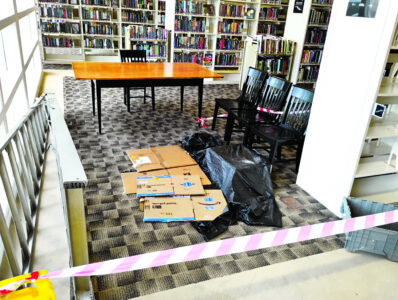
February’s heavy snows and subzero temperatures left the Austintown branch of the Public Library of Youngstown and Mahoning County with considerable, although not catastrophic, interior water damage, with sections closed off by tape, buckets laid out to catch water, visible damage to the walls and water-catching devices suspended from the ceiling.
YOUNGSTOWN — Water damage at Austintown’s library, a major overhaul at the East Side branch for similar reasons, heaving floors and an uncertain future in Poland are among the most significant issues facing the Public Library of Youngstown and Mahoning County.
The reason may be the way these specific branches were designed.
The Poland branch has placed the library board under constant scrutiny and criticism from local residents demanding the building be saved, even as the library works to identify exactly what is wrong with the building and what, if anything, can be done about it.
February’s heavy snows and subzero temperatures left the Austintown branch with considerable, although not catastrophic, interior water damage, with sections closed off by tape, buckets laid out to catch water, visible damage to the walls, and water catching devices suspended from the ceiling.
East has been under a major renovation over the past year to correct design flaws of the original building, including windows regularly damaged by snow, ice and water; the lack of a proper gutter and downspout system that led to rot around parts of the building; and roofing problems.
According to a cost estimate by Library Chief Stakeholder Relations Officer Zak Kozberg, maintenance costs for Poland and Austintown since 2024 have been outpaced only by the main branch downtown and by East, because of the renovation.
Costs for Poland during that time exceed $492,000, while Austintown totals just under $424,500. The maintenance costs for East are comparatively low — about $104,400 over the same period, but the library also has invested $1,162,500 in the overhaul project, making East its most costly branch today.
For comparison, maintenance costs downtown over that time are about $679,000. And while some branches, like Boardman and Canfield, have maintenance costs that annually exceed $100,000, Austintown and Poland are disproportionate to the rest.
Austintown cost the library system about $143,300 in 2024 and just under $200,000 last year. Poland’s maintenance costs were just over $193,000 in 2024 and about $211,000 in 2025. Both are on track to be considerably higher than all other branches again this year.
“These maintenance costs are an anomaly when averaging out in-house man hours spent at each branch, along with outside vendor work,” said Library Chief Operating Officer Jordan Shaver. “Throughout the system, we have buildings newer, older, larger, and with various types of MEP (mechanical, electrical and plumbing) systems in place. Although a lot of the work is maintaining aesthetics to ensure patron and staff safety like uneven brick pavers and uniquely specified doors and windows that are prone to leaks, another large portion of maintenance time is spent with the MEP systems.”
Shaver said the library is doing everything it can to keep up with all branches — which each has unique maintenance and repair needs — but residents should feel safe visiting any branch.
“All of our facilities are structurally sound. While we have proven deficiencies in various components of a few buildings, all of them are safe. We have details from inspections by architects, engineers, and various trades specific to the issues we’ve encountered,” he said.
The question is why those specific branches — East, Austintown, and Poland — have been so costly for the library to manage.
Looking at the dedication plaques in each, one sees three different general contractors — North Lima-based Brock Builders Inc at East Side; Youngstown-based Frontier Woodworking and Construction at Poland; and Cleveland-based Caputo and Martini Construction at Austintown.
Online records available on the Ohio secretary of state’s site indicate that Frontier’s operating license was canceled in 2003 for failure to pay taxes, and Caputo Martini was dissolved in 2004 — the reasons are not clear but taxes also appear to have played a part. Only Brock remains in operation.
One name that is consistent across the three plaques is that of their architect — the Boardman-based 4M Co.
LIBRARY DESIGN: DECISIONS AND COSTS
The library has seen many architects’ names on plaques over the decades. Charles Owsley designed the main branch downtown, which was completed in 1910.
Youngstown-based Olsavsky Jaminet designed the Boardman location on Glenwood Avenue. Youngstown’s Ronald C. Faniro Architects designed Canfield, Campbell’s Community Literacy Workforce and Cultural Center, which houses the city’s local library branch, the West Side’s Michael Kusalaba branch on Mahoning Avenue, the original Newport branch renovation and subsequent garage addition, and Tri-Lakes branch in North Jackson.
The Sebring branch, built in 1964, was designed by Glaus, Pyle and Schomer — now Glaus, Pyle, Schomer, Burns and Dehaven, known as GPD Group of Akron, which is handling the major renovations at the East Side branch. Brownlee Woods, built in 1967, was designed by Damon, Worley, Cady, Kirk and Associates, a firm also responsible for the original College of Business Administration at Kent State University. And Struthers, built in 1955, was designed by then Youngstown-based Kling & Frost.
The Austintown, East and Poland branches, and the Springfield renovation project, all were designed by 4M.
Shaver said the simplest answer that explains most variations in maintenance costs is the difference in the needs of each building based on size and use, as well as design.
“Design-specific maintenance is the first and most observable answer,” he said. “For instance, we do not need to maintain the pergola, like at Austintown and Poland, at any other branch simply because no other branch has a pergola.”
But over the past several years, consistent issues have emerged at the Poland, Austintown and East branches.
“There are certain design thoughts and theories — like having windows at grade, like with Austintown and Poland and one at Springfield, and every time the snow builds up against it, the seals break. The windows are pressurized with argon gas to give them an insulation value, and once those seals break, you get condensation in the window and you’ve got to replace them,” Shaver said. “They’re just different things that need your attention. There were some design ideas and finish materials that just have been proven by multiple architects and engineers to not be durable.”
Kozberg was even more pointed.
“The fact remains that design choices were made when these buildings were conceived that PLYMC is now paying millions to rectify, regardless of who did the construction work,” he said.
The East branch was designed in 2007 and completed in 2009. It is now nearing completion of a major overhaul, under the direction of a new architect.
“It’s an unfortunate project, but it’s a great project,” Shaver said. “There were water filtration issues, mostly due to exterior grading. The building didn’t have a standard siding on it, it had a palladium coating right over top of the OSB, so it was somewhat permeable and created bubbles in it. Then there was also a lack of gutters and downspouts, so water would just bounce up off the ground and settle onto the palladium coating.”
With the help of GPD Architects and Youngstown-based Murphy Contracting, the library has removed the palladium coating, replaced round windows with square windows, installed a waterproof coating around the outside of the building and breathable Rain Screen panel siding. The library also solved the problem of nearly nonexistent gutters and downspouts and installed a new roof.
The next step is to regrade around the outside of the building, do exterior painting and pour a frost slab at the door.
“The idea is that we can’t necessarily serve the community in a building that is porous and showing some rot,” Shaver said.
POLAND REPAIRS
Poland, the inspiration for much indignation and outrage among residents in recent months, has been a constant source of stress for Shaver, Kozberg and the library’s entire staff. Kozberg said the status of Poland is by far the most commonly asked question library staff receive.
Some issues at Poland are easier fixes, officials said.
Pavers outside the entrance tend to heave as cold weather leaves the ground beneath uneven. Shaver said they usually just have library maintenance staff pull them and reset them to be sure they are level.
“Most recently, we hired Tabor’s Lawn and Garden to pull a whole section of it just to make sure the water slipped away from the front door, so we don’t end up having ice forming there, and we’re getting rid of some tripping hazards,” he said.
The pergolas at Austintown and Poland, because of their construction, tend to take on water damage, and although they may become unsightly, they are not dangerous and can be chalked up to deferred maintenance while other, more serious issues are addressed, such as the basement floor.
“Making a conscious choice to use open hearth slag, to leave it, is not neglect or a maintenance issue. That’s a conscious choice that somebody made to put it in there and leave it and build over it,” Kozberg said.
When the floor at Poland began heaving, the library hired a geotechnical engineering firm to take core samples, which were found to contain open hearth slag, which they believed was left as backfill.
Shaver said it was likely not something that was dumped there, but is highly common to the area. It is often used as filler around railroad tracks and along highways.
Shaver said the building’s stability is not at stake.
“They originally advised — I have old documents — to dig the footers deeper. They dug another 18 inches to hit bedrock so the structure is held up on a firm footing,” he said.
The center of the slab, however, is where contractors may dump almost anything to fill it. The problem with open hearth slag is that when it comes into contact with water, it expands heavily. “So, that’s what’s been determined to cause the heaving in the basement and the friends area.
“To mitigate that, you have to follow the vein. You can’t get a solid price, nobody’s going to give us a solid price, because it’s exploratory,” Shaver said. “You’re going to dig where you see the heaving and keep following it and if you don’t get it all out, you’re still going to have mole holes in your slab floor afterwards.”
On April 9, Kozberg said, options and information for both renovating and replacing the branch will be presented to the library’s building and sites committee for its review, after which a decision will be made on what recommendation to present to the whole library board for a vote. Shaver and Kozberg said the costs between two options will be presented at the meeting, but that assessment has not yet been completed.
AUSTINTOWN LEAKING
During the week of Feb. 9, when subfreezing temperatures rose slightly and some icy areas began to thaw, employees at the Austintown branch began to notice leaking, Kozberg said. While they appear to be somewhat expansive across the rear portion of the library, Kozberg said the damage is not deep, but it does pose a persistent problem.
“We do everything we can to keep everything in-house. It was simply a matter of replacing damaged sections of drywall, none of which has resulted in us limiting services or programs or having to close the building,” he said.
The Cleveland firm Bialosky conducted a full assessment of the building and in December 2014 issued a report. Kozberg said the most significant item relating to the building’s damage is the report’s summary of the roof.
“The roof consists of asphalt shingles and flat roof areas with urethane waterproofing,” the report notes. “Roof was not observed during the assessment. PLYMC utilizes a roofing contractor to maintain the roof. From the drawings, it appears that the flat roof areas are not appropriately built to prevent water infiltration into the building.”
Additionally, Shaver summarized the rest of what needs to be addressed at the branch.
The list includes heaving pavers; decorative pergola and exterior column issues; a rapidly aging fire suppression system — including corrosion and issues in the non-climate controlled attic space; slab settling and cracks in the slabs in partial basement and public spaces; as well as multiple other water infiltration issues in several locations – where the shingled roof meets the glass roof at the public entrance, a the RTU pit locations, around specific non-operating ground level window panels, behind thin-brick veneer, causing the brick to uncouple and detach from the building, and other undetermined areas that often show up as interior drips or dampness around the peaks of some vaulted ceilings.
Shaver said the Austintown branch will soon be subject to an in-depth study and the building’s priority for library officials is virtually even with Poland.
Shaver said there are no considerable or long-term issues thus far with the Springfield branch renovation.
Three of four buildings designed by 4M appear to pose outsized problems for the library system, are costly for upkeep, and take up a disproportionate amount of staff attention.
“It’s an unfortunate situation to be in, because the library is responsible for all of our facilities and the patrons and staff within them, and we do our best to mind the shop,” Kozberg said.
4M did not respond Friday to The Vindicator’s request for comment.
Local News
Officials push back on water regionalization
NILES — City officials expressed concerns about how a meeting regarding one of the city’s resources was ...

St. Baldrick’s Shave hopes to raise $91K

Ex-receiver seeks $80K for his work with troubled SOBE
Lordstown students gain skills through carpentry
Couple fights for clarity, safety of Canfield creek
Puddlers at Republic Iron & Steel went on strike for rule change
120 Years Ago, 1906 transcribed as originally published in the Youngstown Vindicator: “Puddlers are on a strike. ...