

Autism advocate shares life lessons at Press Club
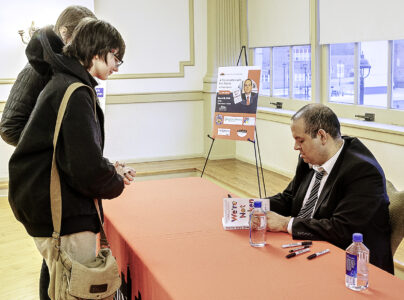
Correspondent photo / John Patrick Gatta Autism advocate, author and journalist Eric Garcia signs a copy of his book, “We’re Not Broken: Changing the Autism Conversation,” for Sarah Clouser of Youngstown following Garcia’s Youngstown Press Club event Thursday at the Tyler History Center in downtown Youngstown.
YOUNGSTOWN — “Be yourself and adjust accordingly.”
It’s a life lesson Eric Garcia, who is on the autism spectrum, offered to those in attendance who also have the condition at Thursday’s Youngstown Press Club gathering at the Tyler History Center.
Billed as “A Conversation With,” he responded to questions from the event’s moderator, Vindicator and Tribune Chronicle reporter and photographer Sean Barron, who wrote a book about his life with autism since his diagnosis in 1967, and several more queries from the audience.
The autism advocate addressed the group with personal stories and views meant to dispel myths about those, like him, who are neurodivergent, as well as referenced his book, “We’re Not Broken: Changing the Autism Conversation.”
With an established writing career, he didn’t have to say a word to impress and inspire the audience but, for more than an hour, he did. Prior to that, he sat down and took questions from guests in a meet-and-greet discussion.
The graduate of the University of North Carolina at Chapel Hill works as the Washington bureau chief and senior Washington correspondent at The Independent and as a columnist with MS NOW (formerly MSNBC).
Previously, he was an assistant editor for The Washington Post’s Outlook section and an associate editor at The Hill, a correspondent for National Journal, MarketWatch and Roll Call and has written for The Daily Beast, The New Republic and Salon.com.
Garcia pointed out that he had a supportive family who frequently took him to the library and had encouragement from a guitar teacher and college professor. Altogether, they helped him make strides toward a career in journalism that focuses on politics.
“That begins at home, where parents teach their kids self-advocacy and standing up for themselves. So, they have a baseline, this level of self-respect and understanding and dignity for themselves. You teach them that inner value of themselves.
“It’s always good when you have accepting people, but the law exists when there aren’t accepting people…but, unfortunately, as we know, the law doesn’t always work for us.”
Forging a path of his own making, Garcia discussed that it was “crucial” when autism was separated from a schizophrenia diagnosis in 1980 and the condition was added to the Americans with Disabilities Act in 2008.
“Had it not been for those deliberate policy decisions, I would not be here right now,” Garcia said.
He added, “If there’s anything that spurs me as a political reporter and why I got into it, it was recognizing the effects of history all around me and the effects of public policy all around me.”
Acknowledging the controversial aspects of the condition, Garcia brought up the United States Department of Health and Human Services announcement in regard to pregnancy and taking acetaminophen.
“We’re still looking for a culprit. I’m not opposed to research and a look at the biology — rather than how we deal with autistic people we have here,” he said.
In particular, he mentioned that there isn’t much research being done on how to deal with aging.
Further connecting with many of the listeners, Garcia brought up the sensory overload that he experienced in the emergency room when he injured his ACL and, later, how climate activist Greta Thuneberg has supporters around her to make sure she maintains a level of comfortability.
During a book signing after the conversation, he spoke of how a change over the years in viewing autism can be a positive.
“Having a spectrum is a net-plus. For the longest time, people thought of a spectrum as more autistic or less autistic, but we realize it’s now more like a color wheel. Different people have different impairments while other people have different gifts and, oftentimes, the gifts can coincide with the impairments.
“In some ways, it’s really good because having a spectrum has allowed people who otherwise would have not gotten diagnosed, particularly for marginalized groups, to get diagnosed.”
Earlier he stated, “The reason why we’ve seen an increase in the odds of diagnosis isn’t just because your kid’s on TikTok. It’s because women are getting diagnosed, poor people are getting diagnosed, people who previously had misdiagnoses of behavioral disorders or other types of development or anxiety disorders now get an autism diagnosis.”
Overall, Garcia emphasized how each individual case is different and how for him being straightforward helps. He brought up his extended verbal contributions during meetings at a publication. An editor dealt with the situation by informing him that a hand signal would be given to wrap up what he was saying.
“It’s when you recognize that people are in your community; they’re full human beings, they’re deserving of their humanity. Then, you can think about how to serve them, rather than just seeing autism as a problem,” Garcia said.