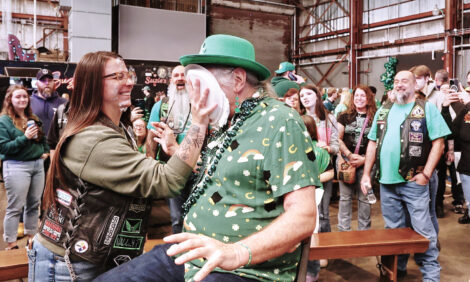
Area children drive to mobility
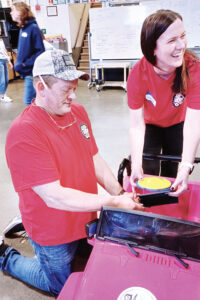
Correspondent photo / Susan Wojnar Larry Dye, assistive technology professional with Miller’s Wheel Chair Solutions, and Shannon Mulichak, an occupational therapist in the early intervention program at the Mahoning County Board of Developmental Disabilities, put the finishing touches on a car Saturday.
CANFIELD — For many young children with mobility challenges, the ability to move independently can open an entire new world.
Through the local Go Baby Go initiative, families in the Mahoning Valley discovered just how transformative that experience can be when children, families, care providers, assisted technology professionals and modified cars ended up together Saturday at the Mahoning County Career & Technical Center.
The Go Baby Go workshop provides custom-modified, battery-powered toy cars to children with developmental disabilities, allowing them to drive, explore and play alongside their peers. Designed for children between 9 months and 5 years who have difficulty moving independently, the vehicles are adapted with specialized seating, accessible switches and other supports tailored to each child’s needs.
The local effort is supported by the Magic of Michael Foundation, a North Lima-based nonprofit founded by John and Denise Hirschbeck. The foundation honors the memory of their son, Michael, who died in 2014 from the rare genetic disease adrenoleukodystrophy (ALD). The couple also lost another son, John, to the same disease in 1993.
“We wanted to do something special in northeastern Ohio to commemorate our boys’ memory and help other families facing the curveballs of life,” Denise Hirschbeck said.
The foundation became involved with Go Baby Go after being approached by local physical therapist Bev Lankitus, who helped bring the program to the Youngstown area after observing a similar effort in Cleveland. Since then, the initiative has grown steadily with support from community volunteers, educators and students.
This weekend, the program reached a major milestone as volunteers prepared 21 newly modified vehicles for local children — bringing the total number of cars distributed through the program to 200.
For many of the children receiving the vehicles, it may be their first opportunity to ride independently in a motorized car designed specifically for their abilities.
The Youngstown program operates with the help of students and volunteers from several local educational programs, including engineering and STEM programs at the Mahoning County Career & Technical Center. Student teams assist in assembling the vehicles, while Valley STEM students design custom license plates for each child featuring their nickname and favorite colors or themes.
Go Baby Go began on Friday with volunteers completing electrical modifications and assembling the toy vehicles. On Saturday morning, families arrived with their children for the final customization process.
Each child was assigned a volunteer team that included therapists, technicians and engineers. Together, they evaluated the child’s specific needs and adjusted the vehicle accordingly.
Many of the modifications focused on safety and accessibility. Seating may be adapted to help a child sit upright, sometimes including added head or trunk support. Some vehicles incorporate secured toddler swings or specialized seating supports. The electronics are also altered so that a child can operate the car with a hand-activated switch instead of a foot pedal. In addition, each vehicle includes a remote-control steering option so parents can guide the car when necessary.
The program also accommodates children who rely on medical equipment such as ventilators, feeding tubes or oxygen.
After the final adjustments were completed on Saturday, the children test-drove their new vehicles before heading home with their personalized ride.
The vehicles serve a purpose beyond recreation. Early independent mobility has been linked to important developmental gains, including improvements in motor skills, language development, cognition and social interaction. For many children, the vehicles provide their first experience controlling movement and understanding cause and effect.
“They open doors to cognitive, language, social and motor development,” Lankitus said. “The benefit is immeasurable.”
The cars also create new opportunities for inclusion. Instead of watching from the sidelines, children can participate in neighborhood play, outdoor activities and even events like trick-or-treating alongside siblings and friends.
Families interested in participating in the program are typically referred by a physical or occupational therapist, often through early intervention or preschool services. The therapist helps determine the child’s needs and completes an intake form prior to the event.
Behind the scenes, the project remains largely volunteer-driven, with many participants returning year after year to help with the builds.
For Hirschbeck and her family, the program represents a meaningful way to honor their sons while helping other families find moments of joy.
“The most rewarding part of the program,” she said, “is letting children and their families know they are loved and valued.”
Local News
Saenger named new dean at YSU’s business college
YOUNGSTOWN — Youngstown State University has announced the appointment of Christina Saenger, Ph.D., as the new ...
Program peddles free bicycles in the Valley
High winds whip Valley, cause power loss to many
Heavy winds Friday and again Sunday caused many residents and some businesses in the Mahoning Valley to be without ...
Boardman goes green
Winning words pose no threat to regional spelling bee victor