

Youngstown school board supports bills to abolish distress commissions
City school board backs measures to abolish distress commissions
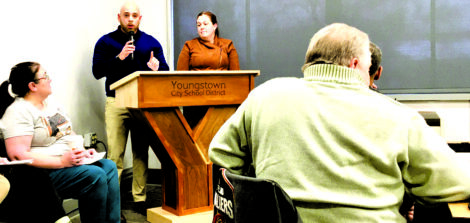
Correspondent photo / Sean Barron State Sen. Al Cutrona, R-Canfield, and state Rep. Lauren McNally, D-Youngstown, discuss bills they introduced to abolish academic distress commissions during the Youngstown Board of Education meeting Tuesday at Youngstown Rayen Early College High School.
YOUNGSTOWN — The Youngstown Board of Education has adopted a resolution to support a pair of bipartisan companion bills aimed at dissolving state mandated academic distress commissions for struggling districts.
“It’s a super simple bill,” state Rep. Lauren McNally, D-Youngstown, said during Tuesday’s regular board meeting.
McNally was referring to Ohio House Bill 610, which she co-sponsored that, at its main core, would “remove every mention of academic distress commissions from Ohio law.”
Also sponsoring the bill that was introduced in November is state Rep. Juanita O. Brent, D-Cleveland.
The other bill the board agreed to support is Ohio Senate Bill 332, co-sponsored by state Sen. Al Cutrona, R-Canfield.
HB610’s primary thrust is to undo the effects of ADCs, which McNally called “a failed model,” but was a core piece of Ohio House Bill 70 that was adopted in mid-2015 and gave a chief executive officer of failing districts complete oversight and full decision-making abilities over local boards of education.
The ADC private commission model was such a failure that moratoriums were passed to stop their “spread” to other school districts across the state such as the Dayton Public Schools, yet the Youngstown, East Cleveland and Lorain districts “were left behind,” McNally told a standing-room-only crowd.
“There is no debate left to be had; the state takeover model didn’t work. In fact, it made things worse,” McNally said in November before the General Assembly. “This is one of my main priorities in this General Assembly. This needs to be fixed for the kids stuck in ADCs and not getting the public education they deserve. I will continue to be persistent and find a way to finally get this done.”
A district’s local stakeholders are the ones best equipped to meet their students’ needs, not a single individual who can make decisions with no oversight, she added.
SB332
“I want to do what’s best for the students, the district and Youngstown,” Cutrona said about the primary driving force behind having introduced SB332, which contains language similar to that in HB610.
In addition, the legislation, introduced Dec. 1, 2025, would replace ADCs with new student support teams beginning in the 2026-27 school year for struggling buildings with low performance ratings (fewer than two stars of five on the state report card for the previous two school years). Such teams would be made up of administrators, school board members, teachers, parents and a team representative who would conduct surveys of student support needs and develop recommendations for improving student learning, then submit their findings for boards’ approval.
Another provision relates to allowing parochial and other nonpublic schools to make their own agreements with their townships’ police departments regarding school resource officers, Cutrona noted.
It was important for both bills to work in tandem to try to speed up the process of getting them passed, he said.
“Youngstown cannot be left behind,” Cutrona added.
During Tuesday’s meeting, a few board members expressed gratitude to McNally and Cutrona, including Brenda Kimble, a longtime fierce and outspoken opponent of HB70.
Recently, the Lorain School District was removed from academic distress “with the stroke of a pen,” and East Cleveland schools came out of such status last month after having earned a three-star rating and meeting certain benchmarks, which left Youngstown as the sole district under that heading, the Rev. Kenneth L. Simon, New Bethel Baptist Church’s lead pastor, said.
Simon, who also serves on the Community Leadership Coalition on Education, noted that HB70 was originally intended to provide wrap-around services, but was “hijacked” then passed with no debate. As a result, a high-paid CEO was in charge of making all important decisions with no restrictions and no input from local school boards, he recalled.
Consequently, the coalition mobilized to fight HB70 because “we knew it was going to be devastating to our district,” Simon added.
A key part of that 11-year fight entailed further educating community members and stakeholders in the district about the importance of ending state takeovers, he said.
Also helpful in that effort was the passage in 2021 of House Bill 110, which gave struggling districts three years to reach benchmarks in their Academic Improvement Plans to again assume local control, he said.
Local News
Youngstown man arrested after gunshots fired in Liberty
LIBERTY — A concerned call from a neighbor resulted in a Youngstown man getting arrested on gun charges ...
Move to undo Ohio’s new marijuana restrictions clears hurdle
The Ohio Secretary of State confirmed Tuesday that Ohioans for Cannabis Choice submitted enough valid signatures to ...
3 defendants added in case of $127K scam against woman
WARREN — A superseding indictment in a 2024 federal criminal case adds three additional defendants to a criminal ...

Youngstown Action Center focuses on caring for others
Offenses of man called ‘disgusting,’ ‘heinous’