Water advisory board in Trumbull revisits regionalization
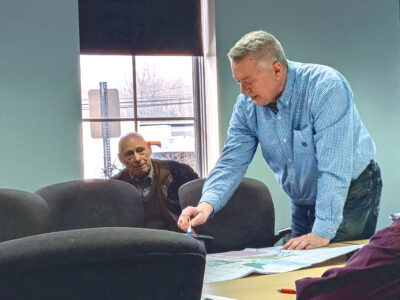
Staff photo / Brandon Cantwell Trumbull County Sanitary Engineer Gary Newbrough, standing, looks at a map showing the different water districts in Trumbull County as Commissioner Tony Bernard looks on. The 12-person Water Advisory Panel had a special hour-long meeting at Newbrough’s office that focused on a regional approach to water supply.
VIENNA — A county commissioner noted that a study for efforts to regionalize the Mahoning Valley’s water systems would require the backing of city governments, as local officials reintroduced the topic Monday afternoon.
The 12-person Water Advisory Panel had a special hourlong meeting at the Trumbull County Sanitary Engineer’s Office, with state Rep. David Thomas, R-Jefferson, and Trumbull County Commissioner Tony Bernard sitting in and providing feedback.
A staffer from Rep. Nick Santucci’s office also joined the meeting via Zoom.
The panel is only able to bring recommendations before the county commissioners for their approval, but it couldn’t vote to bring any before them at the meeting because it was short one representative to have a quorum.
Matt Blair, an attorney and chairman of the Youngstown / Warren Regional Chamber, looked at Ohio Revised Code 6115, the statute that formed the Mahoning Valley Sanitary District — a regional water district that was formed between the cities of Niles and Youngstown.
“There are no other entities under 6115 in the state of Ohio — this is the only one. Because McDonald had McDonald Steel at the time, they did not become a member city,” Blair said. “They did become the only contract recipient of MVSD water directly, so McDonald gets pretty much the same rate that Niles and Youngstown gets.”
Blair said regionalization also was discussed when Tom Humphries headed the chamber.
He said the MVSD sells water to Youngstown, McDonald and Niles at “far discounted rates” compared to what the townships pay. The townships then sell the water to other entities.
“With Youngstown, it’s not quite as bad because Youngstown pretty much has all the transmission lines all through Mahoning County,” Blair said. “They sell what we call ‘surplus water’ directly to Canfield and these other communities — so there’s only one markup.”
With Trumbull County, however, Blair said Niles sells water to Girard, who sells it to Liberty, with a “substantial markup,” something he said has been going on for years.
“It impedes economic development; if you’re going to do a project in Liberty, it’s very difficult because the cost of the water is like the highest in the whole state of Ohio,” Blair said. “Not because the water costs that much — it’s the same exact water that went to Niles at the discount rates.”
Blair said he’s looked into Ohio Revised Code 6119, the statute implemented in Toledo and Columbus that deals with the regionalization of water, which he thinks the water board would be seeking.
Blair said it’s a five- to six-year process from the time it begins to have the organization in place.
“We talk about it in the chamber all the time — it really does impact this Valley. It does not make us competitive,” Blair said. “We can’t compete with areas who have addressed this issue and have regionalized and done what they needed to do to correct it.”
He said the chamber also should consider regionalizing sewer service too. Blair said he had previously spoken with Tom Holloway about compensating Niles and Youngstown in the scenario of regionalization happening, as they funded the MVSD at the start.
Blair said both cities would be able to receive money for use of the transmission lines since they own them. He added it wasn’t a novel idea he came up with and used as an example East Ohio Gas and the money it makes off the gas transmission lines, despite not owning them anymore.
Blair noted that cities sell the water based on infrastructure cost, adding that it was hard to explain what justified 20% to 40% markups to surplus water, which was being sold at the rate to inside-rate residents, plus the markup.
“The water being sold outside the city, in my view, should be sold at a rate below the inside rate; the outside entity is maintaining the facilities to distribute that water,” Blair said. “We look at legislation that would, in the short term — even before regionalization — cap what a water seller can charge for surplus water outside its boundaries.”
Blair said it would be a “major game-changer” for the Valley if representatives could get together and put together a plan, as the area would be competitive, noting the varied rates across the two counties.
Weathersfield Administrator David Rouan said it wouldn’t be a quick fix to change the statute because the entities still own the water lines, adding that his township has water supplied like Liberty, which has several sources.
“There’s going to have to be some kind of consideration or offset that’s going to be had for them because they didn’t install them,” Rouan said. “A lot of the time, the county projects you’re working on right now will fund entirely the installation of the line, and then turn it over to the municipality for maintenance — and that’s kind of complex as well.”
Blair reiterated that regionalization was a long-term plan, as an engineer would have to be brought in to put one together.
“It’s going to be a long-term process because they’re going to want paid for their infrastructure — if they’re even willing to give it up,” Blair said. “You can’t take it without paying for it, and a lot of bonds and stuff are still out there, being paid on these infrastructures.”
Trumbull County Sanitary Engineer Gary Newbrough said both Niles and Youngstown would have to be included in any sort of water authority, as they’re the largest purveyors of bulk water — also noting that the City of Toledo is included in the Toledo Regional Water Authority.
“I would think you would want their buy-in on it, but I can understand their reluctance to do so,” Newbrough said.
Former Champion Trustee Rex Fee explained that a 40% increase is applied to any bulk rate passed through — for some of the customers, at least.
“What it does is it floats the boat off the inside customer, they can keep their inside city customer rates low on the backs of the outside user,” Fee said. “There has to be a change there, legally. I’ve been an advocate — show me the justification for this rate increase. And they’re very hesitant in giving you anything.”
Fee said it was “unconscionable” for outside users to take costs on the chin.
Blair said things needed to get to a point where water rates were being set on both water and what it takes to maintain infrastructure.
Vienna Trustee Phil Pegg recalled sitting in on a Public Utilities Commission of Ohio meeting with Brookfield Trustee Dan Suttles regarding Aqua Ohio, a private water entity.
Pegg said Masury is going to have a substantial increase in water rates, with some of the community asking if they could come over to the county’s system.
Newbrough said he did not know if Aqua has any sewer customers in Trumbull County, noting that they’ve expanded to other communities such as Campbell and Struthers.
Regarding regionalization, Thomas recalled Santucci saying it’s much easier to do something that doesn’t change code — making it the go-to response.
“If there’s things that you want us to change, this splits our districts pretty evenly; both of us would have to be on board,” Thomas said. “It seems like there’s groups within some of our districts that would be happy and not happy.”
Rouan said the cost of water was only one part of it, as aging infrastructure also needs to be addressed.
Thomas said he would prefer to take action in a way that simplifies things.
“If there is something as you’re going through that process that you think, ‘This needs to be,’ I don’t mind using legislation as a hammer to try and negotiate and use as well,” Thomas said.
Rouan said the deadline for an engineering study is March 12.
Bernard asked if they should reach out to Warren, Niles and Youngstown to see where they were at, questioning why they should spend $300,000 on a study if the cities weren’t on board.
Blair said information was needed to begin discussions with the cities.
“This study that needs to be done can be done on a county basis to look at their system inventory and see how complex this is. We need that done before we can even talk to Warren, Youngstown, Niles,” Blair said. “I believe that study needs to be done there, regardless of how we proceed — you’re not going to get their buy-in initially. We’re going to go there with no information and try to get them to buy into something.”
Blair, who served as the MVSD’s president for 21 years, recalled a time when Niles and Aqua competed for customers, resulting in prices dropping.
“If we were able to take the county and just buy water from one source, that would enable us to have Niles compete against Warren — and even maybe Aqua,” Blair said. “You’d have three different water sources that you could have them all working together and buying from one source.”
Local News
Bill decreases transparency of campaign finance reports
CHARLESTON, W.Va — The two lone Democratic members of the 34-member West Virginia Senate voted against an ...

Valley 9-year-old goes the distance to aid vets
County leader apologizes to residents
YOUNGSTOWN — A Mahoning County commissioner is apologizing for a seemingly threatening comment she made about ...
$30K award for sex abuse ‘inadequate’
YOUNGSTOWN — Jessica Shobel’s attorney has filed objections to the ruling of a Mahoning County magistrate ...
Nine charged with Medicaid fraud
COLUMBUS — Indictments filed this month by Ohio Attorney General Dave Yost accuse nine Medicaid health care ...