

Talk on tax reform bills turns tense
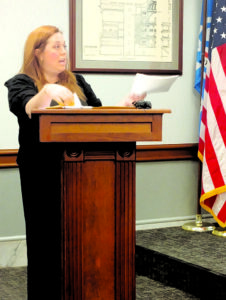
Staff photo / Dan Pompili State Rep. Lauren McNally, D-Youngstown, addresses Mahoning County commissioners on legislation dealing with property tax reforms.
YOUNGSTOWN — A discussion about Statehouse property tax bills turned tense at Thursday’s Mahoning County commissioners meeting.
State Rep Lauren McNally, D-Youngstown, addressed commissioners during the public comment period of the meeting to share information about some small-scale property tax reform efforts being considered for passage by the Ohio General Assembly in both the House and Senate.
McNally specifically mentioned three bills — one that affects how much money county governments will receive over the next three years, another that gives authority to the Ohio Department of Taxation, at county auditors’ expense, to adjust or equalize property values and still another that affects that way the millage floors are calculated for school district and vocational school levies.
“I came in today because I’ve been working with the Mahoning County commissioners over the last handful of years on property tax reform bills and getting the Statehouse to make some moves. So I came in to update them on the handful of bills that we did pass at the end of the year that are about to take effect, especially because they do affect the way the county operates and their financial bottom line,” McNally said.
“It wasn’t to have a debate on what should or shouldn’t be done, and unfortunately, Commissioner [Geno] DiFabio wanted to have an argument.”
The discussion did not start out contentious, as it appeared DiFabio was asking questions that McNally was able to answer easily and clearly.
McNally discussed House Bill 124, which requires the taxation department to consider no more than a representation of “arm’s length” property sales submitted by county auditors while conducting sales assessment ratio studies in order to make adjustments to proposed property values.
McNally’s notes, provided to The Vindicator, state that the change would allow Taxation to challenge auditors’ samples as unreasonable or unlawful before the Ohio Board of Tax Appeals.
Using representative samples from auditors rather than selecting samples independently, the state aims to save administrative costs for both county auditors and Taxation.
House Bill 129 requires that current expense fixed-sum levies be included in the calculation of a school district’s 20-mill floor or a vocational school’s 2-mill floor for property tax purposes.
It outlines three specific and strict circumstances under which schools may levy property taxes for a fixed sum of money, and requires that any new fixed-sum levy must be for current operating expenses and lonely levied for up to five years.
McNally’s notes show that the expected losses to school districts, statewide, will reach $162 million in fiscal year 2026, $223 million in 2027, and $224 million for 2028.
Some local examples include the Jackson-Milton Local Schools, which would lose just over $1.1 million for FY 2026, and approximately $1.66 million each of the next two years. The Poland Local Schools would lose about $1.3 million in FY 26 and $2.28 million each of the following years.
The discussion was direct between the Democratic state rep and Republican commissioner, and maintained a civil, if charged, tone as DiFabio asked about what the state thought any of these bills accomplished.
“Who in the audience — and it’s not your fault, it’s the way it’s done — understands any of that? How taxes are figured, the 20-mill floor?’ DiFabio asked.
“Nobody does,” answered McNally.
“Absolutely, nobody does. So all that talk from the state about how the taxes are figured and everything else, that doesn’t do anything for anybody in the room. It’s all mumbo jumbo.
I want to know … the bills that you passed — HB 124, you’re essentially saying that the state controls the assessments and they’re going to change the way they do that? Why didn’t they do that before the housing boom, and why didn’t anybody take any action then, I didn’t hear your voice or my side’s voice or anybody’s voice calling for that then,” DiFabio said.
McNally responded: “But we did. Six years ago we tried to get a commission put together and it was never allowed to be put together.”
DiFabio continued.
“I’d also like to know — we have the ability from the state to cut property taxes, and everybody’s putting it on the county because the counties have the ability to just double this and double that. Well, I want to know what the state has put into all this in cutting the property tax? Where has their budget taken the hit?” DiFabio said. “They already told the county they’re not reimbursing anybody, well I want everyone at the state to know the services come to us. We have to provide services, at the end of the day the state should help us and they’re not helping us.”
“No, I agree, they’re not, these bills are pointless,” McNally said. “HB 335, I’ll put it in numbers. you’re (pointing toward regular homeowners in the audience) gonna get $2 dollars in monthly savings, that’s it,” she said. You’re (pointing toward the commissioners) gonna lose $27 million in 2026, $45 million in 2027, and $80 million in 2028. So is your $2 a month savings worth you guys not being able to pay your street department, police, fire, that’s all we’re giving you. But these bills are crap, they’re not enough.”
The two also agreed that the state’s formula for school funding is problematic, with Ohio only providing 32% of the funding, leaving the remainder to be covered by 68% of the collected property taxes.
“The state only funds 32% of public schools, and the rest is on your back, and it is not fair. The state is not paying its fair share, it’s not even paying what the court ordered us to pay,” McNally said.
At that point, Commissioner Carol Rimedio-Righetti chimed in to say that she thinks McNally does a fine job trying to work across the aisle with her Republican colleagues, like State rep Tex Fischer, at which point DiFabio grinned at her.
It has been reported that Rimedio-Righetti, who is retiring at the end of 2026, hand-selected McNally as the Democratic candidate to succeed her in office.
McNally appeared to take exception to the grin DiFabio gave his colleague.
“I didn’t come here to be mocked by a county commissioner. … I didn’t come here to be mocked by you,” she said.
“Nobody’s mocking you, how did I mock you?” He asked.
“You snickered,” she said.
McNally seemed to think DiFabio was disagreeing with Rimedio-Righetti’s compliment, and indirectly insulting McNally.
Later in the meeting, after McNally left the hearing room, DiFabio said there was no slight intended toward McNally, and she just does not understand the banter between himself and Rimedio-Righetti.
“I’m grateful Rep. McNally was here to share all this information with us,” he said.
Local News
On the record Trumbull County
Trumbull County WHAT: Trumbull County Board of Developmental Disabilities organizational meeting Jan. ...
Poland group continues campaign to keep library
POLAND — Jeanne Rostan served as spokesperson for the Poland Save Our Library Committee at Tuesday’s village ...
Traffic lights, gravel road top comments in Poland meeting
POLAND — Township Trustee Frank DeMain addressed Poland Village Council at its Tuesday meeting regarding the ...
Lordstown officials, residents object to renewed EPA permit for energy center
LORDSTOWN — Village officials and residents expressed their objections to the Trumbull Energy Center being given ...
Objects that carry lives
Investigation begins into officer involved shooting in Coitsville
COITSVILLE — The Ohio Bureau of Criminal Investigation is investigating an officer-involved shooting that took ...