

Speaker shares research on links to Underground Railroad
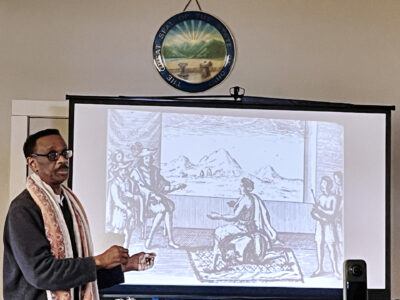
Staff photo / Bob Coupland Youngstown resident Vince Shivers, who has taught an honors course on the Underground Railroad, spoke this week at Braceville Township Hall on the work he and others have done in checking residents’ calls of their homes or properties being part of the Underground Railroad.
BRACEVILLE — Youngstown resident Vince Shivers has spent many years researching the Underground Railroad, including the Braceville area, sharing what he has found with a group who attended an America250 event.
Shivers was the guest speaker this week at the Braceville Township Hall program attended by more than 30 people.
Shivers has taught courses at Youngstown State University on the Underground Railroad and the work he and others have done checking calls from Mahoning Valley residents regarding homes and other locations that may have been part of the Underground Railroad for enslaved African Americans who escaped.
Shivers holds master’s degrees from YSU in American history and historic preservation and has worked in various fields, including working as a professor for 10 years at YSU, where he taught an honors program on the Underground Railroad.
“There was a growing need to teach about the Underground Railroad in particular in Ohio and western Pennsylvania. There were discussions on all the Underground Railroad sites from this region starting in New Castle,” Shivers said.
He said he and others did research in Columbiana, Mahoning and Trumbull counties to gather information on local connections to the Underground Railroad.
“We have more Underground Railroad sites in this area than many other parts of the state. Some we do not know about,” he said.
Shivers said he traveled to Africa to do research in villages where people were captured and transported from large kingdoms in West Africa, such as Angola.
When the Africans were brought to America, they were placed on plantations and soon lost their name, culture and identity.
He said through research he and others have gathered information on those individuals who fled along the Underground Railroad.
Shivers said many of the enslaved people were knowledgeable in agriculture and also as brick masons.
“While doing research, we had to learn to read old English when looking for information on people,” he said.
Shivers said there are facts about the Underground Railroad where newspapers would communicate about the runaway slaves and how they were helped through the articles and that the slaves followed the North Star.
He said there are myths that there are many tunnels along the Underground Railroad, which is not the case.
“Tunnels are rare. We would go and check places that people said were hiding places,” he said.
“We did see where river routes were used by the slaves,” he said.
He said when looking at maps, he and others found that Ohio and Pennsylvania were extremely active.
He said he and Terry Blake would research locations in Mahoning and Trumbull counties looking for properties believed to be on the Underground Railroad.
Shivers said an Underground Railroad Research Team was formed with high school students who worked as “Underground Railroad detectives.”
“Whenever someone would call me and say ‘my house is part of the Underground Railroad,’ the team would work on the project,” Shivers said.
He said many of the slaves received help from white and black abolitionists when coming through the area heading to Canada.
“The abolitionists put their lives on the line to help other people. We can see from this that this area of Ohio was extremely active on the Underground Railroad,” he said.
Shivers said many of the slaves trusted the black abolitionists.
Shivers said he is gathering information on residents from Braceville for oral histories.
“In this area there are little towns like Braceville that have histories to share. Braceville had the Phalanx area I am doing research on. The Underground Railroad helped show the history of that time period,” he said.
Local News
Trumbull reviews three options for mass transit
WARREN — Three transportation options developed by Trumbull Transit Administrator Mike Salamone are being ...
Emergency response on a roll
On the record Weathersfield
Weathersfield WHAT: Township trustees meeting Tuesday PRESENT: Steve Gerberry, Ed Whittaker and Rich ...
Architect hired for Trumbull EMA building
WARREN — Trumbull County commissioners on Wednesday approved providing up to $21,400 to hire Baker, Bednar, ...
Liberty road crews praised for work during snowstorm
LIBERTY — With January’s winter scares nearly in the rearview mirror, trustees and residents heard from ...
Specifications added to cold-case rape, kidnapping charges
YOUNGSTOWN — A Mahoning County grand jury has issued a superseding indictment against Jack Sheetz, 57, formerly ...