

Objects that carry lives
Genealogy comes alive at Mahoning County Chapter meeting
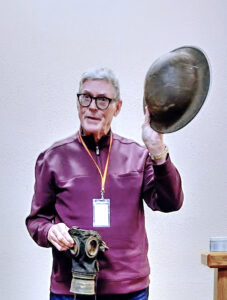
Correspondent photo / Susan Wojnar Mike Heher shares his grandfather’s WWI gas mask and helmet at a meeting of the Mahoning County Chapter of the Genealogical Society Wednesday.
BOARDMAN — On a winter evening inside St. Charles Church, weathered books, fading photographs, handwritten journals, military artifacts and fragile documents told stories far larger than their physical size.
The Wednesday night meeting of the Mahoning County Chapter of the Genealogical Society was not centered on charts or databases, but on tangible pieces of the past — objects that carried memory, loss, migration, faith, and survival.
Members were invited to bring in artifacts connected to their family histories and to share the stories behind them. What unfolded was a deeply human portrait of genealogy as lived experience rather than abstract research.
David Burnham, 67, of Canfield, began by sharing two books — volumes that shaped not only his understanding of his ancestry, but his approach to genealogy itself.
“I don’t like to call myself a genealogist,” Burnham told the group. “I prefer the term family historian.”
The first book, Deacon John Burnham of Ipswich and Ebenezer Martin of Rehoboth, Massachusetts by Elisabeth Puckett Martin, was purchased in the 1990s and traces Burnham’s direct paternal line in colonial New England. The book contains footnotes, maps, illustrations and deeply sourced documentation.
“It really makes my family’s lives in colonial New England come to life,” Burnham said. “It’s not just names and dates. You understand the world they lived in.”
The second book, The Wilms Family from The Netherlands to The United States, History, Memories and Genealogy 1713-1998, documents his maternal line. Compiled by relatives to commemorate the 90th anniversary of the Wilms family reunion, the book includes migration stories, memories, and generational records. Burnham’s grandmother served as the family reunion secretary, preserving births, marriages, and deaths — work Burnham himself later assisted with.
“About a third of the book includes family memories,” he explained. “Those memories really make the lives of my Dutch ancestors — who came here in the early 1800s — feel real.”
Burnham now serves as Historian of the Western Reserve Colony of the Mayflower Society of Ohio, where he helps others navigate their own family histories.
“Family history isn’t just a lot of lists and charts,” he said. “It’s about understanding how my family got me to the place in life I am now.”
Amy Suszynski of Salem held up a carefully preserved journal. Written in 1881 by Jacob Busch at the age of 83, it recounts his journey to America as a 12-year-old child, along with stories of earlier ancestors and relatives.
“I also brought my aunt’s family history that she wrote for my grandparents’ 60th wedding anniversary,” Suszynski said. “My family has lived in Greenford, Ohio, since the 1820s. I’m proud to be carrying on that tradition.”
For Lee Arent, 77, of Boardman, documents told the extraordinary story of his grandfather, Samuel Arent, whose life traced a path through persecution, immigration and achievement.
Born in 1894 to a German Lutheran family living on a land grant in Russia, Samuel’s early life was shaped by discrimination. His father was killed when Samuel was just 3. His mother fled Russia with Samuel and three other children, leaving the eldest son behind to tend the farm and carrying her husband’s body with her.
At age 12, Samuel’s journey nearly ended in Liverpool. A severe eye infection prevented him from boarding a ship to New York with his family. The family’s plans were halted until an unknown Jewish family — strangers waving goodbye — offered to care for Samuel until his eye healed. He was left alone in a foreign city.
Three months later, still only 12 years old, Samuel boarded a ship from Rotterdam and somehow reunited with his family in Jersey City. They eventually settled in Beaver Falls, Pennsylvania, where a strong German immigrant community helped them rebuild.
Samuel never attended school in America, yet by age 25 he owned a corner grocery store. By 27, he was a naturalized citizen with two children. He later served on city council and became a founding member of the Beaver Falls Municipal Water Authority. When he retired at 71, he still owned nine rental properties.
“He achieved all of this as a German immigrant, with no education after age 11, during World War I and World War II,” Arent said. “There was no discrimination in America against German immigrants.”
“If they lived in today’s America,” Arent reflected, “their story might be very different.”
Military history surfaced again through artifacts brought by Mike Heher, vice president of the society. He displayed his grandfather Michael Emmet Morkin’s World War I helmet, boots, gas mask, signal flags and a diary kept during his service in France.
Heher read excerpts from diary entries written in 1917 — ordinary days punctuated by Mass, meals, band concerts and boxing matches, set against air battles, rain-soaked nights and gas attacks. The diary transformed a distant war into a lived, daily experience.
“One of the interesting things,” Heher said, “is that my grandfather only talked about his service once. We didn’t know anything about it until after he died.”
Roslyn Torella, 59, of Lowellville and author of two books on the town’s history, brought a single photograph taken around 1907. It showed a family posed carefully — parents seated, a baby on the mother’s lap, and a small boy standing beside her.
“I knew the baby was my grandmother, Katherine Schein, born in 1906,” Torella said. “But that little boy stopped me in my tracks.”
Further research revealed a forgotten child — John Schein, born in 1906 and named for his father. He died at age 6 from membranous croup, a common killer of young children in the early 1900s.
“Without this photograph,” Torella said, “I may never have known he existed.”
While the evening focused on objects and stories, the broader mission of the Mahoning County Chapter framed their significance. President Tim Seman explained that the society exists to guide researchers and preserve local family histories, particularly those connected to the Mahoning Valley.
“Genealogy and local history are inextricably intertwined,” Seman said. “Genealogy brings history to life by placing real people in place and time.”
Mahoning County’s unique formation and industrial past, combined with its diverse immigrant population, make genealogy especially rich — and complex — in the region. The society collaborates with libraries, archives and historical institutions across county lines, helping researchers access records that tell fuller stories.
Ultimately, Seman emphasized, genealogy is about connection.
“You feel a sense of belonging from a shared life and shared fate,” he said. “You realize you have a seat at the table.”
Local News
On the record Trumbull County
Trumbull County WHAT: Trumbull County Board of Developmental Disabilities organizational meeting Jan. ...
Poland group continues campaign to keep library
POLAND — Jeanne Rostan served as spokesperson for the Poland Save Our Library Committee at Tuesday’s village ...
Traffic lights, gravel road top comments in Poland meeting
POLAND — Township Trustee Frank DeMain addressed Poland Village Council at its Tuesday meeting regarding the ...
Lordstown officials, residents object to renewed EPA permit for energy center
LORDSTOWN — Village officials and residents expressed their objections to the Trumbull Energy Center being given ...
Objects that carry lives
Investigation begins into officer involved shooting in Coitsville
COITSVILLE — The Ohio Bureau of Criminal Investigation is investigating an officer-involved shooting that took ...