

New report summarizes chemical spill, cleanup to date
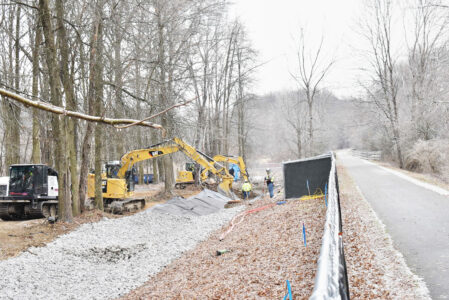
Staff file photo / Ed Runyan Workers were photographed in February of 2025 installing a liner in the “adjacent ditch” between the Mill Creek MetroParks Bikeway, right, and the Material Sciences Corp property at left. A fenced wetland and Sawmill Creek are just beyond the workers to the north.
CANFIELD — The Ohio Environmental Protection Agency and August Mack, the consulting company helping Material Sciences Corp. clean up the damage done by a July 2024 chemical spill at its factory near Canfield High School, have provided a new summary of the cleanup to date.
The summary, called a Corrective Action Framework, “is intended to summarize the goals and expectations of the (OEPA and MSC) that will facilitate any additional investigation, interim measures and other activities” at the site, the document states.
Although the document contains much regulatory and scientific jargon, it succeeds in giving an overview of causes of the spill at MSC’s factory at 460 W. Main Street. The spill was discovered when a person on the Mill Creek MetroParks Bikeway saw brown liquid in the ditch between the factory and the bikeway and reported it to authorities.
The report also summarizes the investigations of groundwater and vapor at the factory and at the high school late in 2024 and early 2025, and investigations of nearby Sawmill Creek. It explains that the Corrective Action Framework process began with a meeting in January of 2025 at the OEPA offices in Columbus involving the OEPA, August Mack and MSC.
The document also mentions several companies that operated the factory before MSC took it over in 2013 and discusses the kinds of hazardous-chemical investigations that have taken place there over the decades.
The following are some highlights of the document:
MSC is on a 9.75-acre site with an 84,000-square-foot main building and two small buildings. The buildings and asphalt fill 60 percent of the site. The rest is wooded and undeveloped. The location has “operated as a metal galvanizing and (metal) coil coating facility since the early 1950s,” the document states. In July of 2024, MSC conducted a scheduled cleaning of its factory, “which appeared to dislodge dark brown (water) that contained cyanide and metals.”
Before the 1950s, the property was used for agriculture until Life Time Products constructed the factory to manufacture coated steel products. It was known as Canfield Steel at one time.
After the spill in July 2024, MSC re-lined the basement and six inches of the lower wall of the factory with carbon steel “to prevent potential release of” chemicals used in the steel plating business from leaving the basement and getting into the environment. Two roof stormwater drainage pipes in the factory that were “believed to have corroded,” appeared to have allowed chemicals to be discharged from the factory, the document states. Both pipes were addressed by MSC, apparently to prevent them from contributing further contamination.
HISTORY
In August 1980, an “occupant” of the site notified the U.S. EPA of “hazardous waste activities at the site.” In 1993, the U.S. EPA carried out an assessment and “identified 12 Solid Waste Management Units at the site,” meaning areas from which “hazardous chemicals might migrate,” according to the U.S. EPA. The assessment found problems with one area, a chromate-treatment area. But the others were considered “not a significant potential for release.”
Based on August Mack’s investigation of the 2024 chemical spill and the “historical” chemical dangers at the site dating back years earlier, August Mack identified six areas as “areas of concern,” the document states.
They are the ditch between the factory and the Bikeway; a wetland at the far north end of the MSC property; Sawmill Creek, which flows just north of the factory; groundwater; shallow soil; and perched water, meaning water separate from the water table.
A 2016 environmental site assessment carried out by the property owner at the time indicated that in the 1970s, the company at the site was cited for an illegal discharge of cyanide from the northeast side of the factory building because of a cyanide spill into a drain. Hydroxide was used to “reduce the cyanide concentrations,” but “no cleanup was reported.”
TESTING
The testing done at the MSC site after the 2024 spill showed “elevated concentrations of trichloroethylene (a degreasing solvent), as well as hexavalent chromium, cyanide and zinc in soil at the factory, in the adjacent ditch, the wetland just north of the factory and Sawmill Creek, the Corrective Action Framework document states.
Lots of soil samples were taken in October of 2024, and permanent monitoring wells were installed in areas such as the wetland, the adjacent ditch and Sawmill Creek.
Environmental impacts were found in soil and groundwater on MSC site, as well as surface water and soil on other nearby properties. Testing done at the high school “out of an abundance of caution” showed no elevated levels of hazards in ground water or soil gas, the document states.
SAWMILL CREEK
A summary of surface-water testing near the factory stated that chemicals of concern were detected in “the adjacent ditch” near the factory, the “wetland (near the factory) and Sawmill Creek,” the document states.
“Based on these impacts, a fence was installed between the adjacent ditch and bike path,” the document states. Caution signs were also installed as an interim measure near Sawmill Creek just north of the high school to “limit … exposure (to contaminants) on Oct. 13, 2025.”
August Mack continues to try to “secure access agreements for additional sampling near Sawmill Creek,” the document states. The caution signs read: “Avoid recreational use” and “Do not drink the creek water.” The document states that no cleanup in that part of the creek can happen until further evaluations are carried out.
The document contains a statement that appears to be concerning: “Surface soil in Sawmill Creek exceeds Residential and Industrial (allowable levels) in some locations and is identified as a Complete exposure pathway” for residents, construction/excavation workers and recreators.”
A Texas Department of Health and Human Services web site states that a completed exposure pathway is one in which “Someone has been exposed to a hazardous substance in the past or present.” It states that a potential exposure pathway is “When people have been exposed to a hazardous substance in the past, might be exposed currently or may possibly be exposed in the future.”
The Centers for Disease Control has a YouTube video on the internet that states that “If an exposure pathway is complete, then all five parts of the pathway are present and an exposure is occurring or has occurred in the past.”
A separate CDC YouTube video states that the first pathway is a contaminant source. The second looks at how the chemical might move or change in the environment. The third pathway is how a person could come in contact with the chemical. The fourth pathway is “how a chemical enters a person’s body,” such as touching water. The fifth pathway is whether there are people in the community who could be exposed, the video states.
One of the most recent documents in the Ohio EPA documents web site, dated Feb. 12, was the monthly progress report for January. It mentions without explanation that “Results from sampling conducted at residential properties along Sawmill Creek in December 2025 were provided to residents in January 2026.
When Bryant Somerville, OEPA spokesman, was asked Friday whether the areas tested recently are along Briarcliff Drive, he said more information will be provided in a later report.
DOWNSTREAM SAWMILL CREEK
Testing of “Downstream Sawmill Creek,” starting at Cardinal Drive near Canfield High School and proceeding north toward the Meander Reservoir, which is 3.75 miles away, showed no surface water or sediment detections above OEPA surface water allowable levels. That testing took place in April and May 2025.
The report states that arsenic “appears to have a widespread distribution” at elevated levels at the factory and nearby. But “arsenic is not used” at the factory,” and “concentrations” of arsenic at or near the factory “were generally within (acceptable) levels established in Mahoning County.”
The document adds that “there is no evidence that arsenic was ever used at the (factory) historically.” Arsenic “is not identified as a site contaminant of concern,” the document states.
NEXT STEPS
The Corrective Action Framework document does not make it clear what is next for the cleanup. But it states that an investigative report is due the first half of 2026.
It states that in the second half of 2026, a Corrective Measures Study is due.
According to the Dec. 31, 2024, Ohio EPA Director’s Final Findings and Orders for the MSC cleanup, a Corrective Measures Study is the name for “the activities to be undertaken to develop and evaluate potential remedial alternatives for the cleanup of the facility.”
MSC spokesman Dan Williamson stated on the MSC Response web site that “MSC will continue to complete all necessary sampling required … so the project can move on to the next phase of the remediation process.”
He said that once all sampling is complete, a final report “detailing all results will be compiled and provided to Ohio EPA for review and approval. That report is currently expected to be submitted sometime in Summer 2026,” he stated.
He stated that MSC “continues to implement the soil, groundwater, and subsurface vapor sampling required (by the OEPA). Initial phases of … sampling have been completed, and MSC has been working closely with the Ohio EPA to assess the results.”
BIOLOGICAL HEALTH OF SAWMILL CREEK
A recent study was carried out on the biological health of Sawmill Creek and the soil and sediment in the creek.
Lisa Cochran, Ohio EPA public information officer, stated in an email that the study, carried out by MAD Scientist Associates, showed that since 2013, “the habitat has shown improvement, and the fish and macroinvertebrate community remains consistent with Ohio’s water quality standards.”
As of late January 2026, the OEPA was “reviewing the report, making sure the study complied with” the work plan for the cleanup. If it does, the OEPA will notify the report’s authors, “acknowledging the report’s completion. After that, the Ohio EPA will determine if additional data is needed.”
Williamson stated on the MSC Response website that the study looked at the “habitat, fish community and invertebrate community in Sawmill Creek during the summer of 2025.”
The study “followed the Ohio EPA approved biological sampling plan, recommended site locations and sampling guidelines. The locations for the 2025 sampling were chosen by Ohio EPA for comparison against a 2013 Ohio EPA biological and water quality study of the Lower Mahoning River Watershed, which includes Sawmill Creek.”
Williamson stated that “The study revealed that the Sawmill Creek biological metrics ranged from fair to excellent. Since 2013, the habitat has shown improvement. The fish and macroinvertebrate community is consistent with Ohio’s water quality standards.”
Attempts to get assistance from biology professors at Youngstown State University and The Ohio State University to translate the terminology in the report for nonprofessionals, including the public, was not successful.
Local News
Mahoning County courts
Marriage licenses granted Feb. 9 to 13 in Mahoning County: Scott David Honthy, 50, Youngstown, and Michelle ...
On the record | Struthers, Campbell boards of education
Struthers WHAT: February board of education meeting PRESENT: Walter Baber, Kristin Fox, Joseph Fuline, Robert ...
Woman, 78, is killed in New Middletown crash
NEW MIDDLETOWN — Two vehicles crashed around 11:30 a.m. Friday on state Route 170 just north of East Calla Road, ...

DownBeat center stays upbeat on local talent
Betras threatens suit over Oakhill
ODOT plans Weathersfield sidewalk project
WEATHERSFIELD — The Ohio Department of Transportation plans to replace approximately 1,636 feet of deteriorated ...