Canfield students connect
Amateur radio links school to astronaut aboard space station
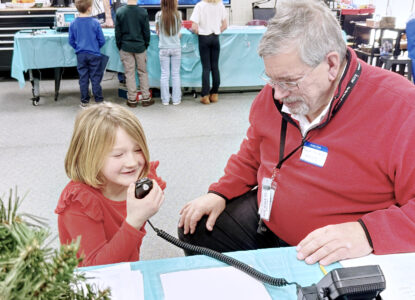
Submitted photo Hilltop student Reagan Smidt gets used to talking over the airwaves under the guidance of Mahoning Valley Amateur Radio Association member David Touvelle during a Mission Canfield program earlier this month. A group of 20 students was able to talk to an astronaut aboard the International Space Station.
CANFIELD — A group of 20 Hilltop Elementary School students was able to talk to an astronaut aboard the International Space Station earlier this month.
It was a rare and special program that is still part of their classroom studies, and even has students looking at an interesting hobby — amateur radio.
“We are continuing to use what we learned from the event in our classes,” said Hilltop teacher Bethany Lopatta. “Students are still adding information to their ‘space folders,’ which serve as keepsakes and learning portfolios. These folders include QR codes linking to recordings and videos from the experience, along with facts and reflections about what they have learned.”
She said the excitement has continued beyond the event, and even has some students interested in amateur radio to the point they are now planning to work toward getting their licenses.
The connection with the space station didn’t happen overnight. It actually began in April of 2025 when Lopatta and teacher Stephanie Palumbo applied for the “Live Space Contact” after one of Lopatta’s second-grade students said she had a relative who worked for NASA. The relative agreed to have a virtual meeting with the Hilltop second graders.
After arranging for the virtual meeting, Lopatta was driven to begin searching for information about space and NASA on her phone. From that search, a NASA application popped up on her Facebook feed. She checked into it and found the application was legitimate.
“We had to apply for this,” Palumbo said.
They filled out the application and didn’t find out about the acceptance until October. To prepare for the NASA connection, the students had to learn about amateur radio. When Hilltop was approved for the program, referred to as ARISS (Amateur Radio on the International Space Station) it was linked up to local amateur radio operators.
One of those operators was Ronald Leckfor of the Warren Amateur Radio Association.
“This was the first time I was involved in an ARISS Contact, which is a program designed to enable schools to make contact with the International Space Station,” Leckfor said. “This ARISS Contact was arranged by Gordon Scannel of Michigan and fellow Mahoning Valley Amateur Radio Association member Dave Scannel.”
He said there are only approximately 24 ARISS contacts with schools per year, so this was a unique and rare event for Hilltop Elementary School.
“The students involved in this event will still be in junior high school when the ISS is deorbited into the South Pacific Ocean by a special version of the SpaceX Dragon capsule in 2030,” Leckfor said.
Leading up to the ARISS contact, students were involved in a wide range of preparatory activities. During Radio Week, in collaboration with members of the MVARA, students learned about radio communication, call signs and Morse code, exploring how astronauts communicate with Earth.
Students also learned about all of the astronauts aboard the International Space Station, including their backgrounds, roles, and missions. This helped the students understand the teamwork required to live and work in space.
In October, students had a video chat with a retired astronaut, John Herrington. The event gave them additional real-world perspectives and firsthand stories about life and work in space.
“Earlier this year, we also held a full STEM Week focused on forces and motion, where students built and launched rockets made from pool noodles,” Lopatta said. “This hands-on activity helped them understand the science behind motion and gave them a fun, interactive way to explore engineering and physics concepts.”
All students participated in related field trips throughout the month of January, including visits to the Youngstown State University planetarium and the OH WOW! Science Center, helping to build excitement and deepen their understanding of space, science, and exploration.
Just prior to the ARISS event at Hilltop, the students were introduced to amateur radio during the first week of February, which is known as “Radio Week” that leads up to the Feb. 13 World Radio Day. During Radio Week, students got a thorough introduction into the world of amateur radio.
“As a member of Mahoning Valley Amateur Radio Association, I am happy to have participated in one of several ways we helped prepare these talented students at Hilltop Elementary School for their out of this world Mission Canfield,” Leckfor said. “MVARA helped all the students learn about the radio system used to enable the students to speak with the astronaut aboard the ISS and even Morse Code, which they loved doing. They learned about the concept frequencies with a demonstration using tuning forks and an oscilloscope to show the signals the tuning forks create.”
Leckfor said the students also were introduced to the same orbital map used during the actual contact to show them exactly where above the earth the ISS was at any time.
To allow the students to learn how to conduct a one-way at a time conversation with amateur radios, they were given an opportunity to talk on high frequency amateur radio bands with other amateur radio operators, and then they were given a chance to talk with Santa over VHF 2 Meter Radio or for the older students, play the Guess which Animal I Am game over the airwaves.
“I, personally had a blast working with these great children and Stephanie Palumbo, helping them push through their shyness and get used to talking on a one-way at a time, radio system by squeezing the push to talk button on the microphone, saying what they wanted to say, and then saying ‘over’ when they were finished speaking,” Leckfor said. “I worked the 2-meter talk to Santa station for two days and there were many others on our MVARA ARISS team involved who manned these activities, getting these children oriented with a small taste of STEM and the practical application of all of the above, in the form of amateur radio.”
He said it is the technology that serves to strengthen local communities with emergency communications when weather causes electric utilities to fail and the cellphone towers to run out of battery backup.
On the day of the ARISS contact, Lopatta said the students welcomed guest speakers. One was a student’s uncle, who is an engineer helping to create the new ISS, which will be launched in 2030. Ohio Gov. Mike DeWine was invited to the event, but he was busy on the contact day, so he recorded a short video of himself talking to the Hilltop students right before the live contact with astronaut Chris Williams.
In addition, Marie Rupert’s class designed, sold and made shirts for all students to wear on the day of the event as part of their class economics project, adding another layer of excitement and unity for this special day.
Palumbo and Lopatta were able to travel to the Kennedy Space Center in Florida over the Martin Luther King Jr. holiday weekend to receive ARISS-related training, which helped ensure the contact and surrounding activities were as meaningful and successful as possible for their students.
The actual contact was a very brief 10 minutes as the ISS was directly overhead and in contact range. Among some of the questions asked of Williams were: what is the most important thing to do now for a student to become an astronaut, what is the most unusual thing seen from space, what did it feel like when the rocket lifted off, and how long did it take to get used to low/no gravity?
The Mission Canfield program continued on Feb. 17, when students took part in a Google meet with astronaut John Shoffner, who served as a pilot for Axiom Space’s Ax-2 mission to the International Space Station aboard the SpaceX Dragon. Several students asked questions while the school watched from their classrooms.
“It was a wonderful experience for our students in grades K-4 and a meaningful continuation of our recent space activities,” Lopatta said. “He did an outstanding job explaining his journey, thoughtfully answering students’ questions, and sharing photos and videos from his training and time in space. Our students were highly engaged throughout the session, and it truly was a memorable opportunity for them to connect with someone who has lived and worked in space.”
Shoffner shared how his journey to space was fueled by curiosity, perseverance and a passion for learning. He spoke about using his mission to inspire students and teachers around the world and encouraging them to pursue their interests and dream big in this new era of space exploration.
As part of the students’ Mission Canfield event, each received a NASA folder where they could keep track of their activities and make reflections, research and record what they have learned. As they progress, they earn “badge” stickers similar to mission patches the astronauts receive and they can store them in their folders.
The whole ARISS experience was one that Palumbo and Lopatta plan to keep on their radar for the future.
“The experience with amateur radio on the International Space Station really sparked student interest in space, so we plan to continue space studies this year and in the future,” Lopatta said. “This was an unbelievable experience for our students, and we encourage schools to explore and apply through ARISS USA. Their mission is to bring this opportunity to students who may never have an experience like this before. Once we have a completely new group of elementary students in about six years, we would love to apply and do it again.”
Local News
Mahoning county courts
Marriage licenses granted Feb. 17 to 20 in Mahoning County: Ron Curtis Davis, 41, Austintown, and Emily Patricia ...
Property transfers
Property transfers recorded Feb. 17 to 20 in Mahoning County and portions of Trumbull County: ...
Cambodia takes back looted artifacts handled by British art dealer
PHNOM PENH, Cambodia (AP) — Cambodian officials on Friday received more than six dozen historic artifacts ...
Poland district’s forecast shows deficit spending in ’27
Woman charged with arson in Hillman Street fire
YOUNGSTOWN — Yvonne Howell, 68, was arraigned Friday in Youngstown Municipal Court on a charge of aggravated ...