Acclaimed poet visits Volney Rogers
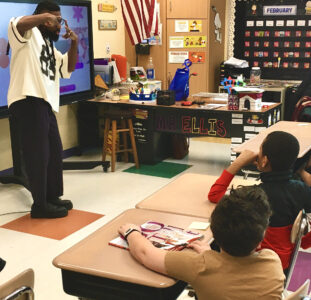
Correspondent photos / Sean Barron Quartez Harris, a Cleveland-based poet and teaching artist, conducted a workshop Wednesday for Volney Rogers Elementary School second- and third-graders about the art of writing, as well as on his latest book, “Go Tell It: How James Baldwin Became a Writer.”
YOUNGSTOWN — At a young age, Amarion Chilton already has built a firm foundation on civil rights history — not to mention having internalized an invaluable life lesson.
“They fought for us to have everything, and that we can do what we do now,” Amarion, a Volney Rogers Elementary School third-grade student, said. “It doesn’t matter what skin color you are; we’re all the same inside.”
Perhaps a driving force that brought such observations and sentiments to the forefront of Amarion’s mind and heart was having heard a presentation from, and dialogue with, Quartez Harris, an acclaimed poet and teaching artist who visited the school, 310 S. Schenley Ave., on Wednesday. Harris also discussed his latest children’s book, “Go Tell It: How James Baldwin Became a Writer.”
Sponsoring Harris’ appearance at the school, where he also spoke to classes of second-graders, was Mahoning Valley Sojourn to the Past.
Amarion, who said he hopes one day to start writing children’s books, cited several pivotal civil rights figures he’s studied and admires: Rosa Parks, who famously refused to relinquish her bus seat to a white passenger Dec. 1, 1955, and was pivotal in launching the 13-month Montgomery Bus Boycott; Minnijean Brown Trickey, one of the nine students who integrated the all-white Central High School in September 1957 in Little Rock, Arkansas, and became part of the “Little Rock Nine;” and Joan Trumpauer, a civil rights activist who took part in more than 50 sit-ins and was among the Freedom Riders who were arrested in May 1961 in Jackson, Mississippi, where she and some of the others served two months on Parchman Penitentiary’s notorious Death Row.
Harris told the rapt and inquisitive third-graders in Mark Ellis’ class that Baldwin had developed an early interest in reading — so much so that at one point, his mother, Emma B. Jones, hid his favorite book on the top shelf of a bathroom closet, fearing that if her son repeatedly read it, he would damage his eyes.
Nevertheless, the young Baldwin found the book, and he spent several days per week at the 135th Street Library in Harlem, where he further procured his love of books before he used a pencil to write his school’s song that became its first play.
“He wrote about his pain,” Harris said, referring to how Baldwin, the oldest of nine children, dealt with continually being mocked for his appearance.
To further underscore the budding writer’s love for words, Harris used the analogy of glitter, pointing out that the tiny shiny particles are difficult to remove – just as Baldwin “couldn’t get words off him.”
Some other early forays into the writing field for Baldwin came when he attended Frederick Douglass Junior High School in Harlem, where he edited the school newspaper, the Douglass Pilot. Around the same time, and under the tutelage of faculty advisor Herman W. “Bill” Porter, the young student published his first essay, “Harlem – Then and Now” in the autumn 1937 edition.
While a student at DeWitt Clinton High School in the Bronx, Baldwin was the literary editor for the Magpie, the school magazine, before he graduated in the early 1940s. One of his classmates was famed photographer Richard Avedon.
In all, Baldwin wrote 22 books that included fiction and poetry, along with a children’s book for a relative, Harris noted. A theme that coursed through most of his works was telling the stories of those whom he perceived had been treated unfairly “and to heal the world. You can heal the world with books and words,” Harris told the students before having them repeat several times in unison, “I can do it, too.”
“When you read about James Baldwin, you’re also reading about yourself,” the Cleveland writer and educator continued.
Before delving into the famous author and playwright’s life, Harris shared with the students and teachers a few of his own struggles that included having been in kindergarten without knowing how to correctly spell his name. Consequently, reading and writing were highly challenging for the young student before a teacher encouraged him to try his hand at poetry, an art form that provided latitude to be structurally nonsensical, as well as with extra space outside of always following the ironclad rules of grammar.
“My whole life, everyone told me my reading and writing was a deficiency. I never thought I could use my deficiency until I was introduced to poetry,” Harris said in a March 2024 interview with The Land, a Cleveland publication. “I could break things apart, break words apart and perform with words. That’s when I was like, ‘All right, I’m in.'”
During his often humor-laden appearance, Harris also took on the role of motivational speaker via encouraging the students to realize that even if they don’t become writers, they have the capacity to find success after challenging themselves to achieve difficult feats.
“The very thing you think you’re not good at can be the very thing that brings out the best in you,” he said, adding, “It’s your job to lean on people who believe in you when you don’t (temporarily) believe in yourself.”
That message seemed to have resonated with Amarion, who said his greatest takeaway from Harris’ time in the classroom was better understanding the importance of reading and maintaining positivity, both of which can open many doors.
Harris also is a Baldwin House fellow and was named Ohio Poet of the Year for his book “We Made it to School Alive.” In addition, he has spent several years as a second-grade teacher in the Cleveland Public Schools and continues to teach poetry workshops.
Local News

Zetzer again withdraws from congressional race
Trumbull elections board allows candidate to run without full name on ballot
WARREN — The Trumbull County Board of Elections agreed to permit Shelley Pratt Sandberg to run for probate court ...
Acclaimed poet visits Volney Rogers
Rulli seeks to censure Democratic congressman
U.S. Rep. Michael Rulli, R-Salem, introduced a resolution to formally censure Democratic Congressman Al Green for ...
Youngstown board to buy 2 Chill-Can parcels
YOUNGSTOWN — The city’s board of control today is expected to approve paying $10,000 to a former Chill-Can ...