

Winter storm on target to smash Valley
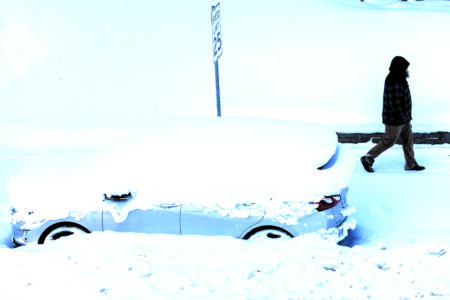
A person walks by a vehicle that was plowed in by snow in Grand Rapids, Mich. on Friday, Jan. 23, 2026. (Joel Bissell/Kalamazoo Gazette via AP)
The Mahoning Valley may not have had a white Christmas, but it seems Mother Nature has not forgotten that it is indeed winter in Northeast Ohio, and she plans to remind us of it this weekend in grand fashion.
The National Weather Service in Cleveland warns of an imminent winter storm that should begin in the Valley overnight Saturday and continue through Sunday, depositing anywhere from 6 to 10 inches — and possibly as much as a foot — of snow.
While social media is rife with jokes about inconsistency in meteorologists’ predictions, Karen Clark of NWS in Cleveland said there is no mistaking what their radar shows — the storm is coming.
“This storm in particular has a lot of uncertainty, especially from a national perspective, because there will be a lot of snow and ice farther south, but here we’ll stay entirely on the snowy side of things,” she said. “The snow, once it starts, it’s going to snow for quite a while, maybe a full 18 hours, beginning late Saturday night through Sunday evening. During that time, we expect to see about 8 to 10 inches.”
Clark said the storm will not meet the standard for blizzard conditions because the wind will be relatively tame — only about 10 mph in the Youngstown-Warren area — as opposed to the 35 mph threshold to be considered a blizzard.
In addition to the snow, extremely cold weather also is on the way. While Sunday’s temperatures will hover around 20 degrees and perhaps dip a bit below, come Monday and Tuesday, Clark said, the temperature will plummet with wind-chill values between minus 5 and minus 15 degrees.
STATE OFFICIALS’ ADVICE
The storm has the attention of officials statewide and in a joint news release from the Ohio Department of Public Safety and Ohio Department of Transportation, Gov. Mike DeWine advised caution.
“We are watching the storm closely, and I’ve directed our state agencies to be ready to clear the roads and help motorists as soon as the snow hits,” DeWine said. “The best way you can help law enforcement and road crews is to prioritize your own safety by taking your time on the roads, being patient and giving snowplows plenty of room to work if you must travel.”
The release notes that very low temperatures will make snow removal challenging for road crews because salt is less effective once temperatures drop below 20 degrees. ODOT will mix in additives to activate the salt at lower temperatures, but drivers should expect roadways to take longer to clear after the snow stops falling.
“Our snowplow drivers will be working long hours to keep the roads safe and passable, please do your part by driving for the conditions, putting your phone down and giving crews room to work,” said ODOT Director Pamela Boratyn.
The release states that ODOT plows have already been struck 30 times this winter, compared to 54 total last year.
“Many of these crashes are the result of drivers following too close and rear-ending plows or drivers losing control while trying to pass plows,” Boratyn said.
FIRE DEPARTMENTS PREPARED
Local fire departments also are taking precautions.
“One of the things we do as a fire department is pay attention to weather, so that we can increase staffing if need be,” said Howland fire Chief Ray Pace. “Since this will be a snow event, our department has its own plow truck. If someone calls 911 for an ambulance, sometimes people’s driveways may not be plowed, so we can send that plow truck with the ambulance, so we can get people out of their home safely and get them into the ambulance quickly.”
Austintown fire Chief Dave Schertzer said his department also keeps a plow truck, and when the weather gets extremely cold, they try to keep larger fire apparatus in the garage and send staff out in SUVs for nonfire and non-EMS calls, such as carbon monoxide checks.
“We take a lot of factors into consideration — what are the impacts of the storm going to be, do we need to do something special or not?” he said. Schertzer said Valley residents should not panic about the storm.
“As significant as it sounds, getting 8 to 10 inches or a foot, if you realize that it will be spread over 24 or 36 hours, it’s probably not going to be as big a deal because there’s time for road departments to come out and plow and salt the roads,” he said. “I don’t think we’re going to have any periods where the snow is coming down at such a rate that it can’t be dealt with.”
Southington fire Chief Scott Bower, a member of the Trumbull County Emergency Management Agency board, is working with all agencies and the 911 center to establish a marking plan for vehicles stranded on the road.
“It’s just something we came up with to cut down on duplicate responses. We’ll have a car in the ditch, maybe on (Route) 11, and get multiple calls about it,” he said. When the first crew responds to the vehicle and clears that scene, they’ll mark it with caution tape. When a passing motorist calls it in again, dispatch can ask if they’ve seen the tape. If they have, they know another unit does not need to be sent.
“And that can help to cut down on responses to keep everybody safe and off the roads,” Bower said.
Clark, Bower, Schertzer and other officials all advise residents to just take time Saturday to stock up on some food and water, stay off the roads unless absolutely necessary, and just stay warm and dry.
For those who must travel, ODOT and ODPS recommend they stock their vehicles with a winter car kit that includes: ice scraper, shovel, jumper cables, flashlight, warning devices, blankets, cell phone charger, first aid kit, water and food.
“It’s also important to make sure that your tires have plenty of tread, check your battery and keep your windshield washer reservoir full. In the event of a broken-down vehicle or crash, turn on your hazard lights, move your vehicle as far off the road as possible, remain inside the vehicle and safely call #677 or 911 for assistance. If your vehicle becomes stuck in the snow, clear the tailpipe of any possible debris to decrease the chance of carbon monoxide poisoning,” the ODPS release states.
RED CROSS SAFETY TIPS
The American Red Cross offers these tips to stay safe during the storm:
* Stay warm indoors to prevent frostbite and hypothermia.
* Make sure you can heat your home safely. Prepare your home to keep out the cold with insulation, caulking and weather stripping.
* Consider using an indoor thermometer or thermostat to monitor the temperature inside.
* Plan to check on loved ones and neighbors to make sure they are staying warm. This is especially important for older adults and babies.
* Drink plenty of warm fluids, but avoid caffeine and alcohol.
* Avoid travel if you can.
* If you must go outside, plan to dress properly. Keep your nose, ears, cheeks, chin, fingers and toes covered in warm, dry clothing. These areas are the first to be at risk for frostbite. Wear layers of loose clothing, a coat, hat, mittens and water-resistant boots. Use a scarf to cover your face and mouth.
* Know where you will go if your home becomes too cold. You could go to a friend’s house, a public library or a warming center.
* Gather emergency supplies, such as food, water and medicine before the storm. Stores might be closed and it may be unsafe to travel.
* Organize supplies into a “Go-Kit” and a “Stay-at-Home Kit.” The Go-Kit should have at least three days of supplies you can carry with you if you need to go somewhere else to stay warm. Include critical backup batteries and chargers for your devices (cell phone, CPAP, wheelchair, etc.) The Stay-at-Home Kit should have at least two weeks of supplies.
* Ensure you have enough warm clothing, such as hats, mittens and blankets for everyone in your household. Don’t forget about your pets.
* You may lose access to drinking water. Set aside at least one gallon of drinking water per person per day.
* Consider having emergency supplies in your vehicle, such as a blanket, warm clothing, a first aid kit and boots.
* Have a one-month supply of needed medications and medical supplies. Consider keeping a list of your medications and dosages on a small card to carry with you.
* Have a snow shovel and ice-melting products to keep your walkways safe.
* Be ready to live without power, gas and water.
* Learn how to keep pipes from freezing.
Local News
Property transfers
Property transfers recorded Jan. 12 to 16 in Mahoning County and portions of Trumbull County: Austintown ...
Police chief in Austintown charts path to recovery for department
Air Force veteran appointed Trumbull dog warden
An Air Force veteran with extensive dog handling experience will oversee the Trumbull County dog pound starting ...
Missing file found in Mahoning baby murder case
YOUNGSTOWN — Despite whatever complications arose last year preventing the Mahoning County Prosecutor’s Office ...
Commissioners may seek state AG opinion on tax map move
WARREN — Trumbull County commissioners are discussing requesting an opinion from the Ohio Attorney General’s ...
Statewide clerk of courts group to embattled Ciccone: Resign
YOUNGSTOWN — The Ohio Clerk of Courts Association has censured controversial Mahoning County Clerk of Courts ...