

West Virginia Senate considers historical Bibles in classrooms
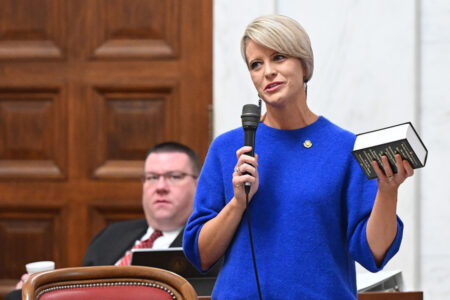
Photo courtesy of West Virginia Legislative Photography West Virginia Senate Education Committee Chairwoman Amy Grady said Wednesday a bill she was the lead sponsor of would allow schools to receive donations for copies of the first Bible printed in America at the end of the Revolutionary War.
CHARLESTON, W.Va. — Some lawmakers in the West Virginia Senate want to put copies of the first Bible printed in revolutionary America in certain classrooms, but an effort by others to amend the bill to include the Catholic Bible failed.
Senate Bill 388, requiring public elementary or secondary schools to make the Aitken Bible available to certain classrooms, was on second reading and amendment stage Wednesday. The bill will be up for passage in the Senate today.
The bill mandates that all public and charter schools provide the Aitken Bible to specific fourth-, eighth-, and 10th-grade social studies classrooms. The legislation prohibits the use of public funding to purchase these Bibles, but schools can accept private donations to acquire the necessary materials.
HB 388 was one of the first bills recommended for passage by the Senate Education Committee since the start of the 2026 legislative session, which began Jan. 14. The committee recommended the bill for passage Jan. 22. Senate Education Committee Chairwoman Amy Grady, R-Mason, is the lead sponsor of the bill.
“The bill as it’s written currently makes the Aitken Bible available as a resource for students in fourth-, eighth-, and 10th-grade classrooms,” Grady said. “Those particular ages were chosen because of the content standards that are taught in social studies and history classes in that time period.”
According to the Library of Congress, the Aitken Bible was first printed by Philadelphia publisher Robert Aitken in 1782. The 1,452-page King James Bible is considered to be the first Bible printed on American soil and is sometimes called the “Bible of the Revolution.”
“The significance of this particular Bible is that it is historical to our nation because during and after the Revolutionary War and the American Revolution when trade was stopped with Britain, we stopped receiving many products. One in particular was the Bible,” said Grady, a fourth-grade teacher. “In fact, it was illegal to print Bibles in America. You had to get them from Britain. So, when we stopped receiving that, in response, Congress actually approved this one particular Bible.”
A U.S. Supreme Court ruling prohibits the use of the Bible in public schools for religious purposes, but it does allow for the use of the Bible as part of academic curriculum. SB 388 does not require West Virginia students be taught about the history of the Aitken Bible, only that the Bible be made accessible to social studies students.
“The significance of this particular Bible has to do with historical significance,” Grady said. “It is not religion-based. And it’s not saying the teacher has to use it to instruct from. It’s just making it available to students in the classroom as a resource because those contents (of American history) are being taught.”
West Virginia Senate Minority Leader Mike Woelfel, D-Cabell, attempted to offer an amendment of SB 388 to also require the Catholic American Bible in fourth-, eighth- and 10th-grade social studies classrooms.
Woelfel’s amendment failed in an 8-25 vote Wednesday.
West Virginia Senate Assistant Minority Leader Joey Garcia, D-Marion, argued that by supporting the inclusion of the Aitken Bible, lawmakers were once again adding an additional unfunded mandate on public schools.
“This seems to be another situation where we are requiring something to be done in our public education system,” Garcia said. “If it’s going to be done, I might even go more broadly. If we’re going to provide access for this Bible, then why not the Catholic Bible? Why not the Koran? These all have historical importance.”
Local News
Man charged with 14 counts of arson to be evaluated for sanity
YOUNGSTOWN — Mahoning County Common Pleas Court Judge R. Scott Krichbaum on Wednesday ordered that an evaluation ...
Man sentenced to two years in prison for drunken crash
West Virginia Senate considers historical Bibles in classrooms
Compromise sought in Trumbull tax map debate
WARREN — Trumbull County commissioners are hoping to bring the county engineer and auditor together in a meeting ...
Students inspired by local history
Bill would ease efforts for larger townships to become cities
Legislation introduced by state Rep. David Thomas would make it easier for larger townships to become cities with ...