

ThriveMV continues supporting immigrants
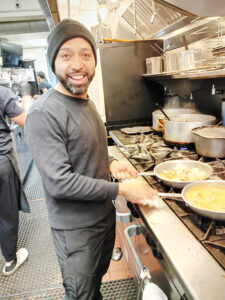
Correspondent photo / Susan Wojnar Jorge Carreno, 42, of Girard, who immigrated from Mexico in 2003, demonstrates his cooking skills at Margherita’s Grille, which he operates, along with El Hefe, both in Girard.
Thrive Mahoning Valley was founded with a simple but powerful mission: to ensure immigrants and newcomers feel welcomed, supported and connected in the Mahoning Valley.
According to Vicki Vicars, vice president of operations, the organization emerged in response to an urgent local need following Hurricanes Maria and Irma, when families displaced from Puerto Rico began relocating to the region. Many arrived facing significant barriers — particularly language access and unfamiliar systems — that made even basic tasks overwhelming.
Early efforts focused on ensuring these families could access essential services without those barriers standing in the way. Led by Justin Mondok and Christopher Colon, graduates of the Raymond John Wean Foundation’s Emerging Leaders Program, the initiative received early backing through the Foundation’s Community Investment Grant program. That original spirit of friendship, advocacy and hands-on assistance continues to guide ThriveMV’s work today.
“Navigating a new life in the Mahoning Valley can be daunting,” Vicars said. “Thrive Mahoning Valley is there every step of the way.”
Recognizing that each newcomer’s journey is different, ThriveMV provides individualized support that includes help with applications, translation services, household and hygiene pantries, Goodwill vouchers, housing referrals, English language classes, employment and education connections, transportation assistance, referrals for legal aid and citizenship services, and most recently added, a farmers market.
Transportation remains one of the most persistent barriers, particularly for international students and adults without access to a vehicle. To address this gap, ThriveMV operates the Pedal Forward Program, which provides bicycles and safety equipment to newcomers.
The program relies on donations of gently used or new bikes, parts, helmets and locks, which can be dropped off at ThriveMV’s Wilson Avenue location in Youngstown. The effort is supported by a social enterprise bicycle shop that refurbishes and sells bikes and gear, with proceeds reinvested into the program.
Vicars emphasized that meaningful integration requires collaboration. ThriveMV helped establish the Newcomers Network, a coalition of organizations working together on immigration, resettlement, and repopulation efforts. Through the network, partners identify emerging needs, share resources, and advocate collectively for newcomer communities.
The organization also works with local employers to foster inclusive workplaces, offering professional Spanish translation services, human resources consulting and cultural competency training for leadership and staff. Outreach extends to youth and the broader community through partnerships with the Youngstown City School District’s English Language Learner Program, mentorship initiatives, educational presentations on belonging and cultural history, and community meals that provide hot food with support from local donors.
Several Mahoning Valley residents who relocated from other countries shared their experiences — stories that reflect both opportunity and the ongoing challenges of building a new life.
FINDING A NEW HOME IN THE VALLEY
When Jacqueline Nash, 52, of Canfield, arrived in Ohio from Canada in the 1990s, the Mahoning Valley was never intended to be a permanent destination. She initially moved for work, spending a decade in Cleveland before settling in the Youngstown area. At the time, she was a programming language instructor for Adobe and needed access to multiple airports.
What began as a practical decision gradually became something deeper.
“Over time, it really became home,” Nash said. “I built my life here and eventually I built my business here too.”
Today, Nash owns and operates Skin Solution Med Spa in Boardman — a business that reflects both her professional journey and her commitment to the community she now calls home.
As a Canadian, Nash said her transition was relatively smooth. Cultural and language barriers were minimal, and she quickly felt accepted. What stood out most, she said, was the warmth of the people.
“The Mahoning Valley just feels warmer and more welcoming than Cleveland,” she said. “People here are friendlier and more approachable. There’s a sense of community that makes you feel seen.”
Her husband’s experience, however, revealed a different reality. An immigrant from Colombia and a trained plastic surgeon, he faced significant challenges tied to language — not just vocabulary, but nuance.
“Language isn’t just about knowing English,” Nash said. “One unfamiliar word or phrase can completely change the meaning of a conversation.”
She recalled watching him struggle during early job training, including a routine visit to the Bureau of Motor Vehicles. When an employee asked him to place his face against a headrest and identify a blinking light, the terminology itself became a barrier.
“He had never heard words like ‘headrest,’ ‘chin brace,’ or ‘blinking,'” Nash said. “He was completely confused. Luckily, I was there to paraphrase.”
Experiences like that reinforced for Nash the importance of organizations such as Thrive Mahoning Valley and the English Center of Youngstown.
“They don’t just provide resources, they build confidence,” she said. “They help people feel less embarrassed, less isolated and more capable of navigating daily life.”
At her med spa, Nash strives to offer that same compassion. Whether clients are dealing with acne, scarring, aging or weight concerns, she aims to help them feel more comfortable in their own skin.
“We live in a world where appearance still affects how people are treated,” she said. “If I can help someone feel more confident and move through life with less self-consciousness, that matters.”
Nash also pointed to transportation as a persistent barrier for immigrants. Her husband did not obtain a driver’s license until his 30s, having lived in places with robust public transportation.
“Here, limited public transit makes everyday life much harder,” she said. “When you add language barriers, things like work, appointments and paperwork can become overwhelming.”
Despite those challenges, Nash describes the community response as overwhelmingly positive.
“People here are curious and welcoming,” she said. “They love a story, and they love rooting for people. That’s one of the things I appreciate most about Youngstown.”
FROM MEXICO CITY TO GIRARD KITCHENS
Jorge Carreno, 42, of Girard, came to the Mahoning Valley from Mexico City with little more than kitchen skills learned at home and an expectation that his stay would be temporary. Today, he owns and operates Margherita’s Grille and El Hefe, two successful restaurants in downtown Girard.
Carreno began cooking at age 7 alongside his mother, making tamales and learning the value of hard work. As a teenager, he sold food at flea markets. At 19, he immigrated to the United States, settling in Warren, where he worked long hours as a dishwasher, prep cook and line cook while studying English in his spare time.
His original plan was to earn money for college and return to Mexico. That changed after meeting his future wife, Amy Simeone, while working in the restaurant industry.
In late 2006, the couple planned to move to Mexico, but a family loss and an unexpected opportunity altered their course. Within 24 hours, they decided to stay after Amy’s father offered to help them renovate Little Pipino’s restaurant in Girard. In 2007, they opened Margherita’s, named after Amy’s grandmother.
Carreno credits mentor Henry Barrios, former chef at Alberini’s, with helping him understand the business side of running a kitchen. Today, Margherita’s features made-to-order Italian and American dishes, alongside rotating biweekly specials.
Carreno openly acknowledges that he initially entered the United States without legal status and later obtained a work permit. He recalls a 27-day journey after reaching the border, including crossing the desert without water and being treated “like a package” by smugglers.
Since then, he has built a life rooted in family and community. Thirteen family members have legally joined him in the United States, several of whom now work in his restaurants.
Reflecting on his heritage, Carreno emphasized the respect for elders deeply ingrained in Mexican culture. He believes success requires personal responsibility and long-term commitment, noting that many immigrants view their stay as temporary. While he does not place blame on the immigration system, he hopes policymakers better understand immigrants’ experiences and contributions.
YSU BRINGS MAN TO VALLEY
ABM Rahman, 40, of Canfield, was born and raised in Bangladesh and arrived in the United States in 2009 as an international student at Youngstown State University. He earned a degree in civil engineering and now works for the federal government as a civil engineer, serving as an expert witness to help set just and reasonable utility rates.
His first job after graduating from Youngstown State University was with a local engineering consulting firm. Sixteen years later, the Mahoning Valley remains the only American community he has ever known.
“This is the longest I have lived anywhere in my life,” Rahman said. “This is home.”
He chose Youngstown because YSU offered him a significant grant, but the transition was not easy.
“It was culture shock,” he said. “I had never left Bangladesh before. The weather was a challenge, and the lack of public transportation made things difficult.”
Rahman said he was fortunate to find friends who helped him get around until he earned his driver’s license. He did not seek out formal immigrant support groups at the time, relying instead on friendships and YSU’s international student office.
While Rahman feels deeply connected to the Valley, he expressed concern about changing attitudes.
“I hope the community stays how it was 16 years ago and doesn’t move toward anti-immigrant sentiment,” he said.
He also shared a lighter wish: “Bangladeshi food is incredible, but unfortunately there’s no restaurant here that serves it.”
A VOICE OF CONCERN
Another immigrant living in the Mahoning Valley, who requested anonymity, offered a more somber perspective.
“Coming from a developing country, I recognize patterns that others may not,” the individual said. “What feels unprecedented to many Americans is familiar to me — and I know where it leads.”
The individual said they did not immigrate for financial gain, but to escape corruption and the lack of freedom of speech.
“It’s frightening to feel that leaving my friends and family may have been in vain,” they said. “I have seen how this trajectory ends, and it keeps me up at night.”
Vicars said these stories underscore why Thrive Mahoning Valley’s work is so vital.
“I am deeply inspired by the immigrants in our community who are willing to share their stories,” she said. She acknowledged that fear of detention or deportation prevents many from speaking openly, a reality that affects entire families.
“I encourage the good people of this Valley to support and uplift them,” Vicars said.
Local News
Property transfers
Property transfers recorded Jan. 12 to 16 in Mahoning County and portions of Trumbull County: Austintown ...
Police chief in Austintown charts path to recovery for department
Air Force veteran appointed Trumbull dog warden
An Air Force veteran with extensive dog handling experience will oversee the Trumbull County dog pound starting ...
Missing file found in Mahoning baby murder case
YOUNGSTOWN — Despite whatever complications arose last year preventing the Mahoning County Prosecutor’s Office ...
Commissioners may seek state AG opinion on tax map move
WARREN — Trumbull County commissioners are discussing requesting an opinion from the Ohio Attorney General’s ...
Statewide clerk of courts group to embattled Ciccone: Resign
YOUNGSTOWN — The Ohio Clerk of Courts Association has censured controversial Mahoning County Clerk of Courts ...