

Talk toasts start of America250
George Washington, his beer highlighted
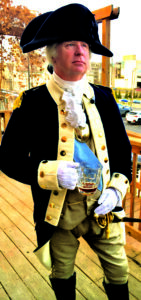
Correspondent photo / Sean Barron Curt Radabaugh, a President George Washington reenactor, discusses the nation’s first president during a Tavern Talk at Noble Creature Wild Ales & Lagers in Youngstown
YOUNGSTOWN — Many people who love history not only had an opportunity to hear about it and have it reenacted, but to drink part of it.
“We love historical beers here,” Ira Gerhart, who owns Noble Creature Wild Ales & Lagers, said.
All three aspects of history came to life for nearly 100 people, courtesy of a Tavern Talk gathering Friday afternoon at the business, 126 E. Rayen St., near downtown. The event also featured a President George Washington reenactor who described many aspects of the first president’s life in the Continental Army.
The two-hour funfest kicked off a series of America250 events that Youngstown State University will be hosting throughout the year to celebrate the nation’s semiquincentennial, or 250th anniversary.
Gerhart and Kyle Starkey, a YSU history professor, collaborated recently to brew a special type of beer called “George,” which is a somewhat modernized version of a rather simplistic beer that had been brewed from Washington’s original recipe in or near 1757.
“Our recipe, compared to George’s, would be a bit sweeter,” Starkey said Friday, adding that the modern version has about 4.7% alcohol, and the alcohol content of Washington’s likely was 3% to 4%, depending on how well added yeast may have factored in it.
For their part, Starkey and Gerhart took light malt, a bit of oats, hops, water and molasses, resulting in a light alcohol brew, Starkey explained. He also said that adding yeast to the brew was uncommon in Washington’s time.
LOOKING BACK IN TIME
Providing an often dark glance into life in the Continental Army Washington led in the years before the country’s founding was Curt Radabaugh, a retired police chief from southern Ohio who also is a George Washington reenactor.
The 1770s was an active decade because it consisted of the Boston Tea Party on Dec. 16, 1773, in which colonists, disguised as Mohawk Indians, boarded British ships in Boston Harbor and, in defiance of the Tea Act (“taxation without representation”) and the British East India Co.’s monopoly and taxation, dumped 342 chests of tea into the water.
Also pivotal during that decade was the first Continental Congress that met Sept. 5 to Oct. 26, 1774, in Philadelphia, of which Washington was a part, with delegates from 12 of the 13 colonies (Georgia was absent) to establish citizens’ rights and boycott British goods, Radabaugh said.
In May 1775, after the first Continental Congress failed to resolve various issues with Britain, the second Continental Congress convened and served as a de facto government for the colonies and created the Continental Army during the Revolutionary War, then appointed Washington as commander to lead it, Radabaugh said.
Key results included printing money, managing war efforts, levying taxes, drafting, then adopting, the Declaration of Independence in 1776, securing alliances with France and other countries and drafting the Articles of Confederation by 1781 to establish a permanent government.
He also mentioned Samuel Whittemore Jr. and Richard Lord Jones, who, at ages 78 and 10, respectively, were the oldest and youngest of those who fought in the Revolutionary War.
Whittemore, who was a farmer and soldier, is perhaps best known for grabbing a musket and two pistols to ambush British grenadiers during the Battle of Lexington and Concord in April 1775, killing two of them, Radabaugh said. Despite having been bayoneted several times and shot in the face, Whittemore lived to be 96, he added.
Jones, who was from Colchester, Connecticut, joined the Continental Army and enlisted in the 3rd Connecticut Regiment. Buoyed by a strong sense of patriotism and loyalty to Washington, in June 1777, the 10-year-old volunteered to serve his country, Radabaugh noted.
In addition, Jones had a level of singing talent, and on one occasion, Washington’s wife, Martha Washington, gave him $3, which Jones kept until his death in 1852 at age 85, he said.
Washington also marched his troops to Valley Forge, Pa., where they stayed about six months and built 1,500 to 2,000 huts after having lost the Battle of Brandywine Creek and the city of Philadelphia to the British army, under Gen. Sir William Howe, on Sept. 11, 1777.
“Valley Forge became the fourth largest city in the colonies at that time,” Radabaugh said, adding that an estimated 2,000 troops died there largely from starvation, diseases and poor medical facilities.
Despite the enormous suffering and setbacks, the army eventually became a disciplined and structured fighting force, courtesy of Baron von Steuben and, over time, became a symbol of American perseverance.
Steuben, a Prussian-born army officer, reformed Washington’s troops and became highly regarded as a founding father of the U.S. Army.
“This country has gone through a lot in 250 years,” Radabaugh said, including 27 amendments to the Constitution, which he referred to as “one of the longest surviving documents on the planet.”
In addition to portraying the nation’s first president, Radabaugh intends to honor the nation’s 250 years via celebrating throughout this year when opportunities arise, he added.
He also noted that Sept. 17 is Constitution Day, which commemorates the signing of the document in 1787 and recognizes the framework, importance and structure of the nation’s form of government.
Local News
Elections board hopes to hire attorney
YOUNGSTOWN — Tired of the ongoing problems at its current location and what it says is inaction by Mahoning ...
Two testify they were in car with men charged in girl’s murder
Trumbull sheriff’s office gets $1.75M grant for new roof
WARREN — The Trumbull County commissioners are expected to vote today to accept a $1.75 million grant from the ...
City seeks to dismiss, refile suit against Marchionda, Bozanich
YOUNGSTOWN — City officials have asked that the city’s $834,608 civil lawsuit against developer Dominic ...

South Side explosion lifted second story of house and dropped it
Austintown cuts support for Falcon Media
AUSTINTOWN — The township will end its support for a student-run media program in another effort to save taxpayer ...