Talk addresses blacks’, Jews’ shared history
Groups joined for civil rights fight
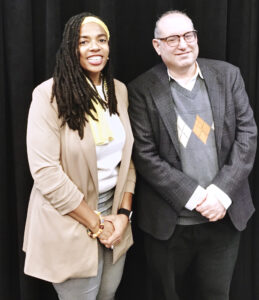
Correspondent photo / Sean Barron Cryshanna Jackson Leftwich and Adam Fuller, both Youngstown State University professors, gave a presentation Thursday at the Jewish Community Center of Youngstown regarding solidarity and other aspects of relationships between the Jewish and black communities during the civil rights era and beyond.
YOUNGSTOWN — As she scanned her audience, Cryshanna Jackson Leftwich was pleased to see diversity staring back at her.
“We are bonded by similar exclusions by American society,” Jackson Leftwich, a Youngstown State University professor of politics and international relations, said.
She was referring to a diverse audience of several dozen people of many races and colors in the same room, something that would not have been possible 60 years ago — especially in the Jim Crow South, Jackson Leftwich added.
She and Adam Fuller, a YSU associate professor of politics and international relations, spoke about black and Jewish people’s shared history during a lecture they gave Thursday afternoon at the Jewish Community Center of Youngstown, 505 Gypsy Lane, on the city’s North Side.
The one-hour presentation, “From Exodus to Freedom Rides: Jewish and Black Americans Marching Together for Civil Rights,” also coincided with Dr. Martin Luther King Jr.’s 97th birthday. The official King holiday is Monday.
Hosting the program was the Jewish Community Relations Council of the Youngstown Area Jewish Federation.
In the 1930s, and preceding World War II, Adolph Hitler and others in the German Nazi Party borrowed from the playbook of Southern racists’ treatment of black people in the Jim Crow South and used some of it as a template for the suffering and genocide they inflicted on many Jews, Jackson Leftwich noted.
Despite the restrictions blacks faced because of segregation laws and customs, some rose up, such as Claudette Colvin, who, at age 15, refused to surrender her seat to a white woman on a crowded, segregated bus in April 1955 in Montgomery, Alabama, eight months before Rosa Parks followed suit. Colvin, a longtime civil rights and social activist, died Tuesday in Texas at age 86.
Jackson Leftwich also alluded to Ruby Bridges, who, on Nov. 14, 1960, at age 6, became the first black student to integrate the all-white William Franz Elementary School during a school desegregation crisis in New Orleans. Bridges, 71, remains a civil rights activist.
Despite progress on certain fronts, efforts to erase much of American history, along with cuts to diversity, equity and inclusion programs continue, she said, adding that “we have to figure out ways to work together for the benefit of all.”
Many blacks and Jews also walk alongside one another as part of a commitment to do their part to uphold King’s dream of equality, fairness, inclusion and justice, she explained.
Even though many in the black and Jewish communities seek to attain the same or similar goals, society has some “troublemakers” who try to stoke the flames of discord and division between the two groups, said Fuller, who’s also director of YSU’s Center for Judaic and Holocaust Studies program.
One of them is right-wing podcaster Candace Owens, who, Fuller said, promulgates conspiracy theories such as the false narrative that Jews were responsible for the slave trade. In March 2024, Owens was dismissed as host of a political talk show on The Daily Wire after being accused of making a series of comments deemed as anti-Semitic.
Despite the common bonds between many black and Jewish people, neither group is monolithic. Some Jews harbor racist feelings and are “hostile to blacks’ civil rights,” while others are indifferent toward black people’s plight through history, but most empathize with black people who have been largely excluded by society, Fuller explained.
One such example was Polish-American Rabbi Abraham J. Heschel, who was a close friend of King’s. In February 1968, the two men sat next to each other in Arlington National Cemetery at the Tomb of the Unknown Soldier in silent protest of the Vietnam War.
To a large degree, many Jews had two motivations for aligning themselves with black people’s causes. One was a moral responsibility to do what they felt was right, Fuller said, adding that the Book of Deuteronomy contains passages pertaining to Israelites’ experiences as slaves in Egypt.
One such passage is Deuteronomy 24:18, which reminds the Israelites they were once captives in that country until God rescued them.
The second motive for some Jews was practical and political, because having certain groups of people marginalized also was “bad for Jews,” many of whom saw the need “to solve this problem for our own sake,” Fuller said.
Even though many people reflexively associate lynchings with black people, a Jewish man named Leo M. Frank suffered that fate Aug. 17, 1915, at age 31, Fuller said. A group of armed men kidnapped Frank from his jail cell, where he was being held on a charge of killing a 13-year-old employee at an Atlanta factory for which he was the superintendent. It came out later that Frank had been wrongfully convicted of the crime.
Over the years, certain rifts have occurred between black and Jewish people. One such division were affirmative action programs in the 1970s that were intended to make it easier for black people to be accepted into institutions of higher education, yet, many Jews felt, the effort made it harder for them to be accepted, Fuller said.
Also, after the 1967 Arab-Israeli War (also known as the “Six-Day War”), some black leaders — excluding King — took an anti-Israel stance. For his part, King wrote a letter to a friend criticizing the friend for using the term “Zionist” to refer to Jews, Fuller continued.
In 1977, President Jimmy Carter appointed civil rights activist and King confidante Andrew Young as the first black ambassador to the United Nations. Another controversy developed two years later when Young came under fire for having an unauthorized meeting with a Palestine Liberation Organization representative, which resulted in his resignation from the cabinet-level position. In addition, many contend the meeting embarrassed the Carter administration.
In some cases, Jews identified with the Black Power movement of the 1960s and 1970s, Fuller explained. A prime example was Meir Kahane, a militant rabbi and activist who founded the Jewish Defense League in 1968, which had as one of its slogans “Never again,” referring to promoting Jewish pride and symbolizing a strong commitment to prevent future persecutions against Jews.
In spite of certain differences, controversies and disagreements among the two groups, though, they likely will continue to see eye to eye on most issues. Fuller said.
“Going forward, their alliances will be in good shape,” he added.
Local News
Answer is: Mahoning Valley firsts
House Judiciary Committee OKs Joyce’s organized retail crime bill
The U.S. House Judiciary Committee approved a bill, sponsored by Congressman Dave Joyce, that targets theft, fraud ...
Talk addresses blacks’, Jews’ shared history
Kirkmere school floated as site for board of elections
YOUNGSTOWN — The future of the Mahoning County Board of Elections has been hotly debated in recent months, and ...
Liberty police probe deaths
LIBERTY — Township police are investigating the deaths of two people at their residence Thursday afternoon. ...