

Police chief in Austintown charts path to recovery for department
AUSTINTOWN — In November, voters approved a levy that provides the township’s struggling police department with much needed financial stability, but that does not mean they will be returning to business as usual.
In fact, it will take most of this year just to undo most of the damage.
“What I think people don’t understand about the levy is that it doesn’t mean that now we have that money everything will immediately go back to the way it was a couple years ago,” said Police Chief Valorie Delmont. “We let it get so bad, and now it’s going to take us most of 2026 just to recover from everything that happened in 2025 and before.”
The Vindicator recently sat down with Delmont to discuss the state of the department and what recovery looks like.
One year after township voters shot down a continuous 2.4-mill continuous levy, they reversed their decision — by the exact same margin, 52% to 48% — and passed in November a new five-year renewable 2.22-mill levy that will generate about $2 million for the department.
At this month’s meeting of the Board of Trustees, Delmont provided some monthly and annual statistics, as has been her practice since taking over for retired Chief Robert Gavalier in March.
Not all the numbers she provided for 2025 have readily available comparisons from 2024.
But those that do tell a good part of the story about what the department has had to do to make ends meet while struggling with a diminishing budget.
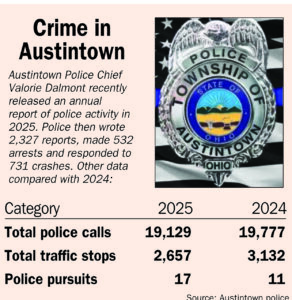
Delmont reported that Austintown police had 19,129 calls for service in 2025, a reduction of 648 from the 19,777 calls for service in 2024. That figure corresponds closely with the 2,657 traffic stops in 2025 compared to 3,132 traffic stops in 2024.
The 475 fewer traffic stops represents 73% of the total reduction in calls.
While traffic stops are not requests for service from the public, they still count as statistical calls.
“When there’s less officers out there, we have less time to make traffic stops. When we’re fully staffed and we have six, seven, or even eight officers out there, there’s officers to handle calls, and officers to make traffic stops,” Delmont said.
But as part of the cost cutting efforts, the department has reduced duty shifts to five officers at a time.
“When there’s five officers on the road each shift, there’s no extras. Those five officers are handling calls, and they may be doing traffic enforcement in between those calls, but if it’s a busy shift, they may not have time to make traffic stops if those five officers are handling all of the calls.”
Officers may still be inclined to pull over a vehicle on their way to, say, take a report on a theft that has already occurred, if they observe a vehicle that seems to pose a clear danger to public safety. But officers have not been out routinely watching traffic as they used to.
In 2025, Austintown Police wrote 923 traffic citations [no comparison for 2024]. And while they did not have as many traffic stops last year, they did see an uptick in police pursuits — 17 in 2025 compared to 11 in 2024.
But Delmont noted one of the problems with that, too. With only five officers on the road, an officer making a stop or engaging in a pursuit of a suspect vehicle may not have the necessary backup available.
That is not so much an issue during the day when pulling someone over for speed violation in a school zone, but it does mean that officers may be more inclined to let things slide in certain areas of the township at odd hours of the night and early morning.
Another compromise made in 2025 was that officers who normally participated in the Mahoning Valley Law Enforcement [Drug] Task Force and Mahoning Valley Human Trafficking Task Force have been pulled back to ensure proper patrol coverage in the township. Detectives also have been taken from their desks to cover patrol shifts.
Delmont said that doesn’t mean her staff are not doing their jobs, but choices have to be made and efficiency has suffered in many cases.
“Our calls are still coming in and we’re still responding. It may take us a little longer to investigate the crimes, the reports that are filed, it may take us longer to get back to somebody, but that doesn’t mean it’s not getting done,” she said.
“If two officers are on a domestic and two on a traffic accident, we may get a call about a theft in progress, where loss prevention is calling saying somebody just pushed out a cart full of merchandise and they’re giving us a description of the vehicle, and we have no one available to go stop that car. So now we’re responding to a retail business after the fact and taking a report,” Delmont said.
That means that instead of catching the person in the act, recovering the stolen goods, making the arrest, and clearing the call, it’s now something that a stretched detective division will need to make time to investigate when they can.
Overall, Delmont reported that Austintown police in 2025 wrote 2,327 reports, made 532 arrests, and responded to 731 crashes.
They have done all of this with a reduced patrol and detective division, in a year when there were multiple homicides in the township.
At the same trustees meeting where Delmont gave her annual statistical update, Fiscal Officer Laurie Wolfe provided an annual summary as well. She noted that transfers from Austintown’s general fund in 2025 exceeded 2024 — roughly $845,000 in 2025 compared with $797,000 the previous year — but the general fund was only used to support three departments and the expected transfer of about $1 million to the police department was cut in half.
“Police cut their expenses by about 8%,” Wolfe said. “It took a lot of hard work, but it was well received.”
Before and after voters defeated a 2024 police levy, the department had begun cutting costs — as much as $150,000 before the levy was shot down and roughly another $100,000 since.
In addition to task force pullbacks and detective reassignments, Delmont — and Gavalier before her — cut training and equipment costs; eliminated as much overtime as possible; and deferred cruiser replacement and some maintenance costs. The department also cut its police dog program, which was supported through the end of the year by donations.
Austintown also renegotiated dispatch contracts with most outside communities the center serves to bring those communities’ costs more in line with the annual average per-call cost and to remove what they said was a disproportionate financial burden on Austintown’s police and fire departments for dispatching.
So, with the savings and the levy now in place, what does that mean for the department getting things back on track?
Delmont said it means time. Time to find and recruit and hire new officers. Time to order and outfit new cruisers to replace those in the fleet that are well past their optimal running life.
For a township in a fiscal crisis, with a recently failed police levy, applications and resumes from new officers don’t exactly come in by the dozen. But since November, Delmont said, they are receiving applications again.
Optimistically, Austintown could have a new officer on the road this summer, hopefully two. But that requires time to qualify and certify them before they can be on the road with another officer as a trainee. If it’s a transfer from another department — Austintown has become unfortunately familiar with the traffic moving the opposite direction in recent years — they would only have to familiarize them with the department’s standards and practices, which will save a few months.
Cruisers, which used to run departments about $43,000 to purchase and fully outfit, now cost $63,000. Three new cruisers have been ordered, but likely will not be on the road until late summer or early fall. There is a wait list to receive the cars, and a wait list to get them into a specialized mechanic to ensure they are properly outfitted with all necessary equipment, and another wait list to get the department’s striping and lettering on them.
Delmont said Austintown does what it can to save time and costs, like stripping down old cruisers themselves, removing the striping and lettering, and even auctioning off the parts that can be sold and keeping equipment that can be transferred to a new cruiser.
The police dog program, which was cut in June to save $10,000 last year and $20,000 this year, for two police dogs and their handling officers, is down to one police dog. Ptl. Jason Murzda transferred to Struthers Police Department with his K9 partner Gunney. Ptl. Brad McFadden remains on the force with his partner Eras.
Delmont said Eras is about 8 years old and may have another two years left before retirement. She said the overall cost — $9,000 annually for police dog training and handling, and another $1,000 for the cost of keeping the dog healthy — is something the department can manage while Eras is still on duty and they’ll revisit it after that.
Wolfe said the township intends to spend very frugally, but also wants to make sure departments have the things they need and even some of the things they really want — there are always grants available, and the township can’t apply for them if they don’t know the department wants them, she said.Like the other township departments, Delmont said she does have a wish list.
They’ve already been able to obtain two items through grants — upgrading their Cell Brite service, which collects data from mobile phones for evidentiary purposes, and FLOCK license plate readers, which police have used both for criminal identification and for finding lost residents, among other purposes.
On Delmont’s remaining wish list, she said, is training. The department has lost instructors for required training courses like defense tactics. Having in-house trainers saves money on sending officers to training seminars, and makes it easier to track their progress in the courses.
But that requires better staffing, which facilitates the ability to promote existing officers and get them qualified and certified as trainers. That process, again, will take time and money. Delmont said she does not expect to be able to get detectives properly returned to their desks and begin considering officers already on staff for promotion through the ranks until next year.
The other item, she said, would be an updated police drone. The units the department has are outdated and they constantly have to make in-house repairs and even cannibalize parts from one drone to keep the other running.
And, even if they keep a lean budget and spend the levy money wisely this year, there is one more stark reality facing Austintown police — it could all go away.
Petitions have been circulating around Ohio in support of a ballot initiative for the November election, which would seek to abolish all property taxes — the basis of levy revenues — statewide. If it passes, the levy funds voters approved in 2025 will cease to exist and Austintown will be right back where it was last year, and likely facing the end of its department’s history.
What exactly happens then?
“We don’t know what that looks like. I don’t think anybody does,” Delmont said.
Local News
Property transfers
Property transfers recorded Jan. 12 to 16 in Mahoning County and portions of Trumbull County: Austintown ...
Police chief in Austintown charts path to recovery for department
Air Force veteran appointed Trumbull dog warden
An Air Force veteran with extensive dog handling experience will oversee the Trumbull County dog pound starting ...
Missing file found in Mahoning baby murder case
YOUNGSTOWN — Despite whatever complications arose last year preventing the Mahoning County Prosecutor’s Office ...
Commissioners may seek state AG opinion on tax map move
WARREN — Trumbull County commissioners are discussing requesting an opinion from the Ohio Attorney General’s ...
Statewide clerk of courts group to embattled Ciccone: Resign
YOUNGSTOWN — The Ohio Clerk of Courts Association has censured controversial Mahoning County Clerk of Courts ...