

MLK Day workshop draws about 80 attendees
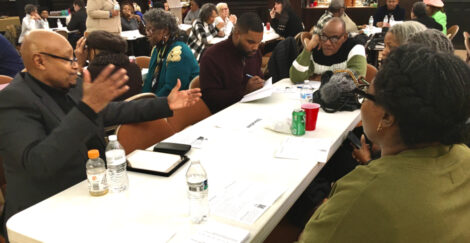
Correspondent photo / Sean Barron The Rev. Kenneth L. Simon, pastor of New Bethel Baptist Church in Youngstown, left, leads a roundtable discussion on education during Monday’s annual Dr. Martin Luther King Jr. community workshop at First Presbyterian Church of Youngstown. The gathering also was to honor King’s life and legacy.
YOUNGSTOWN — For years, Dr. Martin Luther King Jr. spoke and acted against injustices of all sizes, shapes and forms — whether they occurred in the streets or at restaurants, lunch counters, movie theaters and a host of other locations — but now it’s vital to fight injustices that occur in Columbus, a local elected official contends.
“You can’t claim freedom while legislating fear. You love justice when you create legislation to embrace it. Injustice is not dependent on intent, but on impact,” state Rep. Lauren McNally, D-Youngstown, said.
McNally was among those who spoke during the annual Dr. Martin Luther King Jr. community workshop Monday morning at First Presbyterian Church of Youngstown in downtown.
Sponsoring the three-hour program to honor King’s life, work and legacy was the Martin Luther King Jr. Planning Committee of the Mahoning Valley. Serving as moderator was Jaladah Aslam, a committee co-convener.
An estimated 75 to 80 religious and community leaders and others attended the workshop. The three main pillars that were discussed and dissected in roundtable groups were health care, education and voting rights.
McNally blasted Ohio Senate Bill 293, signed into law last month, because it will eliminate a grace period for mail-in ballots by requiring that they arrive by the time the polls close on Election Day, while including more stringent voter roll maintenance. The law likely will create barriers for and disenfranchise some voters, she said, adding that thousands of ballots may not be counted because of postal delays.
Another key injustice and disparity is that an estimated 90% of Ohio students attend public schools, yet in the latest budget, only 30% of funding was set aside for those schools, with nearly all the rest going to charter and private schools, McNally said. As a result, many rural areas and counties may be adversely affected because they have few other options beyond public schools, she said.
“We’re not making things better for kids, we’re attacking them,” McNally said.
Many bills from the Ohio General Assembly that are considered for a vote and that pass — often quickly and with little or no debate or discussion — are “neatly drafted,” “fiscally sound” and cloaked in garments of respectability, coded language and fairness, but in reality, benefit certain population segments at the expense of others, McNally explained.
The state’s current legislative process is one key way many people’s rights are eroded and, by extension, can be harmful in a larger, long-term manner, she said.
“It weakens the moral foundation of our entire government institution,” McNally added.
Nevertheless, a greater number of Ohioans are paying closer attention to their elected officials’ actions, she noted, adding that King warned against unjust laws that were out of sync with morality and natural, moral laws.
“Silence is not neutrality; it’s permission,” McNally said.
The program’s keynote presenter was Tom Roberts, the Ohio State Conference NAACP’s president who, in 2009, was appointed to the Ohio Civil Rights Commission.
Roberts’ talk centered largely around what he sees as the vital importance of coalition building, collaboration and communication among individuals, organizations and other entities, minus competition.
King upheld such a mantra via working with the American Federation of State, County and Municipal Employees Local 1733 in March 1968, which represented the estimated 1,300 striking sanitation workers in Memphis, Tennessee. King also marched in Selma, Alabama, for voting rights and accepted an invitation to come to Birmingham, Alabama, in 1963 to work toward tackling injustices in that city, Roberts noted.
“He wrote from the heart,” Roberts said, referring to King’s famous “Letter from Birmingham Jail.”
The iconic document King wrote on scraps of newspaper or bathroom tissue while spending eight days in solitary confinement April 12 to 20, 1963, in Birmingham was his detailed response to eight clergy members’ stance on the nonviolent direct-action campaigns aimed at nonviolently breaking segregation in what many contended was the nation’s most segregated city.
A pivotal section of King’s letter — and one that some find highly applicable to peacefully addressing much of today’s unrest — talks about the four necessary conditions that need to preclude any nonviolent protest or campaign: collecting facts to determine whether an injustice exists, negotiation, self-purification and direct action.
“We have gone through all these steps in Birmingham. There can be no gainsaying the fact that racial injustice engulfs this community. … Its ugly record of brutality is widely known,” King wrote.
“The ‘Letter from Birmingham Jail’ is right on point. We are here because injustice is here,” Roberts said, quoting part of the correspondence.
In his remarks, Roberts also alluded to the 1949 Howard Thurman book, “Jesus and the Disinherited.” Thurman, who also was a civil rights leader, minister and theologian, interpreted Jesus Christ’s teachings through the eyes and experiences of those who were suffering the pain of oppression, and he offered nonviolent responses to remedy it. In the book, Christ was presented largely as a loving and wise sage.
On a larger scale, Thurman was describing the concept of the Beloved Community, Roberts said, to which later civil rights leaders such as King and the late Georgia congressman John Lewis often alluded. The Beloved Community envisions a global society built on unconditional love, respect, equity and justice in which understanding, care, compassion and interconnectedness can overcome hatred, poverty and racism, he said.
Roberts also dispelled the misconception that the civil rights movement’s bookends were 1954, the year of the landmark U.S. Supreme Court decision Brown v. Board of Education, and April 4, 1968, the day King was assassinated. Instead, the movement included early slaves who fought against oppression and dehumanization, and tried to cope by singing powerful spirituals such as “Wade in the Water,” which focused on freedom and divine deliverance. The tune also was a coded message for enslaved people to walk in rivers to escape and lose the scent from dogs that pursued them.
Roberts added that, given today’s challenges, it’s extremely important for people to make their voices heard, to engage in community-building efforts and to be part of the Beloved Community.
“We need to replace pessimism with faith, hope and building our community,” he said. “It’s our job to rebuild the community and pass it on to the next generation.”
Later in the program, participants broke into roundtable groups to discuss what they felt was needed in health care, education and voting rights.
Among the ideas proffered were more consistently attending local and state hearings related to the issues, engaging in community forums with steps to implement needed changes, organizing youth forums regarding voting and working with churches and other organizations, exercising one’s right to vote for the president and the down ballots, offering classes at churches, providing more extensive training to prospective school board candidates and refraining from sanctioning teachers who discuss certain social issues in the classroom.
One woman spoke on the importance of caring for one’s own well-being, as well as designing a more affordable health care system, because too many people avoid doctor’s visits because of the cost, and often wait until it’s too late, she said.
Local News
Seaborn teachers receive grants to enhance learning
Frenchko files paperwork for congressional bid
Republican Niki Frenchko, who pulled nominating petitions for the 14th Congressional District seat as well as ...
Hubbard Township police chief’s report wraps up ’25
HUBBARD TOWNSHIP — Trustees and residents gained an idea of how the police department closed out 2025, thanks to ...
On the record
Struthers WHAT: Jan. 12 Board of Education meeting PRESENT: Joe Fuline, Walter Baber, Kristin Fox and Robert ...
MLK Day workshop draws about 80 attendees