

Unity, color, pageantry mark Kwanzaa opening in Youngstown
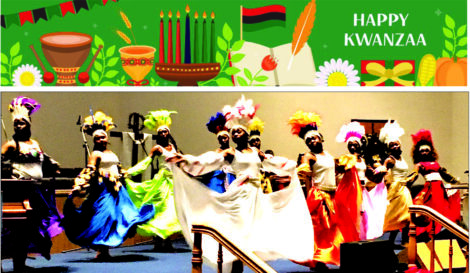
Correspondent photos / Sean Barron Harambee Youth Organization members perform a colorful welcome dance for a Kwanzaa celebration Friday at New Bethel Baptist Church in Youngstown to celebrate the principle of Umoja (unity).
YOUNGSTOWN — Societal achievements during the civil rights movement in the 1950s and 1960s aimed at making the nation live up to its founding creed continue to face mounting threats and rollbacks, so it’s imperative that nonviolent actions to counter such a regression remain ongoing, a longtime religious figure contends.
“Our concern should be for our children and our babies,” the Rev. Kenneth L. Simon, pastor of New Bethel Baptist Church, said. “We cannot afford to be asleep or silent or divided.”
Instead, it’s vital that black people and others come together to continue the long, arduous process of fighting today’s injustices — including voter-suppression efforts — just as Dr. Martin Luther King Jr. and other civil rights leaders had done in their day, Simon noted.
A pivotal way to nonviolently accomplish standing up to today’s societal wrongs is to display unity, which was the theme that coursed through a Kwanzaa celebration Friday evening at New Bethel, 1507 Hillman St., on the South Side.
The 90-minute festive and color-soaked gathering filled with pageantry that also filled the pews focused on Umoja (unity), the first of Kwanzaa’s seven guiding principles. Kwanzaa began Friday and continues through Thursday.
Also posing a threat to societal progress is many of the President Donald Trump administration’s policies, which are largely responsible for many people’s fundamental rights “slowly and methodically being taken away from us,” Simon added. Such dangers to democracy are clearly spelled out in the Heritage Foundation’s Project 2025, along with other perils such as persistent attacks on diversity, equity and inclusion programs at the college level, as well as cuts to many people’s Supplemental Nutrition Assistance Program (SNAP) benefits, he noted.
A local example of what he has long felt would disenfranchise many city voters — especially those without reliable transportation — has been the effort to move the Mahoning County Board of Elections from Oakhill Renaissance Place on Oak Hill Avenue to the Patriot building in Austintown. Simon and others, including members of the Greater Youngstown Community Mobilization Coalition of which he chairs, have attended Mahoning County commissioners meetings to voice their opposition to the move, he said in his remarks Friday.
“We are already dealing with a climate created by our national and state governments that marginalizes minorities, people of color and impoverished persons of all races in our nation, and is insensitive to the needs of the residents of our inner cities. We do not expect our elected county commissioners to make critical decisions like this one, that affect the most vulnerable, in the same insensitive manner,” Simon said in early June.
Many of those who supported the move cited what they have said is the building’s poor condition.
In colorful condition were members of the Harambee Youth Organization, who performed a series of African-Caribbean and other dances. Those included a welcome dance, along with several cultural expressions.
In her remarks Friday, Lynette Miller, Harambee’s founder, outlined the seven principles of Kwanzaa, as well as what she and many others feel is the importance of honoring past leaders who have served as trailblazers.
“We could not get to where we are today without the help of our ancestors and leaders,” she said.
The other six principles, in order, are Kujichagulia (self-determination), Ujima (collective work and responsibility), Ujamaa (cooperative economics), Nia (purpose), Kuumba (creativity) and Imani (faith), Miller noted.
In addition, she asked those in the sanctuary to say aloud the names of ancestors or leaders who they felt needed to be remembered and honored, followed by a moment of silence. Those included Dr. Martin Luther King Jr., Rosa Parks and the late Georgia congressman, civil rights icon and humanitarian John Lewis.
Also during the event, Joelle Purdie, 10, of Twinsburg, formerly of Youngstown, lit seven candles, each of which represented one of Kwanzaa’s principles.
Kenneth King, who is part of the Harambee Youth Organization, explained the significance of several Kwanzaa symbols, crops such as fruits and vegetables (mazao) that represent shared unity, hard work and harvest; the unity cup (kikombe cha umoja), to promote greater unity, honor ancestors and use for libations; the candle holder (kinara), that represents ancestors from which a community grows; and the seven candles (mishumaa saba).
Each of the seven principles is more than merely a blueprint of ideals to practice; it’s important that they are something everyone lives by to better the community, nation and society as a whole, a few of the presenters said.
Along those lines, they can be guiding markers for living a virtuous life, as well as working to preserve public education, protect voting rights and preserve, black people’s heritage, history and culture, Simon said.
“We are moving toward a dictatorship and apartheid if we don’t stand and (nonviolently) fight,” the pastor said, adding, “Black people must unite.”
Local News
Weathersfield completes various projects in 2025
WEATHERSFIELD — The township was able to complete various projects in 2025, with many being funded by the state ...
Diocese concludes Jubilee year
Boy who shot another for shoes sent to juvenile prison
YOUNGSTOWN — Juvenile Makhi Cotton, who shot a 12-year-old boy in August 2024 in Youngstown while trying to steal ...
Self-determination principle of Kwanzaa celebrated at South Side event
Unity, color, pageantry mark Kwanzaa opening in Youngstown
Murder charges dropped
YOUNGSTOWN — Mahoning County Common Pleas Court Judge John Durkin has dismissed the aggravated murder, murder, ...