

Self-determination principle of Kwanzaa celebrated at South Side event
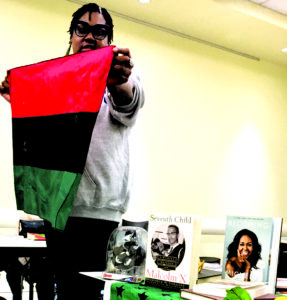
Zakiya Miller, who’s part of the Harambee Youth Organization, discusses the Pan African flag as part of Saturday’s Kwanzaa event at the Newport library in Youngstown.
YOUNGSTOWN — In his young life, William Lambert was a cabin boy on local steamers, a tailor in Detroit’s garment industry, an abolitionist, a public speaker, a newspaper columnist and an active participant in anti-slavery efforts.
Posthumous-y — and more than a century later — he also has served as an influential force in Joseph Napier Sr.’s life.
“He lit a power in me to get me moving, if you will,” Napier, a local historian, said. “He wore about 20 hats; he was very profound.”
Lambert also is the subject of a children’s book Napier’s wife, Christina Streety-Napier, wrote, titled “Code Name Midnight: William Lambert and the Underground Railroad.” He brought a copy of the book to share with others who attended a Kwanzaa gathering Saturday afternoon at the Newport branch of the Public Library of Youngstown and Mahoning County, 3700 Market St., on the South Side.
The two-hour gathering focused on Kujichagulia (self-determination), which is the second of Kwanzaa’s seven guiding principles that were drawn from communitarian values common throughout Africa. More specifically, Kujichagulia refers to the ability of people to name, define, create and speak for themselves.
Saturday’s event also included a writing workshop, along with a literary exchange in which participants shared the names of books, writers, leaders and others who powerfully influenced them.
Napier, who also is a member of the local NAACP chapter, noted that Lambert often worked as a tailor by day but led “a dual life” by working to free slaves via bringing them to Detroit under the cover of darkness and sometimes allowing them to spend the night in a safe house, then smuggling them across the Detroit River into or near Windsor, Ontario, Canada. Lambert, who was born free in Trenton, New Jersey, eventually made his foray into the burgeoning dry-cleaning business and became quite wealthy, Napier said.
In his younger years, Lambert formed an association with George DeBaptiste, and the two men worked closely with each other in the Detroit chapter of the Underground Railroad. Lambert also became active with the Detroit Anti-Slavery Society and was often in the company of abolitionists that included John Brown, Harriet Tubman and Frederick Douglass, Napier noted.
In 1842, already heavily immersed in black politics, Lambert and two other men established the Colored Vigilant Committee, which lobbied for the freedom and rights of black citizens throughout Michigan.
By the time of his death April 28, 1890, at age 72, Lambert had enjoyed a highly lucrative career in the dry-cleaning business and left an estate valued at more than $24 million in 2018 dollars, according to the African American Registry’s website.
Much of Kujichagulia’s significance lies in the importance of people being free to define and speak for themselves, as well as engage in self-reflection and how to process the essence of one’s character and uniqueness. Also important is encouraging people to be resilient, along with letting them share their stories, including how ancestors shaped their lives, Napier’s son, Joseph Napier Jr., said.
Along those lines, the younger Napier, who also is the area’s Juneteenth coordinator with the Youngstown Creative Collective, gave attendees a two-part writing project in which they were asked to expand on a relative or family member who impacted them, and a moment in their lives they felt defined them most heavily. Beforehand, the participants discussed books that left a mark on them.
Ardelia McGee of Youngstown mentioned the 2023 book “Black Folk: The Roots of the Black Working Class” by acclaimed historian Blair LM Kelley, which primarily spotlights the lives of the laundresses, postal workers, maids, porters and others who helped establish the black working class that became a force from the late 1800s to the early 20th century, as well as the essential workers during the COVID-19 pandemic.
Zakiya Miller, a Harambee Youth Organization member, also explained the significance of some of Kwanzaa’s most meaningful and impactful symbols. Those included ears of corn, the seven candles and gifts, which denote children and the future they represent, the seven principles of Kwanzaa and the labor and love of parents and their children’s commitments, respectively.
Kenneth King, who’s also with the Harambee Youth Organization, led a portion, “Let us remember,” in which participants were asked to say aloud the names of people they wished to honor and remember. Those they mentioned included Marcus Garvey, Harriet Tubman, Malcolm X, Dr. Martin Luther King Jr. and Mississippi NAACP field secretary Medgar Evers.
Also on hand Saturday was Jonathan Hearn, an artist from Akron, formerly of Youngstown, whose template “is a little bit of everything,” he said.
A main part of “everything” included several of his acrylic paintings as well as framed resin works of broken alcohol bottles and tie-dyed pairs of socks. The pieces’ common theme was a desire to be unique and express his style of self-determination, Hearn explained.
Another determination for the elder Napier was to ensure more people became familiar with Lambert and his contributions to 19th century society.
“He’s now more nationally recognized after his death,” Napier said, adding, “I felt compelled to get his name out.”
The final Kwanzaa gathering, to focus on the principle of Nia (purpose), is set for 6 p.m. Tuesday at United Returning Citizens, 611 Belmont Ave., Youngstown.
Local News
Weathersfield completes various projects in 2025
WEATHERSFIELD — The township was able to complete various projects in 2025, with many being funded by the state ...
Diocese concludes Jubilee year
Boy who shot another for shoes sent to juvenile prison
YOUNGSTOWN — Juvenile Makhi Cotton, who shot a 12-year-old boy in August 2024 in Youngstown while trying to steal ...
Self-determination principle of Kwanzaa celebrated at South Side event
Unity, color, pageantry mark Kwanzaa opening in Youngstown
Murder charges dropped
YOUNGSTOWN — Mahoning County Common Pleas Court Judge John Durkin has dismissed the aggravated murder, murder, ...