$13.52M OK’d for design of project
Youngstown board awards pacts for wastewater work
Road Work
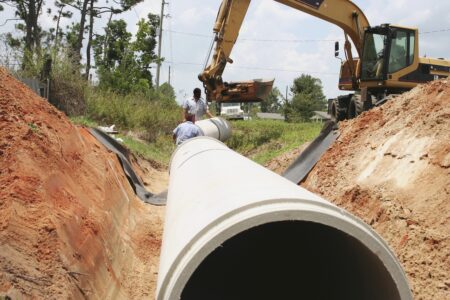
YOUNGSTOWN — The city’s board of control approved $13.52 million in contracts to two companies for final design and construction administration on a phase of its major wastewater improvement work mandated by a federal consent decree.
The work is for an 80-million-gallon-per-day wet weather facility. The structures in the facility would treat excess combined sewage during heaving rainstorms and then release the water.
The city retained MS Consultants Inc. of Youngstown and Arcadis U.S. Inc., a national company, to do preliminary design work on the wet weather facility, said Charles Shasho, deputy director of public works. Both have done extensive work for the city over the years, and plans call for them to do final design work, Shasho said.
The board of control on Thursday voted 3-0 to pay $7.63 million to MS for its work while Arcadis will receive $5.89 million.
The board of control consists of Mayor Jamael Tito Brown, Finance Director Kyle Miasek and Law Director Lori Shells Simmons.
The work should start later this month and take one year to 18 months to finish, Shasho said.
Also needed is a company, probably MS or Arcadis, to handle the construction administration phase of the work, estimated to cost $17 million, Shasho said.
Dec. 12 is the deadline for companies to submit letters of intent for that work with a decision expected about a week later, Shasho said.
“It’s straight-forward enough,” he said. “I’d delay it if someone out of left field came in. The work is to manage the design phase as well as the overall supervision of the project.”
The construction phase is to start January 2028 and take two years to complete, Shasho said.
The city’s initial 2014 agreement to build a 100-million-gallon-per-day facility, the rising cost of the work and the disputed need for such a large system were reasons why the city argued in in 2024 to reopen the consent decree that requires it to make significant and expensive improvements to its wastewater system.
During lengthy negotiations between the city and the federal government, an agreement was reached to honor the city’s request for the smaller facility. Judge Christopher A. Boyko of the U.S. District Court’s Northern District of Ohio finalized the deal Oct. 9.
In a Nov. 12, 2024, amended motion to modify the consent decree, attorney Terrence S. Finn of the Roetzel & Andress law firm in Akron, which represents the city, wrote the project’s initial estimate was $62 million, but is now more than $240 million.
The smaller facility has a preliminary cost estimate of about $180 million, but that is most likely to change once design work is done.
The U.S. Environmental Protection Agency originally had ordered the city in 2002 to do $310 million worth of work, but it was negotiated down to $160 million in 2014 with the expectation it would be finished in 20 years.
The city plans to have all of the work done by Oct. 1, 2035.
The city insisted in court filings that if Youngstown complied with the mandates the cost would be about $380 million to $400 million — well over twice what it agreed to do 11 years ago.
In a June 6 court filing, the federal government stated it “successfully finalized a proposed resolution” to the reduced facility because the city is diverting 35.5 million gallons of combined sewage annually into the Mahoning River in an ongoing project, costing about $10.5 million, as well as an earlier deadline on the wet weather facility and a compressed schedule on an interceptor sewer project to keep wastewater from 13 lines — the city revised it in October to 14 — from flowing into Mill Creek Park’s Lake Glacier and Lake Cohasset.
As part of the federal consent decree, the city’s board of control on Oct. 9 approved a $42.77 million contract with Marucci & Gaffney Excavating Co. of Youngstown for the first two phases of a four-part project to keep water from flowing into the two Mill Creek Park lakes.
The first two phases will focus on Lake Glacier, eliminating four of the 14 overflow lines. The project will replace about 8,000 to 9,000 linear feet of sewer lines that range in size from 36 inches to 60 inches with a new 96-inch sewer line.
There also will be bridge work, river crossings, efforts to lower the lake and the relocation of utilities. The work will start in a few weeks. The project is supposed to be finished no later than May 29, 2028.
When the work starts, several streets, trails and structures at the park will be closed during the duration of the project.
The city plans a compressed schedule with the third phase done by April 18, 2031, and the final part by Sept. 29, 2032.
That project was estimated to cost $47.7 million and will now cost more than $72 million, according to a court filing from the city.
The city finished the first part of the sewer improvement work — upgrades to its wastewater treatment plant — on June 30, 2021. The project was supposed to be finished July 11, 2020.
Boyko ordered the city to pay a $739,500 penalty to the federal government for being late on the wastewater plant upgrades and for the late submission of preliminary designs for the Mill Creek sewer interceptor project.
The city paid the penalty Sept. 24.
Local News

Man gets 2 to 3 years for 2024 assault on woman
Hubbard council hears request for fire building support
HUBBARD — One official said city council will have a meeting to discuss its options regarding the fire department ...
Lordstown ends tax abatement for Metalco
LORDSTOWN — Now that 10 years have passed, village council on Monday approved terminating a 10-year tax abatement ...
Boardman freshman wins Optimist Club essay contest
ODNR seeks nominations for 2026 Hall of Fame
Staff report The Ohio Natural Resources Hall of Fame Award is a top conservation honor that recognizes lifetime ...