Women pilots in WWII faced dangers and discrimination
Speaker in Boardman outlines critical role of WASPs
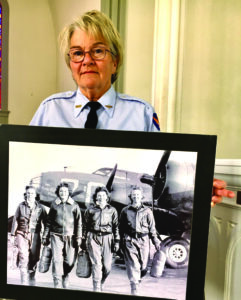
Correspondent photo / Sean Barron Marilyn Mong of Leetonia holds a photograph of four Women Airforce Service Pilots before a lecture she gave Saturday in the old St. James Episcopal Church in Boardman Park on the important roles the WASPs played during World War II. Second from the left is Margaret Kirchner of Youngstown.
BOARDMAN — Even though they failed to receive proper recognition, benefits, honors and military status — and often dealt with discrimination and sexism — the Women Airforce Service Pilots played a pivotal role during World War II, an experienced pilot contends.
“The WASPs flew 60 million miles in every type of plane,” Marilyn Mong of Leetonia said.
The estimated 1,074 women who flew noncombat missions in 1943 and 1944 were the subject of a lecture Mong gave Saturday morning at the old St. James Episcopal Church in Boardman Park.
Hosting the program was the Boardman Historical Society.
The women flew nearly every type of military aircraft, including the Boeing B-17 and B-29 bombers, Mong noted. Others they piloted included the Vultee BT-13 Valiant trainer aircraft; the AT-6, nicknamed “The Texan” on which many Allied fighter pilots were trained; and the P-51 Mustang, which was a long-range, single-seat fighter bomber also used in the Korean War.
Some of the WASPs also flew PQ-8s remotely. They were the first drones, and they communicated with radio-controlled aircraft, Mong said. Radio control pilots often manned PQ-8 and PQ-14 drones from the ground or from a separate plane that followed for a distance of up to five miles, according to the National WASP / WWII Museum’s website.
During her 45-minute talk, Mong also honored several WASPs such as Margaret “Peg” Kirchner, who earned a teaching degree from Youngstown College (now Youngstown State University), piloted a Boeing B-17 Flying Fortress and, after the war, taught in the Saginaw School District in Michigan. In 2019, she was inducted into the Michigan Women’s Hall of Fame.
Also having earned a degree from Youngstown College was Marie B. Marsh, a WASP who received training with the Civilian Pilot Training Program as a civilian pilot, Mong noted. Marsh received training at Avenger Field in Sweetwater, Texas, then was assigned to the Weather Wing headquarters in Asheville, North Carolina, and flew to many Army weather stations across the U.S., as well as on courier service flights to the Pentagon, the National WASP / WWII Museum website shows.
Other pilots with local or regional ties Mong mentioned were Donna Spellnic of Lowellville, and Thelma Nadine H. Bluhm of Alliance. Bluhm was a civilian pilot who flew missions from factories to military bases, and she co-founded the Military Aviation Preservation Society, according to her 2005 obituary.
Mong also told the harrowing story of Cornelia C. Fort, an aviator from Tennessee who was flying with a student Dec. 7, 1941, when a suspicious military plane approached over the Pacific Ocean near Honolulu. A short time later, Fort looked down to see smoke billowing over Pearl Harbor as the Japanese were bombing the site, Mong said.
After the surprise attack, the U.S. sped up the manufacturing of aircraft, she added.
Despite their bravery, sacrifices and danger they faced, the WASPs had no military budget, so they had to buy their own uniforms, which they often referred to as “zoot suits.” In most cases, the outfits had belonged to men, so they were oversized for the women, Mong explained.
In addition, disparities existed between what was expected of the women pilots compared with their male counterparts.
“They were given the same instruction, but held to a higher standard than the male pilots,” she added.
The WASPs also faced the indignity of not receiving proper military status as had been promised. Thirty-eight of them were killed in the line of duty, and a hat often was passed to collect money to have the fallen sent home to their families, Mong said.
Finally in September 1977, Congress passed the GI Bill Improvement Act to retroactively grant the women official military status and make them eligible for military benefits.
In 2009, President Barack Obama awarded the WASPs the Congressional Gold Medal for their service.
Nevertheless, the woman pilots were about more than flying and their contributions during the war before the WASPs were disbanded in December 1944.
“They tolerated discrimination, accepted danger and believed they were opening doors for other women,” Mong said.
Local News
Two kids left home Monday evening and got locked in a stranger’s house
YOUNGSTOWN — Two children were reported as runaways Monday evening after leaving their father’s home in ...
Poland Township chief testifies in Columbus
Work to begin in 2027 on 6.25-mile power line in Youngstown, Campbell
Work on a $27 million power line project in Youngstown and Campbell will begin in November 2027 after the Ohio ...
Man shot by police during arrest is indicted on felonious assault
YOUNGSTOWN — John Doyle, 75, who allegedly pointed a gun at police officers trying to arrest him on a warrant ...
Poland Village historic grant deadline nears
POLAND VILLAGE — The close of business on Feb. 27 is the official deadline for this year’s historic grant ...