Workforce wage gap persists
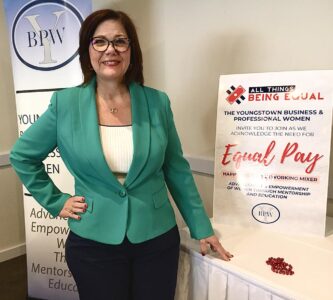
Correspondent photo / Sean Barron Julie A. Doyle, a principal with Cincinnati-based Integral Ops, prepares to speak to those at the Youngstown Business and Professional Women’s annual Equal Pay Mixer at La Casa Mexicana restaurant in Boardman. Her topic was on the wage gap between many men and women in the workforce.
By SEAN BARRON
Correspondent
BOARDMAN — The first vital step in bridging the wage gap between men and women in the workforce is to be aware of the problem in the first place, an expert in leadership and human resources says.
“The pay gap in 2025 is 83 cents on the dollar on average,” Julie A. Doyle, a principal with Cincinnati-based Integral Ops, said.
She was referring to what’s called the uncontrolled pay gap, which is the overall wage difference between men and women without adjusting for performance, experience and other job-related factors.
That was a pivotal piece of the talk Doyle gave Tuesday evening, which was the highlight of the Youngstown Business and Professional Women’s organization’s annual Equal Pay Mixer at La Casa Mexicana restaurant, 7334 Market St.
“This is a problem that’s been going on forever,” Doyle said about the uncontrolled pay gap.
The gathering also was on Equal Pay Day, which symbolizes how far in a given year most women have to work to earn what their male counterparts made in the previous year. In addition, the day is used annually to increase awareness around and combat the negative impact of such pay inequities.
The day fluctuates slightly each year, but is always in March, Doyle noted.
She also differentiated for an audience of more than 60 women and men between an uncontrolled and a controlled pay gap, the latter of which is the salary difference between men and women that takes into account factors that include job type, experience, education and location. The controlled gap between white men and white women is 99 cents on the dollar; for black and Hispanic women, the figure is 97 cents and 95 cents, respectively, to white males, Doyle said.
A 1-cent variation may not seem large on its face, but over time, the discrepancy is significant, she added.
In 2023, the uncontrolled gaps were wider. For example, white women working full time received 80 cents for every dollar paid to white men; for Native American and Pacific Islander women, the differences were considerably more dramatic: 58 cents and 65 cents, respectively, when compared with white men, according to the American Association of University Women, a nonpartisan advocacy organization that was established in 1881 to empower women via fighting for greater economic security and gender equity.
Doyle also discussed the so-called “motherhood penalty,” which refers to a tendency for many working mothers to make less because of biases in hiring, promotions and wage decisions. A barrier to achieving a more level pay field is a negotiation gap, which is the discrepancy in how often and successfully men and women negotiate for higher salaries.
Another challenge many women in the workforce face is a lack of transparency regarding salary negotiations, though this is beginning to change. Legislation pertaining to pay transparency is pending in at least 21 states, Doyle noted.
Also muddying the complex picture of wage gaps is that some employers have unconscious biases often shaped by family history, education, environment and other factors. In addition, certain double standards permeate salary negotiations because men who ask for more are often viewed as strong, bold, successful and confident, whereas women may be seen as bossy, ungrateful or pushy, Doyle said, adding that in many cases, women tend to ask for less.
Doyle discussed several strategies aimed at combating the problem for women, such as the importance of shifting one’s mindset around negotiations and viewing the process through a different lens.
“It’s not personal; it’s business,” she said. “You’re asking to be fairly compensated.”
It’s also invaluable for women to educate themselves on transparency laws and prepare ahead of time, quantify their impact regarding what they or their team has done for a business, be confident enough to propose counteroffers and know when silence in negotiations can be helpful, since it tends to create productive tension, Doyle explained.
“Tell them what you want and wait. Use silence to your advantage,” she advised.
During her talk, Doyle suggested to local business owners in the audience that they standardize how they handle raises and promotions to reduce biases. It’s also important for those who have been successful in negotiations to educate, sponsor and advocate for other women, she noted.
Doyle’s insights and business acumen align well with what the Youngstown Business and Professional Women’s organization has adopted as part of its overall mission, Erinn E. Vranches-Burich, YBPW president, said.
“This is what this organization is all about – mentorships and empowerment,” she added.
In addition, La Casa Mexicana restaurant was selected for Tuesday’s event largely because two sisters, Maria and Elena Hernandez, own it.
Local News
Bishop of Youngstown reacts to pope’s encyclical on AI
Bishop of Youngstown David J. Bonnar , right, released this statement in response to the pope’s ...

Children fetch compassion from therapy dogs

Campbell honors its fallen war heroes
Book signing set for memoir of legendary coach in Valley
Valley astronaut tribute added to First Flight Lunar Module site